Proverbs 9:11
“For by me your days will be multiplied, and years of life will be added to you.”
 Jesus promised, those who believe in Him would be the recipients of eternal life. He also promised we would have abundant life while we live.
John wrote in 1 John 1:5:12, “He who has the Son has life; he who does not have the Son of God does not have life.”
We will never experience the abundant life God intends for us until we first receive Christ and begin to walk with Him. Scripture promises the love of God will flood our hearts, the peace of God will guard our minds, and the life of God will well up within us like a fountain, flowing out upon others around us. Once we receive Christ, we begin to experience the abundant grace of God flowing into our lives. Paul knew this kind of life, and it enabled him to celebrate the Lord, even in the most difficult situations.
There are, however, many Christians who are failing to experience abundant life. They seem to be constantly downtrodden and defeated. In some cases, it may be a result of failing to choose the path of wisdom. Solomon explains that true wisdom has, as its goal, a desire to live pleasing to the Lord. When we walk that road (when all decisions are filtered through a desire to do what is right in the eyes of God), we will find “our days are multiplied and years of life are added.” Things are simply better when we follow the Lord and do it His way. So often, our will fights against the will of God. When we resist Him, we fail to see that His desires are best for us. The height of life is always reached when we surrender all to Christ, and live in obedience to His Word.
Let’s commit together to begin each day by offering ourselves to the Lord, and looking at our circumstances in the light of Scripture. Begin each day this week by dedicating yourself to Him, praying for the things you are facing, and reading His Word. End each day by examining your actions in light of the Lord and His Word. Let’s see how far He can take us down the road of abundant life.
Pastor Jim
Old Testament:
Joel 1- Unattended Children
Joel 2- Turn To Me
 Have you ever been following someone’s directions to a place you have never been, and encountered an unexpected fork in the road? When that happens, we are forced to stop, study the map again, ask for help, and make a decision as to which way to go. Solomon tells us, that in life, when we encounter the unexpected fork in the road, wisdom is there to meet us, and provide direction for our lives. While wisdom is always available to us, there are times when it may be more difficult to know the right path to take. Solomon gives a description of wisdom so we will be able to recognize it the next time we are in need.
 This chapter is given entirely as a warning against the danger of falling into sexual sin. It is written as a letter from a father to his son, pleading with him to avoid the things that will lead to sin. While this sin is perhaps more common among young men, it is a sin we all must avoid. The principles found in this chapter will apply to guarding against all sin. To grasp the danger being warned against, look at what happened to this young man who turns aside from the Lord for sinful pleasure.
 Solomon used the natural world as a teacher of spiritual truth. Not to the extent that his understanding of God was built on what he saw in nature, but rather that nature has a way of illustrating many Biblical truths. In Proverbs, it is common to find references to the animal kingdom as a teaching method.
 “The assembly of the congregation”, or in our case, the church, was designed by God as a means to help the individual believer grow in Christ. The Word of God, corporate worship, and fellowship, were all designed by God to help each of us grow in Christ. When we come to church with a soft heart, eager to hear from God, His Word has a way of speaking directly into the things we are facing; equipping us in advance against trials and temptation. When we enter worship, with a desire to give back to God for all He has given to us, we find we draw near to Him, and surrender more of ourselves to Him. When we develop honest fellowship with other believers, we are willing to ask for prayer and counsel. When we remain open to share our struggles, we find that iron sharpens iron, and we are able to overcome sin and temptation.
 Solomon is giving us a brief glimpse into his home life. In these verses we learn he was raised in an environment of love. He proudly refers to himself as his father’s son and the only one in the sight of his mother. Whatever cultural experiences he might have had being the son of a king, his parent’s love for him was clearly evident. We also see, Solomon was raised on the Word of God. Although David carried the responsibility of caring for the entire nation, he did not neglect the responsibility of caring for his own son. He took the time to instruct Solomon in the ways of wisdom and the Word of God.
 Have you ever heard someone ask, “What’s in it for me?” As if they will not consider the cost of doing something, unless they can understand the personal benefits they will derive. In light of that, notice how Solomon goes to great lengths to express the benefits of living a godly life.
 Wisdom can be defined as the proper application of knowledge in any given situation, or simply knowing what to do. We have all felt, at times, that we do not know what to do. We are faced with a problem, and are crippled with indecision. It is comforting to know, God promises to give wisdom to His children. The question that remains is, how do I get my hands on the wisdom He has? There are at least three simple steps.
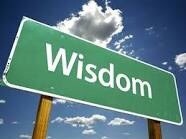 We often find ourselves in the middle of situations where we do not know what to do. Arriving at a fork in the road, without road signs, we feel lost and confused. Often, the most difficult concern is the fear of making a bad decision. The Bible promises, in those times, the believer can call out to God, who will give us a liberal serving of wisdom. No matter what you are facing, the Bible will direct you to a good and godly decision. The purpose of the book of Proverbs, is to provide heavenly wisdom for earthly living. Solomon begins this long journey, consisting of hundreds of nuggets of godly advice, with the secret to obtaining wisdom. He tells us, all wisdom and knowledge must begin with a healthy fear of the Lord.
 f you are anything like me, you have echoed the cry of John, from time to time in your walk with God. It seems whenever things become difficult, confusing or frightening, my heart cries out, “Come, Lord Jesus.” I realize, the only reason for His delay is His desire to see others come to faith in Christ. Peter wrote,
