2 Samuel 11:2
“Then it happened one evening that David arose from his bed and walked on the roof of the king’s house. And from the roof he saw a woman bathing, and the woman was very beautiful to behold.”
 David is one of the most famous men in history. He was a gifted singer, song writer and musician. By today’s standards, he would be considered a superstar. He was also a war hero, who led armies to great victory. No doubt, in that era, David would experience the same treatment as our most famous athletes. His popularity spread throughout the nation, so much so, that songs were being written about him. After reading of a lifetime of successes, we come to a striking passage where we read,
“. . . it happened one evening. . .”
One evening forever changed the life of David. What a different testimony he would have had if only the events of that evening had gone differently. Had he closed the blinds, stayed off the balcony, heeded the warning signs, or even admitted his mistakes, the rest of his life would have been drastically different. It seems to me, David made certain compromises along the way, making it next to impossible for him to resist the temptation of the bathing Bathsheba.
First, although David was a married man, he allowed the culture to define his married life, rather than the Word of God. In our world, when a person succeeds, it is common to get a new car, house, or some bling. In David’s day, when the oriental kings succeeded, they would add wives. The more wives, the greater your success. However, multiplying wives violated the Word of God.
Second, it seems David had learned to compartmentalize his life. As wives and concubines increased, he still worshipped, offered sacrifices, planned for a Temple, and ruled the nation. He truly loved God, but he struggled with his flesh. It was not until he came in contact with Bathsheba, that his subtly sown seeds of disobedience caught up with him, and he fell into adultery. David ultimately faced a temptation so great that he could not resist.
The same is true for each of us. Those careless glances and long stares will build a fire that will one day burn us. The battle for our holiness, purity, and even our marriages, is won long before the temptation is faced. It is daily living that will give the victory. A marathon is won at the alarm clock, the breakfast table, the donut shop, as much as it is won on the track and field. If we hope to win the battle for holiness, we must win the battle at the computer terminal, the magazine rack ,and the TV screen.
Third, once David fell, he spent his time with a cover up. He learned the art of private browsing and how to delete his search history. This cover up had a devastating effect upon his life. The man who was once filled with such mercy that he spared the life of Saul, is the same man who is ready to kill a man for stealing a lamb. Sin had so hardened David, he began to change. He was no longer recognizable as the “man after God’s own heart” (Acts 13:22). Guilt is like that. It has the ability to harden, the heart like tempered steel, so we are changed into someone we never wanted to become.
Fortunately, this is not the end of the story. David repented. A marriage that began in a bad way, was redeemed by God. A woman who once seduced the king, found her way in the genealogy of Christ. it is important to remember, no matter how badly we have fallen, His grace is greater than all our sin. It has been said that He is a bigger Savior than I am a sinner.
No matter how you have fallen, Jesus wants to restore you, and redeem what has been destroyed. He can redeem a broken life, a shattered marriage, and a destroyed witness, if you will let Him. It is time to make David’s prayer the cry of your heart.
Psalms 51:10
“Create in me a clean heart, O God,
And renew a steadfast spirit within me.”
Pastor Jim
 “I love you” is one of the most common phrases in any language. It is the heartbeat behind many popular songs, movies or works of literature. It seems a love story is an underlining theme in every movie whether it is designed as an historical piece, a comedy, or even a horror film. The story of Amnon and Tamar reveal that the love story is as ancient as time itself, and people were as confused then, as they are now as to what love really is.
 Even a casual reading of the Old Testament will lead to the conclusion that Israel did not win their battles on their own. When armies are overthrown by the rushing waters of the Red Sea, walls toppled with rams horns, and a shepherd defeats a warrior with a sling and stone, it is clear that the hand of God is behind the victories. There are times when Israel went to battle in their strength, but those are the times of failure, not of triumph. It is hard to forget the Battle of Ai. Joshua sent the troops into battle without first seeking guidance from the Lord, only to see his army retreat and many soldiers lose their lives (Joshua 7:2-6). Clearly, the strength behind the success of the nation of Israel was the leading and empowering hand of God.
 By killing his brother, Absalom had committed a capital crime. The law required, upon his return to Jerusalem, he be sentenced to death. In addition, he was living as a captive to a foreign king, without the hope of ever being restored. In an attempt to convince David to forgive and restore his wayward son, Absalom, this wise woman from Tekoa speaks of the ways of God. Her words are some of the most beautiful Old Testament expressions of the heart of God for humanity.
 This Psalm begins with the Psalmist describing his hunger for more of God. In a beautifully poetic fashion, he compares his desire for God to a deer panting for water. Thirst is one of our most basic drives, second only to the body’s need for oxygen. He is not only stating that he desires more of God in his life, but that he cannot live without Him. Psychologists have made lists of basic human needs for mental and emotional health. These lists often include things like companionship, communication, a good diet, human touch, self acceptance and proper rest. Unfortunately, they often neglect man’s greatest need; our need for God. Paul wrote:
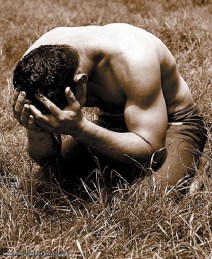 David and Bathsheba found themselves face to face with a parent’s worse nightmare. Their child was diagnosed with a terminal illness for which modern medicine had no answer. Like any of us, David was devastated, he would not eat or sleep, and those closest to him began to worry about what he might do to himself. When the sickness reached the end, and the child passed, David’s behaviors changed dramatically; he showered, ate, and worshipped. When questioned about the sudden change, he declared,
  Without giving us the details, David describes the condition of his life as being in a horrible pit of miry clay. A mire is an area of wet spongy earth, like a bog or marsh. David was saying he was stuck in a very difficult place, and it seemed as though there was no escape. Unfortunately, life can be like that. Even when we are walking with the Lord, we come to times of great difficulties that seem to carry on and on, without hope of ever ending. Sometimes, these miry bogs are the result of what appears to be unrelenting waves of trials. Before we get our head up from one strike, we are hit with another. John Bunyan referred to these times as “The Slough of Despond.” if you are currently facing one of these times in your Christian walk, be encouraged with two things.
 It is easy to become weary in the service of the Lord. This is especially true when it seems we have failed. David sent a group of men as ambassadors of Israel to King Hanun of Ammon. He desired to show kindness to the king after the loss of his father, Nahash. What seemed to be a relatively easy mission, turned out to be an embarrassing failure. Instead of being met with kindness, these men were treated with contempt. King Hanun’s men shaved off half their beards, and cut their robes so that their buttocks hung out, then sent them home in shame. Ammon’s actions were such as to incite war and Joab led the charge. As the battle was about to begin, Joab encouraged the men, by reminding them what they were fighting for.
 I am a sports fan. I enjoy watching a variety of athletics, and am always fascinated when an athlete achieves victory, almost effortlessly. No matter what the opponents do, they are unable to stop him. Over the years, I have come to understand that those who seem to win with the least effort, are really the ones who have put in the most effort. They are the ones who are first in the gym and last out. Their diets, workouts, sleep patterns, even off days, are regimented so as to keep them in the best possible condition for victory.
 Jim Gallagher