Genesis 42:36
“And Jacob their father said to them, ‘You have bereaved me: Joseph is no more, Simeon is no more, and you want to take Benjamin. All these things are against me.’”
 Sometimes perspective is reality. How we see things will determine how we act. Jacob had experienced a series of very difficult trials. He lost his sons, Joseph and Simeon, and now he was in danger of losing his youngest son, Benjamin. As these things built up around him, he cried out in despair, “All these things are against me.” What Jacob failed to realize is, the things that seemed to be working against him, were the very things God was using to work out the salvation of his family. All he could see was loss, but God was at work, behind the scenes, preparing a much greater reward than he could ever imagine.
Life is like that. We see things through the lens of our limited experience and knowledge. When something goes against what we perceive as “the plan”, we become discouraged, upset, heartbroken or even angry. Sometimes, like Jacob, we will forget God’s promises, and raise our voice to accuse Him of wrong-doing. If only Jacob could look beyond the walls of his limited vantage point, and see what God was actually accomplishing, then instead of despair, his voice would be filled with praise. God has a different way, He wants us to look beyond our experiences, and into His promises. He wants us to believe Him when He said, “ALL things work together for good for those who love God and are called according to His purpose.” Romans 8:28
Regardless of what difficulties you are facing today, keep in mind that you cannot see the whole story. You are somewhere in the middle of what God is doing, and He promises not to leave you, but to work things out for His ultimate purposes.
Pastor Jim
 Dealing with the death of a loved one is perhaps the most difficult part of life. Since God created us for life, and it was sin that brought death into the world, we were never really designed to handle death. No matter what, death seems to be unexpected, and the emotions that arise within us are more than we can bear. I recently heard Greg Laurie say, death is often more difficult for the believer because we love at a deeper level. The extreme grief associated with death is made evident in the reaction of Jacob, upon hearing of the death of his son, Joseph. He is so utterly devastated by the news, he refuses to be comforted. While death is difficult, the sorrow it brings is deep, and a season of mourning is expected, but there is something unnatural about Jacob refusing comfort. He should have been comforted by at least three truths.
 Have you ever heard the phrase, “When all else fails”? This seems to be the approach of many, as it relates to prayer. We often try everything at our disposal, before we ever come to the place where we truly plead with the Lord. It is almost as if life were a game show. We lean on our own strength, or use one of our life lines to ask the audience, or phone a friend, instead of taking advantage of the greatest resource available to every child of God – prayer.
 This chapter introduces us to a man who is facing one of life’s greatest challenges; that of a terrible physical disorder. Being a paralytic would mean he not only missed out on much of the experiences of life that we take for granted, but also, he would be totally dependant upon others. He was not even capable of getting to this home on his own.
 This question was not asked on a theology exam, but in a real life situation. A one hundred year old man, and a ninety year old barren woman, were promised a child from whom a great nation would be established. The promises of God were met head on by the circumstances of life, making them seem so far-fetched, both Abraham and Sarah laughed. It was not improbable for a 90 year old woman to have a child, it was impossible. Not only was she passed the age of child bearing, but she had been infertile her whole life. What did not happen in her youth, could not happen in her old age. Yet in these circumstances, God made a promise. When the promise was doubted, God asked them a question, “Is anything too hard for the Lord?”
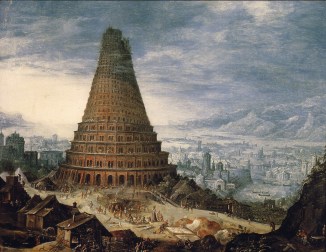 Genesis is the book of beginnings. In it, we are introduced to many things which play a prominent role as the rest of Scripture unfolds. Here, in Chapter 10, we are introduced to the city of Babylon, which becomes a major player in the Biblical narrative. It is mentioned 257 times in the Bible. We learn Babylon was built by a man named Nimrod (whose name means rebellion); he built Babylon in defiance of God. His purpose in building the city is recorded in Genesis 11:4
 Zechariah wrote over 400 years before Christ, and yet, he refers to the cross.
 Zechariah referred to the coming Messiah as the cornerstone. A cornerstone is the stone which forms the base of a building. It supports the weight of the adjoining walls and is the set stone necessary to plum the rest of the building. If that stone is unstable, or too weak to support the weight of the structure, the building itself will collapse. If that stone is out of square, the entire building will be crooked. Every builder understood the importance of the cornerstone. Zechariah was not the only writer to refer to the Messiah as the cornerstone. Isaiah put it this way,
 Things looked bleak for Israel. After their defeat in battle, Jerusalem was destroyed and the Jewish people were taken as prisoners to Babylon. An entire generation arose who had never set foot in the promised land, and who ignored the voice of God, when called upon to return and rebuild. For those who did return, morale was low, as the daunting task of rebuilding a nation amidst constant opposition bore down upon them. Zachariah records the words he spoke to the people, to encourage them to continue on in the work of the Lord. One of his greatest promises is recorded here,
 Jim Gallagher