Mark 13:2
“Do you see these great buildings? Not one stone shall be left upon another, that shall not be thrown down.”
 The stones that formed the Temple were massive. Their sheer size represented permanence. For the disciples, it would be difficult to imagine them ever being destroyed. When Jesus declared that a time was coming when the Temple would be leveled, the minds of the disciples jumped to the future. They asked;
“What will be the sign when all these things will be fulfilled?”
Mark 13 is an abridged version of the Olivet Discourse recorded also in Matthew 24-25. The subject is the signs that point to the return of Christ. Jesus states;
“Then they will see the Son of Man coming in the clouds with great power and glory.”
People are fascinated with what the Bible teaches about the future. Many Christians have become students of prophecy, many books have been written on the subject, Hollywood has produced movie after movie depicting their interpretations of eschatology. Sometimes, in the midst of all this, we can miss the repeated exhortation of Jesus.
“Take heed… Take heed, watch and pray… Watch… What I say to you I say to all: watch!”
While it is important to be aware of the events that point to the return of Christ, it is more important to be focussing on your relationship with Jesus. Are you ready? If He were to return today, what will He find you doing? Are you living your life for His glory and Kingdom? Are you watching or have you fallen asleep? When He returns, we will not be tested on our knowledge of prophecy but rewarded for our faithfulness.
Perhaps this is a good time to take inventory of your walk with the Lord. Maybe you need to do a little “house cleaning.”
Pastor Jim
 More than a month before this event, Moses had ascended Mount Sinai, disappearing into the thick smoke. As the weeks passed, the people began to believe Moses must have died. In their fear and confusion, they approached Aaron, seeking spiritual counsel. They realized they needed a worship service. However, their time in Egypt had left them very confused about who God really is. Aaron instructed them to bring financial gifts, then he made a god they could worship. The cost of their sinful activity was great.
 Imagine the thrill that must have filled Bartimaeus when he heard these words. Although his eye did not allow him to see, he had heard the stories of the man from Galilee, who was healing the sick and raising the dead. Now Jesus was right there within the sound of his voice, able to hear his cries. Knowing that he had nothing to offer, Bartimaeus simply cried out for mercy. “Jesus, Son of David, have mercy on me!”
 There can be little question that the children of Israel were following the leading of the Lord. They had a miraculous door open; freeing them from slavery. They began to march, carrying gifts from Egypt, and being led by a pillar fire and a cloud. What was hard for them to understand was, the Lord had led them into a very difficult place. With Baal Zephon on one side, Migdol on the other, and the Red Sea before them, Israel was boxed in, with no where to turn. As the Egyptian army approached, the Israelites were the proverbial sitting ducks. With fear gripping their hearts, they cried out to Moses, declaring life was better in slavery than in the wilderness. It was with this backdrop, Moses gave one of the most beautiful promises of God.
 The day of Israel’s deliverance from Egypt was so important that an annual feast was established to commemorate the events. It was important to the Lord that His people never forget the severe bondage they were under before He rescued them. He knew they would face great difficulty in the wilderness and within the promised land. Since these difficulties might discourage them, and even lead some to want to return to Egypt, it was important that they remember what life was really like before deliverance.
 When Jesus entered the Synagogue, it seemed everyone in the room knew He would address the man with the withered hand. His disciples were watching carefully. This event would be seared into their memories, and written down in the timeless Word of God. The Pharisees watched Him closely, knowing His compassion would lead Him to the man, even though it was the Sabbath. I imagine the man with the withered hand also watched eagerly, hoping Jesus would do for him, what he had done for so many others. As Jesus approached him, this man must have been excitedly anticipating what Jesus was about to do. It is here, where the story gets most interesting to me. Instead of touching the man’s hand, speaking words of healing, or even asking him to do a religious task, Jesus simply says, “Stretch forth your hand.” What sounds like a simple request to you and me was actually an impossibility. Jesus asked this man to do the one thing that he was not able to do. Had He asked him to run to the priests, to offer a sacrifice of 1000 sheep, or even travel to the pool of Bethsaida; difficult as those things might have been, they were possible. But to stretch out his withered hand, he could not do. Something happened within this man the moment he chose to obey Jesus. The impossible, not only became possible, it happened. His hand was restored.
 The Psalmist, in a time of great despair, wrote, “Why are you cast down oh my soul, and why are you in turmoil? Hope in God…” (Psalm 42:5). Hope serves as an anchor when the storms of life seem as though they are going to overwhelm us. As a child of God, we have the hope that His Word is eternal, and while circumstances may change, His promises remain trustworthy. We have the hope that in the midst of life’s hardships, He will never leave us, but will walk through the fires with us, even carrying us. Perhaps our greatest hope, is that Jesus has promised He will return for us. There is a time coming, perhaps in the very near future, when “as the lighting comes from the East and flashes to the west, so also will the coming of the Son of Man be.” This great hope was foremost in the minds of the disciples, as the events of Matthew 24 unfolded, and the chapter is Jesus’ answer to the question, “when.”
 Everyone of us has had the experience of being mistreated. For most, it has been the little things, like our character being questioned or our feelings hurt. Others, like Joseph, have experienced their entire life being altered by the deeds of another. The story of Joseph is significant in so many respects, not the least of which is, he used his newfound position of power, not to retaliate, but to rescue. It is nothing short of a miracle that this man was not bitter, angry and vengeful. I wonder if we can uncover the secret behind his success.
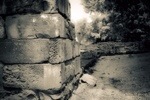 Jesus told a story that the original audience understood to be speaking of how they were rejecting the Son of God. In response to the story, Jesus refers to builders who had rejected the “chief cornerstone.” In many ancient buildings, the foundation was supported by a cornerstone, without it, the foundation would not be able to support that which was built upon it. Jewish lore tells the story of the building of Solomon’s Temple, a project that took many years. The massive stones for the Temple were quarried some distance away from the Temple site and delivered to the builders. As they were laying the foundation, a very oddly shaped stone,that did not seem to fit, arrived. The contractor, thinking the quarry had made a mistake, had the stone thrown away. It was pushed down a hill into the city trash dump. Sometime later, the contractor sent to the quarry asking for the chief cornerstone. The quarry sent back a message saying it had already been delivered. When the contractor argued that he had never received the stone, someone reminded him of the oddly shaped stone, the one that did not seem to fit his plans, that he had thrown in the trash. Sure enough, that was the stone that would support the whole building. With great effort, they raised the stone out of the rubbish heap, and continued erecting what would become a building which would bring glory to God and salvation to man.
 Jim Gallagher