Deuteronomy 33:27
“The eternal God is your refuge,
And underneath are the everlasting arms…”
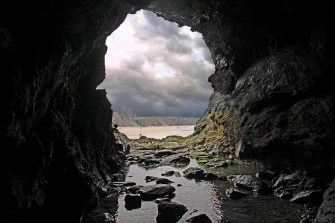 Israel stood on the edge of the Promised Land. Soon they would cross the Jordan and face the giants. After forty years in the wilderness, their task had not become any easier. Knowing he was about to die, Moses reminded the people of their true source of strength.
The eternal God is their strength. ‘Eternal’ carries the idea of being both timeless and limitless. Before time existed, there was God. He is what the philosophers call the “uncaused cause.” It is through Him that all things were brought into being. According to Paul, it is in Him that all things are held together (Colossians 1:17). Although Moses would not be able to lead the people into the land and against their foes, the eternal God would be their refuge and strength. No matter what they faced, the eternal God would provide for their needs.
Notice, Moses reminds the nation of Israel, the eternal God is a source of refuge. A refuge is a hide out. It is a place we go in the midst of the storm, the battle, or the times of confusion. Moses promises that God is the hiding place for all who are facing the storms of life.
A few years ago, we had a large hurricane coming straight at our town. People began to “button up” their homes, to withstand the coming storm. Those with hurricane shutters installed them, while those without, began to fashion plywood, to cover their windows. It did not take long for all the available plywood to run out. I remember seeing one individual, in a panic, covering his windows with drywall. His fear created a panic which caused him to run to a refuge that would not support him in the midst of the storm.
Whatever you are facing, no matter how large or small, remember the eternal God is your refuge. He desires you would run to Him for shelter and security.
Pastor Jim
 Peter makes reference to a simple rule of life. We can only give away what we personally possess. By his own admission, Peter had no money to give this man. It is interesting to note that from an economic standpoint, Peter’s condition was no different than the beggar’s. In the world’s estimation, a man in his thirties who is too broke to share his change with a beggar, is of very little value. Peter would not make a who’s who list in the 1st Century. However, if we look more closely, we see that Peter possessed something far greater than riches that tarnish and fade. Peter said,
  I am sure we have all heard the phrase, “What’s in it for me?” In fact, in all likelihood we have probably used the phrase ourselves. We might ask this as it relates to an investment or work related opportunity. Some suggest, the most important principle in business marketing, is to be sure to let the consumer know what’s in it for them. When it comes to salvation, the answer includes, but is not limited too: forgiveness of sin, restored relationship with God, a transformed life, and the free gift of eternal life. Without doubt, we would be exercising the height of folly to fail to receive all that is offered to us through a relationship with Christ.
  As the wilderness wanderings came to an end, Israel came face to face with two formidable foes. Sihon and the Amorites, and Og and the soldiers from Bashan. Both of these enemies seemed too great a force for the children of Israel, yet they found strength in the Lord and overcame these obstacles. As Moses prepares Israel to enter the Land without him, he reminds them of these victories. In fact, as a reminder of these events, Sihon is mentioned twenty-two times in the Old Testament, and Og nineteen times. God never wanted Israel to forget the victories they experienced in the early years.
 The Holy Spirit is the driving force behind all the ministry that will take place in the book of Acts. Jesus had commanded His disciples to go into all the world and proclaim the Gospel message, but before they went, they were to wait for the outpouring of the Holy Spirit. Their personal lives, their ministries, and their world, would forever be changed because the Holy Spirit came upon them.
 As Moses’ final hour quickly approaches, he pleads with the people to turn to the Lord. He has personally experienced the suffering that comes with rebellion against God. Forty years in Horeb, and forty years in the wilderness wanderings, have forever etched in his mind, the importance of trusting in, and following after, the Lord.
 Recently, I arrived at the church, only to discover that since I drove a different vehicle than usual, I did not have my key. First, I was frustrated at myself, then I looked for someone else to blame, and finally, called one of the other pastors to come open the office for me. When I got in, settled down, and began to unpack my bag, I discovered the key was in my bag all along. I had simply failed to take the time to look for it. Had I dug through the bag, I could have saved myself a lot of wasted time, energy and frustration.
  This verse makes me think of a high school performance where two students are selected to play the horse. One lucky young man gets to be the head, while the other is stuck behind him as the tail.
 The book of Acts is a sequel to the Gospel account, written by Luke. He declares, in this opening verse, the purpose for writing the Gospel account and the book of Acts. He states that the Gospel records what Jesus began to do; and the book of Acts, what He continues to do. Since Jesus is alive from the dead, the story of the Bible is a continuing one. John closed his Gospel account declaring that all the books in the world could not hold all that Jesus did for humanity. As amazing as it may seem, Jesus is not finished. The resurrection is not the end of the story. It is the transition point where the work of Jesus transfers from being accomplished outwardly through His life on earth, to the inward working of His Spirit in the life of all who believe.
 On the verge of entering the Land of Promise, Moses reminds the people they have a choice to make. Upon entering the land, they were to gather the entire nation in the valley between Mount Ebal and Mount Gerazim. On one mount, half of Israel‘s leaders were to read the blessings that would befall a people who obeyed the Word of God. The remainder of Israel’s leaders stood on the other mount to declare the curses that would befall them if they ignored, or rebelled against the Word. In addition to the spoken Word, they were to write the Word on large, whitewashed stones that were easy for all to read. Beyond question, the key to Israel’s success and happiness was their obedience to the Word.
 Jim Gallagher