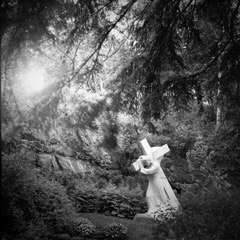
In Between 

Job 9:33
Nor is there any mediator between us, Who may lay his hand on us both.”

In the midst of all his suffering, Job comes face to face with his own sinfulness. He realizes he is guilty of violating the laws of God and asks,

“. . . how can a man be righteous before God?” Job 9:2

As he evaluates himself, and realizes the righteousness of God is so great, it is impossible for him to adequately cleanse himself. He speaks of any attempt at removing his own sin as a foolish endeavor,

“If I wash myself with snow water, and cleanse my hands with soap. . . ” Job 9:30
It is at this point he realizes the hopelessness of his cause. He recognizes the only hope for humanity is if someone could stand in the gap between sinful man and a holy God. Someone so holy, he could have access to God, yet so human, he could relate to the needs of man. Job could see the need for such a person, but could not fathom the existence of such a person.

The good news, to be heralded throughout the earth to every man, woman, and child, is there such a man. God, in His infinite wisdom, sent His own Son to stand in the gap and be the bridge between sinful man and a holy God. As a man, Jesus is able to relate to all our weaknesses. As God, He was able to pay the price for all our sin. The glorious news of the Gospel is that our sins can be forgiven, and we can have access to God through the work of the cross.

Take advantage of this glorious news today. If you have not surrendered to Christ, do it now. If you have, then take time to access the throne of grace and pray for others to come to saving faith in Christ.

Pastor Jim


Communion 

1 Corinthians 11:22
“What! Do you not have houses to eat and drink in? Or do you despise the church of God…”

Paul is addressing one of the most important practices of the church and the individual. He will instruct them regarding partaking in communion. Rather than seeing this ordinance as a necessary, and even holy part of their church life, the Corinthian Christians had turned it into a way to honor the wealthy, thus neglecting the poor. It was a common practice in the early church to feast together before communion. In Corinth, they invited the wealthy to eat first and only after they had their fill did the poor get in line. In some cases, the food was gone and the rich were drunk. Suffice it to say, this was not an acceptable practice. Paul is writing to correct their behavior and to instill within them a proper understanding of communion.

“What! Do you not have houses to eat and drink in? Or do you despise the church of God…”

First, Paul points out that coming to the communion table is different from coming to the dinner table. We must come looking for and expecting something different from when we gather to eat. The expectation is we are meeting with Jesus. Communion was not designed as a religious ritual, but as a means of experiencing fellowship with Christ. The last supper, when this ordinance was established, was a very intimate time. The disciples gathered around the table with Jesus as He spoke with them, and it was at that time, John laid his head in Jesus’ lap. Communion is primarily a time to draw near to Christ. It is through the cross we have access to the Throne of Grace, where we meet with God.

“Take, eat; this is My body which is broken for you; do this in remembrance of Me.”

Second, communion is a time of reflection. Jesus said, “do this in remembrance of Me.” The word remember carries the idea of bringing thoughts together or recollecting. Throughout the day we have scattered thoughts about Jesus. Our time with Him is interrupted by responsibility or distraction, but at the communion table we bring our thoughts into the captivity of Christ, and we focus upon what he has done for us. There are five points that we are encouraged to focus upon. First, we should look in. Paul encourages us to examine ourselves. There, with the cross in view, we look at our life to see if our practices are acceptable to God. It is important that this be done in the shadow of the cross, so we do not leave condemned, but forgiven. Are there practices in your life that need to be set aside in light of Christ? Second, we should look back. Communion affords us the opportunity to examine the cross and reflect upon Christ’s great sacrifice. When we see the brutality of the cross, we can then begin to understand the depths of His love. Each time the whip strikes His back, or the nails are driven, it is a reflection of Heaven’s love. Third, we must look up. The cross is not the end, but rather the doorway to heaven’s throne. It is through the cross, we have access to God. We are encouraged to come boldly to the Throne of Grace, where, in daily fellowship, we can receive pardon for sin, and grace to continue on in Christ. We have not only been saved from sin, we are also saved to Christ. We should be experiencing His life flowing into ours. This happens as we access the Throne of Grace. Fourth, we must look forward. Paul spoke of us “proclaiming the Lord’s death until he comes.” The great hope of the believer is that Jesus rose from the dead and will return one day for His church. He calls us His bride, and the marriage supper of the Lamb awaits the child of God. Communion should ever remind us, and prepare us, for the return of Jesus. Finally, we should look out. Again, Paul wrote that with communion we “proclaim the Lord’s death until He comes.” Communion is the Gospel. Jesus bled and died to save sinners, any and all who receive Him will be forgiven. While communion is a practice for the Christian, it is done in a way to illustrate our need for a savior and to draw men to Christ. The broken bread reminds us of what our sin did to Christ, the cup reminds us of what His blood does for us.

Whenever your church partakes of communion, you should make it a habit to be there, and to bring your unsaved friends.

Pastor Jim


What Are Words For? 

Job 7:11
Therefore I will not restrain my mouth; I will speak in the anguish of my spirit; I will complain in the bitterness of my soul.”

As a child, I learned a simple proverb designed to help when someone said something unkind, “Sticks and stones may break my bones, but words will never hurt me.” As the years passed, I found, for many, the wounds caused by unkind words are much greater than anything a kick or a stick could ever inflict. The closer the relationship, the more painful it is when the sword of the mouth cuts deep. This seems to be especially true in marriage relationships. It is common for a couple to be upset with one another, and lash out with unkind words. The hurt caused by letting insults fly, may take weeks to repair. In some cases, a person never seems able to get over it. I think we can learn a valuable lesson from Job regarding the unkind words that flow out of our mouth in a moment of rage, pain or confusion. Job declares,

“I will speak in the anguish of my spirit; I will complain in the bitterness of my soul.”

Job realized, much of what he was saying was fueled by the intense pain he was experiencing. He seems to be pleading with his friends to understand that some of what he was saying was more of a reaction to his anguish, than an expression of what he really believed. I believe it is important to be very forgiving of a person who speaks out of pain, sorrow or confusion. Just as when the hammer hits our thumb, and a word comes out that we would never say otherwise. It is common for a person to say things in distress, they don’t really mean.

If in the midst of a heated argument, your spouse said something you are having a difficult time getting past, give them the benefit of the doubt. Perhaps they were speaking from the anguish of their spirit. Be willing to extend the mercy Job was hoping to receive from his friends. After all, when the story reaches its end, we find out how wrong they both were.
Pastor Jim


My Way Out

1 Corinthians 10:13
“No temptation has overtaken you except such as is common to man; but God is faithful, who will not allow you to be tempted beyond what you are able, but with the temptation will also make the way of escape, that you may be able to bear it.”


Years ago, Isuzu ran an ad where a man, sitting in the lotus position meditating, looked at the camera as if to speak wisdom and said, “I can resist anything except temptation.” I think that could be said of all of us. We often resolve to commit ourselves to the Lord, and make steps toward following Christ more closely, only to be derailed by falling again into one of those easily besetting sins. This is a very common experience.

Paul reminds us of three characteristics about temptation. First, temptation is common to all men. No matter who you are, or how long you have walked with the Lord, you will be tempted to do things that are not pleasing to the Lord, and are costly to your relationship with Him. This is not written to justify sin, but rather to encourage us to guard against failure. Leading up to this verse, Paul reminds us of the Children of Israel in the wilderness. He states, while all passed through the Red Sea, ate the Manna, and drank from the Rock, only a few entered the Promised Land. We are all given the same resources to equip us for success. Only those who take advantage of the Word of God, the Spirit of God, and the people of God, will overcome the temptations of the flesh.

Second, Paul reminds us that every temptation has a way of escape. There are a few rare cases when we are hit by a surprise attack, but most of the time, we see temptations coming, and are given multiple ways out. Many of the sins that we commit, we do so because we are alone. If someone else were nearby, we would not do them. I think, a very common way of escape, is to simply pick up the phone or go outside. In those rare cases when we are blindsided with temptation, we must follow the example of Joseph, who fled from temptation, even when it meant having his garment ripped off his back.

Finally, Paul reminds us that God is faithful. We would all admit that the reason we fail is that we are too weak. We attempted to resist, but found that our strength was insufficient, and we gave in. Fortunately, we are not left to fight the battle on our own. Our weakness will always be met with His strength. Often, we fail because we keep our attention fixed on the temptation and on our weakness. We will find victory, when we get our eyes back upon the Lord. When David faced Goliath, his eyes were on Jehovah; when he faced Bathsheba, his eyes on the temptation. Victory will be ours when we keep our attention on the Lord. Paul reminded the Ephesians to “Be strong in the Lord in the power of His might.”

Pastor Jim


Guidance 

Job 5:8
“But as for me, I would seek God, And to God I would commit my cause”

One of the reasons the book of Job is so difficult is, though much of the counsel he receives is correct, the application is misplaced. Eliphaz wrongly believed Job was in sin, and his trials were brought about entirely by his disobedience. That being said, we find in this verse, some of the wisest counsel we will ever receive,

“But as for me, I would seek God, And to God I would commit my cause”

Whatever you are facing, the right approach is to seek God and commit your ways to Him. If you are facing a time of great trial, instead of complaining about how hard it is, or looking for an easy way out, take some time to seek God. It may be, you will learn why you are facing the trial, or more importantly, you will learn something about who God is and what He wants to accomplish in your life. When Paul faced a difficult time, he took the counsel of Eliphaz and sought the Lord. He learned God wanted him to understand the sufficiency of His grace in times of need.

Another important aspect of moving ahead through difficult times, is to learn to commit our ways to the Lord. This will ensure that we walk in the right direction, and are involved in the things that are pleasing to God. It is too common among Christians, to use our difficulties as an excuse to sin. We think a rough day at work, gives us the freedom to blow off steam with a few drinks, or to unload on our wife and kids. We think a difficult situation with a friend gives us the liberty to gossip about them, or tear apart their character to make us feel better. One way to guard against allowing hardship to lead to sin, is to commit our ways to the Lord.

Whatever you are facing, whether a devastating trial or a tremendous blessing, take some time to seek the Lord and commit your day to Him.

Pastor Jim


For The Gospel’s Sake 

1 Corinthians 9:23
Now this I do for the gospel’s sake…”

When writing to the Romans, Paul explained, the message of the Gospel has the power to save the sinner. It is when a person humbles himself and accepts that Jesus Christ died to do away with his sin, that he is saved. In order for a person to come to saving faith, he must hear the message and see the reality of it worked out in the life of the believer. Paul, understanding the importance of the Gospel, explains to the Corinthians the things he was willing to forgo, so others would hear about Christ and believe in Him.

First, he speaks of personal freedoms he was willing to lay aside. In his case, he chose to support himself rather than being supported by the church. Others had misrepresented the Lord by making Christian service look like a means of making a buck. To combat this, Paul made certain, while he was in Corinth, money was not the focus of the ministry.

Second, he speaks of becoming “all things to all men that I might by all means win some.” Paul is in no way suggesting that he is compromising the message of the Gospel, or his Christian witness. Instead, he is speaking of being relevant to those whom he is seeking to reach. One way Paul did this was by speaking to be understood. His goal, as a pastor, was not to use such eloquence as to show the world how brilliant he was, but to speak with such simplicity as to be sure the message was clearly understood. He was also careful not to do things that would turn others unnecessarily away from Christ. He saw the big picture. He understood that many of the views, and lifestyle choices people were involved in, were as a result of not knowing Jesus. Instead of making it his aim to change the behavior of the unbeliever, he sought to introduce them to Christ, who would transform their thinking and their living.

Third, Paul spoke of disciplining himself. He realized, one way to undo all his efforts in Corinth, was to personally get involved in sin, thus “blowing his witness.” To guard against this, he treated his Christian life the way an Olympian treats his body. Knowing that success only comes with training, diet and discipline, Paul was sure to have a healthy diet of time with Jesus, study of the Word, and Christian fellowship, while at the same time keeping unnecessary temptation out of his life.

Finally, Paul writes, “When I have preached to others…” The Gospel is seen when we live like Christ. However, it is primarily, hearing and not seeing the gospel, that leads others to faith in Christ. “Faith comes by hearing and hearing by the Word of God.” ( Romans 10:17) To ensure that others came to Christ, Paul opened his mouth and declared the simple message of salvation by grace through faith.

Paul wrote, all this was done for the sake of the Gospel. It would do us all good to ask, “What am I doing for the sake of the Gospel?”

Pastor Jim


The Innocent 

Job 4:7
“Remember now, who ever perished being innocent? Or where were the upright ever cut off?”

While Job was suffering the physical and emotion pain brought on from his trials, three friends arrived to offer their condolences, and seek to bring him answers. Eliphaz was first to speak. It seems he could not comprehend a situation where people did not deserve the suffering they were experiencing. This causes him to ask a very important question, has anyone ever died who was truly innocent?

The Bible teaches that there are none who are completely righteous, each and every person is a sinner and has practiced sin. It is humorous how some people take offense to that. They become upset when they are told they are sinners, even though all the evidence supports the Bible’s claim. A few years ago I was in West Africa on a short term mission trip. I, and another man, began to witness to a group of young men. When the conversation turned to talk about their need for a Savior, one of the young men declared that he was not a sinner. Surprised a bit by his statement, I paused to think about how to respond, while the gentlemen with me simply turned to one of his friends and asked if they thought their friend was a sinner. They all broke out in laughter. Apparently, in their minds he was the biggest sinner of them all.

The reality is, no one is innocent. We are born sinners, and we prove it everyday of our lives by the way we treat others, and ignore the ways of God. Because of our sinful nature, we find ourselves under the judgment of God, facing eternity apart from Him. It is here, where Eliphaz’ question finds its answer. There is One who perished being innocent. That One, is the sinless Son of God, who died on behalf of the guilty. Jesus lived a life without sin, in order to die a death that would pay the price for sin. At His death, even His accusers admitted He had done nothing wrong. His death was in our place, the innocent for the guilty, that He may offer us eternal life.
The solution to our sin problem is found in receiving Jesus Christ. If you want your sins forgiven, and the free gift of eternal life, then invite Jesus to forgive you of sin, to become your Savior and Lord. Take a moment to pray:

“Jesus, I confess that I am a sinner, I ask you to forgive me of my sin, and become my Lord. I pray you would help me leave my old ways behind, and follow after You.”

If you prayed that prayer, let us know so we can help you follow Jesus.

Pastor Jim


Liberty

1 Corinthians 8:13
“Therefore, if food makes my brother stumble, I will never again eat meat, lest I make my brother stumble.”

One of the controversies the Church in Corinth faced had to do with diet. Animals were offered to pagan gods, then the meat was sold at the local butcher shops. This created a real problem for many Christians. For some, their conscience bothered them knowing that the animal was offered to false gods, while for others the issue was much more tangible. Since the butcher shops were often located close to the temples, and the temples were places of sinful activity, some knew that visiting that area would lead them right back into sin. For others, the idol issue was something of their past, and they had no problem eating the meat with thanksgiving. To them, it mattered very little what the farmer did with the animal, since they received it with thanksgiving as from the Lord.

Paul points out that the issue was much bigger than what a person has for lunch, or where they choose to go to dinner. The bigger picture was the conflict between Christian liberties and the law of love. Webster defines liberty as, “the power to do as one pleases.” As Christians, we are free to practice anything that is not forbidden by the Word of God. While there are some movies whose content certainly puts them in the category of forbidden, Christians do have the liberty to attend movies. The same could be said of television, music, and the Internet. However, there are some who, because of their past experience, or recent decision for the Lord, would stumble if they practiced the same liberties. It is here that Paul introduces a principle bigger than liberty, the principle of love.

“Therefore, if food makes my brother stumble, I will never again eat meat, lest I make my brother stumble.”

As much as Paul might have enjoyed a juicy steak, or French dip sandwich, he was willing to lay those aside for the sake of others. Rather than touting about his rights, or how ridiculous it was for them to make an issue over food, Paul saw everything as a means to minister to others. Every Christian has been called to invest in the lives of others, in order to make disciples. For that to happen, we have to be willing to set our freedoms aside for the sake of their growth. Patrick Henry said, “Give me liberty or give me death.” Within the spiritual realm, we might better choose death over liberties for the sake of the Gospel. My freedom to do what I want with my time, could be laid aside, and I could choose to meet with a struggling believer for coffee and the study of the Word. My freedom to sit alone in service and reflect upon the message, could be set aside to sit with a visitor, or someone I know might be struggling or lonely. My freedom to watch the service online from the comfort of my couch, might be set aside to show up early and help get the church ready for others, or to teach a child’s class.

When we set the law of love above the law of liberty, we will see others impacted for the kingdom of God.

Time is short, eternity is forever…

Pastor Jim


For Nothing 

Job 1:9-10
“So Satan answered the Lord and said, ‘Does Job fear God for nothing? Have You not made a hedge around him, around his household, and around all that he has on every side? You have blessed the work of his hands, and his possessions have increased in the land.’”

Job is described as the greatest man in all the East. His greatness was measured by his success and his character. He is described as a man who feared God and shunned evil; one who accumulated great wealth. When the scene shifted from earth to heaven, we find Satan called into question the motive for Job’s faithfulness to God. He asks, “Does Job fear God for nothing?” Then he gives a list of reasons why Job trusted in, and followed after the Lord. I am thankful the answer to Satan’s question is no.

None of us “fear God for nothing”. If we carefully consider our lives, we will see the good hand of our God upon us. The success we have is directly attributed to the grace of God. Some people consider themselves “self made”, yet fail to consider the gifts and opportunities afforded to them are given by God. An athlete, while he must work hard to hone his skills, has been given the athletic ability by grace, apart from his own work. There is an old saying among basketball coaches that ” you can’t teach tall”. They recognize height to be a gift, not something to be earned.

The same is true of a business man, a family man, a successful teacher, doctor or other professional. What we have must be attributed to the grace and goodness of God. The only question that remains is, how will we react to all we have been given? Will we stand upon the walls of the city, like king Nebuchadnezzar of old, and claim our accomplishments are our own; or will we, like Job, choose to fear God and shun evil?

Without question, we do not “fear Him for nothing”. His goodness, grace and mercy, while immeasurable, can, in some ways, be measured by looking at the blessings He has poured into our lives.

Take some time to thank Him for all He has done for you.

Pastor Jim


Relationships 

1 Corinthians 7:2
“A wife is not to depart from her husband. But even if she does depart, let her remain unmarried or be reconciled to her husband. And a husband is not to divorce his wife.”

The Corinthian Christians wrote a letter to Paul asking him some basic questions about how to live out their Christianity. One of those questions had to do with relationships between men and women. Since they lived in a pagan culture, they grew up with pagan examples of how to be single and how to be married. After coming to Christ, they realized God had different standards, and they wanted to learn His ideal for Christian relationships. This chapter is Paul’s response to their question. It is worth noting that Paul writes concerning three groups of people: the single, the married and the separated.

To the single Christian, Paul explains that physical relationships, while designed by God, are restricted to the marriage relationship. In order to remove all doubt about the danger of getting involved physically before marriage, he writes, “It is good for a man not to touch a woman.” Obviously, he is not speaking about an accidental bump or a handshake, but is referring to the physical acts that arouse and lead to sexual activity. Although it is common, encouraged, and expected for single people today to be sexually active, Paul tells the Christian to wait for marriage.

When it comes to the married Christian, Paul has an entirely different message. He explains that when we are wed, we give ourselves to our spouse. We are no longer two individuals living to fulfill our own wishes, but we have become one. Our lives are now wrapped up inseparably with our spouse.This is particularly true as it relates to our physical relationship. Instead of using sex as a weapon to win our way with our spouse, Paul writes, “Let the husband render to his wife the affection due her, and likewise also the wife to her husband.” Clearly, the affection a wife desires is different from what a husband wants. In order to have a healthy marriage, we must take our eyes off our own desires and place them upon our spouse. Sometimes, the most affectionate thing a man can do for his wife is to clean the kitchen, do the laundry or help the kids with their homework.

Finally, Paul has a message for those whose marriages are falling apart. They have encountered such storms within their relationship, the only course of action seems to be to dissolve the marriage before anyone else gets hurt. Within the culture of the ancient world, divorce was common. When things get difficult, people always seem to look for a way out. Paul’s message might be summed up by saying, difficulty is not a reason to dissolve a marriage, but to work on the marriage. He writes,

“A wife is not to depart from her husband. But even if she does depart, let her remain unmarried or be reconciled to her husband. And a husband is not to divorce his wife.”

The situation he describes is a difficult one. The couple has faced such challenges that one or both, have decided to scrap the marriage and move on. To which Paul explains, we should separate only far enough to work toward reconciliation. If you are facing tough times in your marriage, do not look for a trap door that will release you from the covenant you made before God. Instead, look to how your relationship can be restored. It may be, the only solution is for you to daily sit at the feet of Jesus, and plead for Him to change you and your spouse, and restore your marriage. Obviously, two people are involved, and at times, a spouse may refuse to reconcile, but we must always seek the Lord’s best; not what is culturally common.

If you are married, take some time today to read through 1 Corinthians 7 with your spouse and apply the marriage principles to your relationship. It is not too late for God to make your marriage what He intended it to be.

Pastor Jim