Galatians 3:24
“Therefore the law was our tutor to bring us to Christ, that we might be justified by faith.“
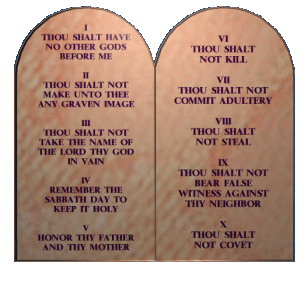 The law Paul refers to is what is commonly known as the Ten Commandments. This law is distinct from all other laws in its source and in its purpose. We are surrounded by laws written by men and designed to be kept. The Law of God was written by the hand of God; its purpose, to reveal that we are incapable of living up to His standard of righteousness. When confronted with the Gospel, many will claim they are good people, trying to honor God by keeping the commandments. Anyone who makes that statement, completely misunderstands the commands of God. Let’s take a look at a few of them and see how we measure up.
Exodus 20:3 “You shall have no other gods before Me.”
God demands first place in our lives. If anything ranks higher in your life than God, and seeking to please Him, you are guilty of breaking the first commandment. Jesus elaborated on this commandment saying, we must love God with ALL of our heart, soul, mind and strength (Matthew 22:37). That is a tall order, isn’t it? It requires that we ask ourselves, “Is there anyone or anything more important to us than living to please God?” If we are involved in an ungodly relationship, or ungodly practices within a relationship, we are guilty of breaking the very first commandment. That should be enough to prove to any honest person, they are not keeping the commandments of God. However, for the sake of argument, let’s look at one more.
Exodus 20:15 “You shall not steal.”
Stealing is defined as taking something that does not belong to you, without the permission of the owner. Stealing is not determined by the value of the item taken, but rather to whom the item belongs. The first recorded act of stealing is found in Genesis chapter three, when Eve took a bite of a piece of fruit that did not belong to her. God took that action very seriously. He did not wink at it, suggesting it was only a little sin that did not matter much. Her act of taking what did not belong to her, and her husband following suit, resulted in their banishment from the garden and sin entering the world.
Clearly, none of us are living up to the commandments of God. If that is true, why then, did God write them? Most laws are written to be observed. When I was a school teacher, I had a list of standards written on the wall of my classroom. Every student could look and understand clearly what was expected of them while in my room. God gave His list of standards to show us we are not capable of meeting them, and each of us is in need of a savior. Like a tutor who sits beside a student to help them understand a concept, the law speaks to each of us, explaining that we cannot save ourselves. No work we have ever done can erase the sins we have committed. We must cry out to the One who saves. Paul wrote, “the Law was a tutor to bring us to Christ that we might be justified by faith.” It is when we recognize we are sinners and Christ is the Savior, that we will cry out to Him to rescue us. Paul went on to say,
Galatians 3:26 “For you are all sons of God through faith in Christ Jesus.”
When we put our trust in the Savior, all of our sins are forgiven and we become the children of God. Instead of pretending we are good enough, it is time to honestly evaluate ourselves in light of the standard of God. Then we must cry out for Him to forgive us of our sins and and make us His children.
Pastor Jim
Old Testament:
Ecclesiastes 7- Pain And Gain
Ecclesiastes 8- When Nothing Happens
 Many different metaphors are used in the Bible to describe what happens when a person receives Jesus Christ. We are born again, adopted, redeemed, forgiven, made alive, and much more. Each of these is designed to reveal different aspects of salvation. Being born again speaks of our new lease on life, being forgiven asserts that nothing from our past will ever be held against us, and being made alive points out the fact that salvation is a supernatural work of God, which cannot take place without the Holy Spirit.
 We spend a lot of time, effort, and energy, seeking to determine the will of God for our lives. Right now, many of us are facing circumstances where we are not exactly sure what God wants us to do. Should I go ahead with Plan A or is it time to implement Plan B? Should I take the new job, or wait this one out a little longer? Should we let the kids do this, or is it best to wait till they are a little older? Needless to say, we are plagued with questions that we need the will of God to answer. While this text does not address those questions specifically, it does give us some keen insight into the will of God for our lives. Paul associates the will of God to the giving of His Son and delivering us from evil.
 This verse carries two vital commands. First, we are told to examine ourselves, then we are told to test ourselves. Both carry the idea of looking at our lives in the light of the Word of God, to determine whether or not we are truly saved. Not all exams are of equal importance, but this is a test we must not avoid, or fail. What is at stake is not a low-grade in class, or the possibility of summer school, but where we will spend eternity.
 Every few years someone writes a book about how they died, went to heaven, and returned to tell about their experiences. The story usually includes something about radiant light, warm feelings, and the awareness of all their loved ones awaiting their arrival. The authors are heralded as experts on the subject of the after-life and their books often become best sellers. Two thousand years ago Paul had an experience where he was “caught up” into heaven. As he reluctantly relates his story, two things stand out to me.
 Part of the reason for writing this letter, was Paul’s authority as an apostle was being challenged. When he came to Corinth, Paul chose not to receive a salary from the Corinthian church, instead he worked with his hands, and received support from the churches in Macedonia. He also chose not to use his great intellect or skills as an orator to persuade the people, but resolved to emphasize the simplicity of Christ, and relied upon the work of the Holy Spirit. As a result, after his departure, many ridiculed him and his teaching, calling his authority into question. Rather than responding to the criticism by referring to the seminary degree, the books he had written, or churches he started, Paul reminds them of the difficulties he faced in order to bring the Gospel to a lost world. This passage was admittedly difficult for the Apostle to write. He was not one who derived pleasure from boasting of his own accomplishments. As difficult as it may have been, I am glad he wrote it. For it reveals the hardships he was willing to endure for others to come to Christ.
 The word ‘walk’ is a common idiom in the New Testament used to illustrate the way we live. Paul is reminding us that whether we are believers or not, we live in the natural world. Believer and unbeliever alike, breathe the same air, eat the same food, and need the same rest. Having said that, Paul goes on to remind us that, although we live in the natural world, we fight a spiritual battle. He does not use the word WAR, as a hook for his sermon, instead he is describing the everyday life of the Christian. From the moment we rise each and every day, we are in the midst of spiritual battle. One of the factors making this battle so difficult, is that it takes place on two fronts. We all battle against our own flesh. We must fight to resist temptation, overcome sin, and live as godly ambassadors of Christ. At the same time, we are battling to see our friends, family, neighbors co-workers, and acquaintances come to Christ. These battles are not won by natural means, but with spiritual weapons.
 As Paul was writing this letter, conditions in Jerusalem were very difficult. Persecution, famine, and perhaps a bit of mismanagement, had left the church in Jerusalem financially destitute. In order to help those in need, Paul assisted in organizing a financial gift from the gentile churches. This passage lays out the guidelines for the giving and receiving of that gift. The principles Paul presents should help to govern our giving, which we often refer to giving as tithing. The word “tithe” means tenth and refers to the Old Testament Law where the children of Israel were required to give a tenth back to the Lord. The New Testament, while not requiring a tenth, does clearly teach the need to “give back” to the Lord.
 Grace is a beautiful word. We use it today to speak of the beauty of motion. We might refer to the “grace” of a gymnast or a figure skater. The word used in the Bible speaks of the giving nature of God. Webster defines it as, “the free unmerited love and favor of God, the spring and source of all the benefits men receive from Him.” In other words, grace is the character trait of God that causes Him to want to give what is best to men. This grace is immeasurable. Paul wrote to the Ephesians regarding the giving nature of God,
 Unfortunately, sadness is a common feeling. We have experienced it in all its varying levels and intervals. We have had little things happen that caused us to frown and go quiet, and we have had deeper experiences that gripped us with sorrow and caused us to weep or even wail. Paul is speaking here, not of the sorrow that comes from your favorite team losing a game, or even losing someone you love, he is speaking of the sorrow that comes upon a person when they realize they have sinned against God. The Psalmist wrote of a time when he was overcome with that kind of sadness;
