Ecclesiastes 3:18
“I said in my heart, ‘Concerning the condition of the sons of men, God tests them, that they may see that they themselves are like animals.’”
 Webster’s dictionary defines science as, “the accumulation of knowledge; particularly the knowledge gathered through the scientific method, which involves observation and experimentation.” In that regard, Solomon was a scientist of the highest quality. He spent much of his life in the pursuit of knowledge, through both observation and experimentation. He was a student of many fields of science, but perhaps, more than anything else, he studied human behavior. Watching the way fallen men and women behaved, caused him to come to the conclusion that humans are nothing more than highly evolved animals. Solomon’s conclusions were impacted by the lab he used for his experiments. Over and over he used the phrase, “under the sun”, which meant he was looking at things through the eyes of the natural, without any regard to the person, work, or Word, of God.
When we remove God and His ways from the equation, it is probable, we will consider man to be little different from other mammals. Men who give no regard to the ways of God, are driven by their appetites: when hungry they eat, tired they sleep, thirsty they drink, angry they fight, and on and on the list goes. It include any emotional drive that wells up within us. Jesus declared, when a person believes in Him, he becomes born again, and is given an entirely new nature. Instead of being driven by his natural impulses, he can be controlled by the Spirit of God.
The German philosopher, Immanuel Kant, suggested true freedom is found when an individual chooses not to be controlled by his natural impulses, but voluntarily places himself under a system of ethics outside of himself. Without saying it, he was echoing the words of Paul the Apostle, who said, “if we walk in the Spirit we will not fulfill the lusts of the flesh.” Galatian 5:16
The Bible declares, God created man in His image, but through sin, we have taken a downward fall, resulting in our becoming more and more animalistic in our behaviors. Fortunately, God provides a cure for the fall. When any person trusts Christ for salvation, the Bible declares he is born again, with a brand new nature, which reveals itself by a desire to do that which is pleasing to God.
Pastor Jim
 Natural gifts, while given by God, are quite different from Spiritual gifts. If you have been given athletic, scholastic, or artistic gifts, you should use those for the glory of God and the furtherance of His Kingdom. However, spiritual gifts are an entirely different subject. Paul writes concerning the supernatural enabling God gives to the believer, for the furtherance of the Gospel, and the growth of the church. There is a great variety of these gifts, but they all serve the purpose of equipping the church to more effectively reach the world for the Christ. Before listing these gifts, Paul gives a few principles for how they work.
 As we read through the Word, it is important to remember the chapter breaks were added later to make it easier to find specific passages. At times, they can create a break in thought not intended by the author. This often causes us to miss something vital in the text. The thoughts of Romans 8 are an obvious conclusion of what Paul declared in Chapter 7. He referred to himself as carnal, a word meaning worldly; and wretched, meaning deeply afflicted, or extremely bad. The reason for his dire view is that he found himself incapable of living a proper Christian life. The Word of God clearly expresses the kind of life which pleases God, and the particular behaviors, thoughts, desires and actions that are regarded as sinful. By his own admission, Paul knew what was right, but lacked the power to accomplish these things. He writes,
 I have often found myself in circumstances similar to that of Jehoshaphat. I am not saying the Moabites have ever tried to attack my house, but I often feel as though I do not know what to do, and my only recourse is to keep my eyes on the Lord. While it is obvious Jehoshaphat did not know how to defeat the swelling armies of his enemies, he was not without direction while he awaited the Lord’s instruction. We see three key ingredients that should be part of our lives when we do not know what to do.
 Namaan was a Syrian general and a man of prominence within that nation. He was a courageous, well-spoken individual, who seemed to be both well liked and morally sound, by the standard of the day. With all Namaan had going for him, he was struck with a blow that would undo the strongest of men. A quick visit to his local doctor had revealed he had contracted the deadly and painful disease of leprosy. No doubt, he gathered with his family and closest friends to share the news. That meeting would have been filled with weeping and despair. No amount of money, power, or position could undo the deadly effects of this disease. He was destined for a long, painful struggle that would definitely end badly.
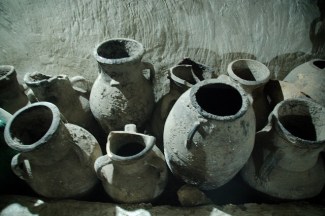 Living conditions in Israel had become very difficult; the nation was constantly at war with its enemies, years of drought had created wide spread famine, and morality was in decline. These things affected the living condition of everyone, regardless of their social status. In the story before us, we are introduced to a poor widow who is facing starvation. Without giving details, we learn that her husband, a godly man, had died and she and her sons were on their last leg. All her resources were gone and the creditors were at the door. In her distress, she sought counsel from Elisha who asked a simple question, “what do you have?” To which she replied, the only thing left in the house was a jar of oil. Elisha went on to instruct her to borrow vessels from her neighbors and fill them with oil from the jar. When she did, they found that the oil poured as long as their was an empty vessel to put it in. I think there are at least two valuable applications from this passage.
 Looking back, we see that the ministry of Elijah was remarkable. He came out of obscurity, and was powerfully used as the voice of God for a nation. His ministry impacted kings, and stirred revival in a morally collapsing Israel. As he aged, the world knew it was losing one of the greatest men who ever walked its soil.
 Even a casual reading of the Old Testament will lead to the conclusion that Israel did not win their battles on their own. When armies are overthrown by the rushing waters of the Red Sea, walls toppled with rams horns, and a shepherd defeats a warrior with a sling and stone, it is clear that the hand of God is behind the victories. There are times when Israel went to battle in their strength, but those are the times of failure, not of triumph. It is hard to forget the Battle of Ai. Joshua sent the troops into battle without first seeking guidance from the Lord, only to see his army retreat and many soldiers lose their lives (Joshua 7:2-6). Clearly, the strength behind the success of the nation of Israel was the leading and empowering hand of God.
 Saul’s rage forced David to flee for his life. He left home and family in such a hurry that he took almost nothing with him. When he arrived in Nob, he immediately searched for both food and weapons. Since he arrived at the home of the priest, and not a military compound, weapons were hard to come by. The only available sword was the one David had taken from Goliath, and it probably sat in a display case.
  Saul was first chosen by God, then equipped for service. This seems to be a pattern. Saul, along with Moses, Jeremiah, and Peter, all resisted the idea of being selected for service by God. Their objections stemmed from a realization of their own shortcomings. What they failed to realize, was God would equip them for whatever He called them to do.
 Jim Gallagher