2 Kings 9:6
“Then he arose and went into the house. And he poured the oil on his head, and said to him, Thus says the Lord God of Israel: ‘I have anointed you king over the people of the Lord, over Israel.'”
 Many men have been called and anointed by God for service. Unfortunately, too many follow the example of Jehu. He spent the beginning of his calling ridding Israel of those who had turned the nation against the Lord. One by one, his sword was a vehicle of judgment against the wicked leaders who went before him. Joram the king of Israel, Jezebel the queen mother, and Ahaziah king of Judah, were all slain for their wickedness, and crimes against the nation. After showing great zeal for righteousness in others, Jehu failed to show the same zeal for his own commitment to the Lord. After successfully using the sword against others, he allowed sin to run rampant in his own life. We read of him,
2 Kings 10:29 “However Jehu did not turn away from the sins of Jeroboam the son of Nebat, who had made Israel sin, that is, from the golden calves that were at Bethel and Dan.”
One of the great dangers of Christian ministry is to become tolerant of your own sin, while focusing on helping to remove the sins of others. The devil is good at what he does, and what he does is deceive. He will spend great energies to get us to take the spotlight off ourselves, and only use it on others. The value of being in the Word of God daily, is that God will use it to probe into our lives and keep us on track.
Be careful to let God remove planks from your life, as He equips you to remove splinters from others (Matthew 7:3-4).
Pastor Jim
 Sometimes, the reason a person fails to walk with the Lord is quite simple. In the case of Jehoram, king of Judah, it was anything but complicated; he got involved with an ungodly woman, who turned his heart from the Lord.
 This is certainly not the only record of Ahab’s sin. He was a man who long ago had given up on any desire to live a life that honors the Lord. This passage does however illustrate, quite strongly, the question asked by Jesus, when He said, “What will a man give in exchange for his soul?” (Matthew 16:24)
 We have four boys who are separated by only five years. When they were little, we, like so many others families, spent a lot of our time visiting amusement parks. As the older ones grew, they were attracted to the bigger rides, and their younger brother wanted to do whatever they did. The problem was, many of the rides had a standard. If you were not a certain height, you could not ride. At times, this created quite a controversy. We tried everything to make him just a little taller, we spiked his hair, we bought shoes called “Heelies”, that had a wheel in the back, and provided a couple extra inches to his height. However, time and time again, when we reached the entrance, he was excluded. He simply did not measure up.
 This Psalm is fulfilled in at least three ways. First, it expresses an actual time in the life of David. His enemies have mounted up against him with such great force that he feels like one who is drowning in a mighty flood. The enemies he faces are those who have sided with Saul, to seek his life; those who were against him because he had chosen to follow God, and finally, and perhaps his greatest enemy, is his own sin. In the midst of the battle for his own life, sin had mounted up like an army, seeking to destroy him. David’s victory over these enemies is found as He seeks the mercy of God. He writes, “Hear me, O Lord, for Your lovingkindness is good; turn to me according to the multitude of Your tender mercies.” Psalm 69:16
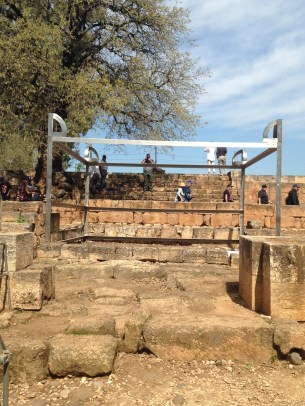 If a traveler from a distant land were to arrive in Israel during the reign of Ahab, there would be little to convince him that these were a people chosen by God. If he entered from the north, the first thing to catch his eye would have been a massive altar built on a high hill in the area of Dan. This altar was erected to give worship to a massive golden cow the people revered as their god. If he came from the south, he would see a similar site erected in Bethel. If he made his way into the heart of the nation, to the newly built city of Samaria, he would find the focal point of the city was an altar built to Baal, the god of fertility. If our traveler were to continue through the towns and villages of Israel, he would see a wide variety of altars and high places built to almost every imaginable god under the son. Essentially, Israel had deteriorated from a nation whose purpose was to glorify YHWH, and be a beacon of light to the world, to a nation just like their neighbors. They had all the same problems, and addressed them with all the same solutions, as those who had never met the Lord.
 We recently had a friend visiting who we had not seen in a number of years. One of his first comments was how much our children had grown. When he last saw them, they were pre-teens, now they are young men. He was shocked at how they had changed, in what seemed to be such a brief period of time. For us, the changes do not seem quite as drastic, because we are watching what happens from day to day. It is only when we bring up a photo or video that we see how much things have really changed.
 Jeroboam had been called and anointed as king of Israel. He was given the same opportunities and promises that David was given. His problem was, instead of drawing near to the Lord, he followed the gods of the surrounding nations, and turned Israel away from the Lord. God, in His unparalleled mercy, sent an unnamed prophet to win Jeroboam back to the ways of the Lord. The man of God declared a powerful message of rebuke to the king; and with a stunning show of the power of God, the altar split in two. Jeroboam’s heart had become so hardened, his response was to demand this young man be imprisoned. As the king’s hand stretched forth condemning the prophet, his hand suddenly withered. With a withered hand, and a broken altar, the king pleaded with the prophet to pray for him. Sadly, his prayer was not one of repentance, he simply wanted things restored to the way they were.
 It is almost eerie to compare the similarities between Solomon and Saul, and Jeroboam and David. As a result of personal sin, Solomon, like Saul, had the kingdom taken from him. While Jeroboam, like David, was chosen by God, to rise to the challenge and lead a new nation. Sadly, both men failed miserably. The root cause of Solomon’s sin is explained earlier.
 King David committed a sin by taking a census of the people, rather than trusting in the arm of God as Israel’s defense. His sin was forgiven, but the consequences were grave.
 Jim Gallagher