Psalms 102:17
“He shall regard the prayer of the destitute, and shall not despise their prayer.”
 Sometimes the Psalms come with titles that give insight into the situation that stirred the author to write. In his case, we are not given the details of his life circumstances, but are told of the purpose behind this song. He writes,
“A Prayer of the afflicted, when he is overwhelmed and pours out his complaint before the Lord.”
Affliction is designed by God to drive us to Him, that we might receive His mercy and find the necessary comfort. Sadly, that is not always the way we react to difficulties. I recently attended an event where a group of people gathered in response to a tragedy that affected all of them. While I understand that difficulty often causes our emotions to speak for us, I was stunned by much of what I heard. Instead of realizing our mutual weakness and need for the mercy of God, I heard person after person speak of how they would not allow this tragedy to break them or to change them. It is as though, the hardship they faced gave them greater resolve and increased resistance against the Lord.
I do not think this was an isolated incident. In fact, in the final years of Judah, the people expressed this same stubborn rebellion against God. While the Babylonians conquered their land and began taking the children into captivity, we read of the leaders continuing with their wicked lifestyles. Instead of allowing the common tragedy to break them, they determined to stand strong in their opposition to God. It is as if they were saying, “You can’t break us and we will never bend.”
Perhaps you are facing a difficult season. Please keep in mind, that part of the reason for this hardship is to bring you to your knees, where you would allow the affliction you are facing, cause you to cry out to the Lord for His mercy.
Pastor Jim
Questions for Psalm 102
- The Psalmist is writing in a state of distress and is overwhelmed with trouble. He even loses his appetite in verse 4. When you’re in the same condition are you pouring your complaint before the Lord?
- In verses 6-7, the Psalmist compares himself to a lonely bird, a pelican of the wilderness, an owl of the desert and a sparrow alone on a housetop. In times of loneliness do you seek fellowship? Turn to Psalm 133 and read about God telling us how good and pleasant it is to be in fellowship.
- As you read this Psalm from verses 8-28, you might be going through this or dealing with that, but one of these days we’re going HOME, AMEN!
- In verse 26 the Psalmist says “They will perish, but You will endure.” Jesus said, “Heaven and earth will pass away, but My Words will by no means pass away” Matthew 24:35. What are you building your life upon? Be encouraged; build it on the Lord, because He’s the only one who is sure.
 One of the great benefits of being a Christian is the promise that God will provide for the needs of His people. This same truth is repeated throughout scripture in a variety of ways. Abraham heard God say He would be his shield and his reward, the Levites were promised that God would be their inheritance, the widow was told her oil would be multiplied, and Jesus promised to care for us as He does for the lilies and the sparrows. It is not difficult to find promises declaring that God will meet our needs, but at times, it is very difficult to trust them.
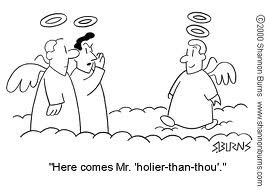 “Holier than thou” is defined by a modern dictionary as, “having a superior attitude or view of one’s self.” It is most commonly used as an accusation against a Christian who calls out sinful behavior. Have you ever been accused of being ‘holier than thou’? If you have, it was probably because you attempted to share Christ with someone. This verse is often coupled with Jesus’ command not to judge lest we be judged, and is used as a defense mechanism by those who are involved in ungodly practices. I think it is worth noting, this statement was actually first used by unbelievers who claimed they were holy enough on their own, and did not need a savior. In fact, anyone who refuses Christ and the cross, is essentially claiming to be ‘holier than thou’.
 As Isaiah looked at the present condition of his world, his heart cried out for the Lord to come. He was not alone in this cry, for the apostle John brought the book of Revelation to a close crying out for Jesus to return. Saints throughout the ages have echoed his plea. There will be a literal fulfillment of Isaiah’s prayer; Jesus will return for His church and He will set up His kingdom. That being said, Isaiah’s prayer has a much broader scope as well. I have found myself, on multiple occasions, praying for God to rend the heavens to meet with me. In times of quiet prayer, as I am about to face a situation that I know I am less than equipped for, my heart pleads for God to rend the heavens and meet with me. In times of corporate worship, as I lift my voice and raise my hands, I often cry for Him to rend the heavens to minister to His church.
 Isaiah describes the fall of Moab. He explains that it will be devastating and it will take place very soon. While this is clearly a divine prophecy which will include specific details, including the time in which this fall will take place, it did not come without warning. The Assyria troops were marching throughout the region and conquering all who opposed them. Since Moab was no match for Assyria, it was inevitable, they would soon be overthrown. I am struck by their reaction to these warning signs.
 This Psalm begins with the Psalmist describing his hunger for more of God. In a beautifully poetic fashion, he compares his desire for God to a deer panting for water. Thirst is one of our most basic drives, second only to the body’s need for oxygen. He is not only stating that he desires more of God in his life, but that he cannot live without Him. Psychologists have made lists of basic human needs for mental and emotional health. These lists often include things like companionship, communication, a good diet, human touch, self acceptance and proper rest. Unfortunately, they often neglect man’s greatest need; our need for God. Paul wrote:
 Jim Gallagher