Judges 15:14
“When he came to Lehi, the Philistines came shouting against him. Then the Spirit of the Lord came mightily upon him; and the ropes that were on his arms became like flax that is burned with fire, and his bonds broke loose from his hands.”
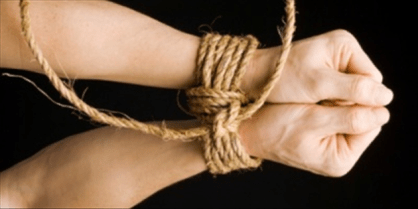 Whenever an artist attempts to illustrate Samson, he looks like a cross between an NFL linebacker and a competitive body builder. He is painted as bigger, stronger and more muscular than all those in in Israel or Philistia. You might find it interesting that no physical description of Samson is ever recorded in Scripture. What is evident is the fact that his strength and subsequent victories, were all directly connected to the Spirit of the Lord being upon him. It was not Samson’s ability that gave him strength, but the power of the Spirit. In this text, we find the Spirt of God enabling him to break the bonds that held him as a captive. Ropes that would hold the average man at bay were torn, as if they were wet tissue paper.
This serves as a beautiful example of the work of the Spirit, in the life of a believer. We are all held back by the things we lack the power to overcome. For some, it is a difficult experience in our past, others, struggle with a particular desire of the flesh, still others are consumed with addiction. Like Samson, we need a work of the Spirit to enable us to break the bonds that hold us captive. The Bible teaches that the Holy Spirit is given to those who ask. However, Jesus explained that this asking requires persistence. If we are in need of God’s intervention to set us free from any form of bondage, we must ask, seek and knock, until the windows of heaven open, and the Spirit is poured out upon us.
Sadly, when Samson was set free, he went right back into the behaviors that got him in trouble in the first place. Many times, it is not that God has failed to provide the power for deliverance, but that once we are set free, we begin to take steps leading us right back into bondage. If you are struggling, take time to confess it, call out to God for help, and begin to remove those things which make it easy to go back into sin.
Pastor Jim
 The scene in Acts 21 might best be described as a riot. The people of the city had lost all sense of the Temple worship, and had become a violent mob determined to put Paul to death. Their rage escalated to the point where the Roman soldiers had to almost beat them back, in order to pull Paul out of their clutches. We read, when they reached the stairs (the way of escape) Paul could no longer walk on his own, but had to be carried by the soldiers. It seems that even after the arrival of the soldiers, the crowd was still taking shots at Paul.
 The tribes of Reuben, Gad and Manasseh chose to separate from the rest of Israel and live east of the Jordan River. Although the Jordan is not a large river, and crossing it during the dry season would not be a difficult endeavor, this division would prove to be very costly. It is clear from the event recorded in Joshua 22, the effects of this separation were felt immediately. Once they returned to their land, they attempted to create a connection with the rest of Israel by erecting an altar that resembled the one in Shiloh. In their minds, this would keep them connected to Israel, even when the Jordan separated them. Their actions were considered to be idolatrous by the other tribes, who pleaded with them, that rather than building an altar, why not cross the Jordan and join the nation. A religious symbol is not the solution for a wandering heart.
  Many of the cities throughout Israel were designated as “Cities of Refuge.” This meant, if a person accidentally caused the death of another, he could flee to one of these cites for protection from the revenge of the victim’s devastated family. The rules governing these cities were simple. If death was caused accidentally, the guilty could flee to the city, and remain safe within its borders, until the death of the reigning High Priest. After his death, the crime was completely forgiven and the individual was free to return to his normal life. This law was designed to curb vengeance, but also serves as a picture for us of the work of Christ.
 After Joshua led the armies of Israel in victory against the Canaanite kings, he distributed the land to each of the tribes. The lands were determined by lot and the size of each tribe. The lot was like a divinely inspired roll of the dice. They may have prayed, rolled the dice, and trusted the Lord for the outcome. Once the lands were distributed, each tribe was responsible to occupy their portion. In order to occupy the land, they had to settle into what they had previously conquered, then daily, deal with those inhabitants who stubbornly remained.
 Stephen’s story is a common one with an uncommon ending. All who have attempted to share the love of Christ with others have experienced the crowd turn on us. The very ones we have prayed for, and stepped out in faith to share with, have accused us of wrong doing, and lashed out against us. Unfortunately for Stephen, these men lashed out not only with words, but also with stones. Stephen was taken outside the city, as if he were a false prophet, and stoned to death. A martyr could be defined as one who lives for Christ, even if it means dying for Christ. Stephen is not the only martyr the church has ever seen, but he was the first.
 Israel stood on the edge of the Promised Land. Soon they would cross the Jordan and face the giants. After forty years in the wilderness, their task had not become any easier. Knowing he was about to die, Moses reminded the people of their true source of strength.
 Peter makes reference to a simple rule of life. We can only give away what we personally possess. By his own admission, Peter had no money to give this man. It is interesting to note that from an economic standpoint, Peter’s condition was no different than the beggar’s. In the world’s estimation, a man in his thirties who is too broke to share his change with a beggar, is of very little value. Peter would not make a who’s who list in the 1st Century. However, if we look more closely, we see that Peter possessed something far greater than riches that tarnish and fade. Peter said,
  I am sure we have all heard the phrase, “What’s in it for me?” In fact, in all likelihood we have probably used the phrase ourselves. We might ask this as it relates to an investment or work related opportunity. Some suggest, the most important principle in business marketing, is to be sure to let the consumer know what’s in it for them. When it comes to salvation, the answer includes, but is not limited too: forgiveness of sin, restored relationship with God, a transformed life, and the free gift of eternal life. Without doubt, we would be exercising the height of folly to fail to receive all that is offered to us through a relationship with Christ.
  As Moses’ final hour quickly approaches, he pleads with the people to turn to the Lord. He has personally experienced the suffering that comes with rebellion against God. Forty years in Horeb, and forty years in the wilderness wanderings, have forever etched in his mind, the importance of trusting in, and following after, the Lord.
 Jim Gallagher