Revelation 15:3-4
“Great and marvelous are Your works, Lord God Almighty!
Just and true are Your ways, O King of the saints!
Who shall not fear You, O Lord, and glorify Your name?
For You alone are holy.
For all nations shall come and worship before You,
For Your judgments have been manifested.”
 While the tribulation continues on earth, John’s attention is drawn once again to the scene in heaven. The contrast alone should be enough to persuade us to surrender to Christ. Earth is experiencing the wrath of God, while heaven is being filled with sweet and continuous praise. Those who have been rescued from the tyrannical reign of the Antichrist stand before the throne and worship.
One of the evidences that a person has met Christ and been set free from sin is a desire for worship. While it is not required to fall on our knees, lift our hands, or even sing loudly, it is hard to imagine a person who has been impacted by the love and mercy of God who will not offer the loudest praise. Just the other night in our worship service, I noticed one young lady who humbly turned, faced her chair and knelt in worship. She has been growing so much in her relationship with Jesus of late that she could not resist the desire to bow in worship. I think we can learn a lot from the praise song of the redeemed found here in a Revelation 15.
““Great and marvelous are Your works, Lord God Almighty!”
Their praise stemmed from focusing upon the works of God. As they stood before the Lord, they recalled the way in which they had been redeemed. Since these are tribulation saints, we know they had neglected the things of God for most of their lives and ignored the gospel. Still, the persistent love of God hunted them down and won them over. They, like we, could look back to the cross, where the love of God was poured out to redeem them from sin and give eternal life. Reflecting upon the work God has done is vital to a life of praise.
“Just and true are Your ways, O King of the saints! Who shall not fear You, O Lord, and glorify Your name? For You alone are holy.”
As important as it is to look back upon the works of God, it is also vital that we look up to the person of God. He is worthy of the highest praise for what He has done, and also for who He is. Their praise stems from remembering three things about the nature of God. First, He is just; second, He is the king; and third, He is holy. All of the judgments of God are just. We often accuse Him of being unfair, however when His judgment is finally meted out upon a Christ-rejecting world, we will see how mercy and truth have met one another, and how righteousness and peace have kissed.
“For all nations shall come and worship before You, For Your judgments have been manifested.”
Finally, their worship includes an understanding of the promises of God. The judgments that the Word of God has warned about are finally coming to pass. Peter speaks of those who mock God because He waits so long to execute judgment; failing to recognize it is His mercy which holds back His judgment. One of the best ways to increase a heart of praise is to focus upon the promises of God. Too often, in dire circumstances, we look only to our surroundings, instead of looking into the promises of God. The saint who trusts the promise over the circumstances he faces, or the emotions they stir up, is the saint whose life will be filled with the loudest praise.
Pastor Jim
 John looked into the future of mankind and saw the day when the heavens will open, not to speak, but to call home all who have trusted in Christ for salvation. Paul explained that the dead in Christ would rise first, and we who are alive and remain will be caught up together in the air (1 Thessalonians 4:16-17). What a day that will be, when we are no longer looking through a glass dimly, but we are face to face with Christ (I Corinthians 13:12) steeped in His glory.
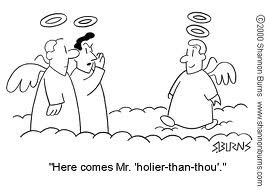 “Holier than thou” is defined by a modern dictionary as, “having a superior attitude or view of one’s self.” It is most commonly used as an accusation against a Christian who calls out sinful behavior. Have you ever been accused of being ‘holier than thou’? If you have, it was probably because you attempted to share Christ with someone. This verse is often coupled with Jesus’ command not to judge lest we be judged, and is used as a defense mechanism by those who are involved in ungodly practices. I think it is worth noting, this statement was actually first used by unbelievers who claimed they were holy enough on their own, and did not need a savior. In fact, anyone who refuses Christ and the cross, is essentially claiming to be ‘holier than thou’.
 As Isaiah looked at the present condition of his world, his heart cried out for the Lord to come. He was not alone in this cry, for the apostle John brought the book of Revelation to a close crying out for Jesus to return. Saints throughout the ages have echoed his plea. There will be a literal fulfillment of Isaiah’s prayer; Jesus will return for His church and He will set up His kingdom. That being said, Isaiah’s prayer has a much broader scope as well. I have found myself, on multiple occasions, praying for God to rend the heavens to meet with me. In times of quiet prayer, as I am about to face a situation that I know I am less than equipped for, my heart pleads for God to rend the heavens and meet with me. In times of corporate worship, as I lift my voice and raise my hands, I often cry for Him to rend the heavens to minister to His church.
 When Hezekiah heard the report that his condition was terminal, and death was knocking at his door, he immediately began to pray. His prayer recounted the way he had lived his life in commitment to the Lord. All that was left was to beseech the mercy of God, for an extension of days.
 Every few years someone writes a book about how they died, went to heaven, and returned to tell about their experiences. The story usually includes something about radiant light, warm feelings, and the awareness of all their loved ones awaiting their arrival. The authors are heralded as experts on the subject of the after-life and their books often become best sellers. Two thousand years ago Paul had an experience where he was “caught up” into heaven. As he reluctantly relates his story, two things stand out to me.
 In the previous chapter, Job made a list of all the good things he had done. He speaks of being a good husband, caring for his employees, giving to charity, being a religious man and avoiding evil actions. These are all notable qualities and should be a part of our lives, but not one of them is capable of making us righteous or justified before God. Job made the mistake of thinking he could earn his way to heaven. He assumed his good works would outweigh the bad things he had done. CS Lewis sought to express the problem with self-righteousness in his book “The Great Divorce.” He speaks of a man who refuses to enter heaven. He thinks he is above those who have gone in through the doorway of grace. In response Paul would declare,
 David, and others, invested in the temple at great personal cost. They devoted their time, talents, and treasures to ensure that the house of the Lord was built. Their devotion to this project stemmed from realizing that the work of God would outlast them. David would not live to see the temple, but knew that his investment would impact the nation long after his departure. For years to come, this building would be a place where the Word of God was proclaimed, and commitments to the Lord were made, as each of Israel’s revivals centered around the events that took place at this building.
 Things in the kingdom of God run very differently than they do in the kingdoms of men. This is particularly true of exaltation. The word exalted means “to raise in rank or power, to be elevated or lifted above.” What exaltation is, and how to achieve it, are different in God’s Kingdom.
 Jim Gallagher