Psalm 52:1
“Why do you boast in evil, O mighty man? The goodness of God endures continually.”
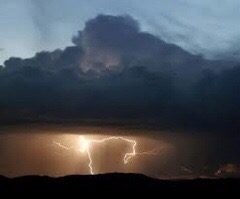 We live in a world of contrast. On the one hand, we see the fingerprint of God all around us, demonstrating His goodness. Earlier in the Psalms, David wrote, “The heavens declare the glory of God; And the firmament shows His handiwork” (Psalm19:1). When we see the beauty of creation, the birth of a child, or the love of betrothal, we are struck by the goodness of God.
On the other hand, there is another force clearly at work in our world. David calls it “evil,” and he witnessed its effects all around him. This Psalm was written after Doeg had murdered dozens of men, out of his selfish ambition and lust for gain.
We, too, see evil all around us with the ability to access information from all of the world. We have all been stunned by thousands killed in floods, earthquakes and hurricanes. As horrible as these things are, they pale in comparison to the evil that men inflict upon other men. Wars, fought for nothing more than a selfish drive for power, have been responsible for the brutal death of millions, upon millions, of lives. We have all heard of the atrocities under Hitler and Stalin. Tragically, these are not just distant memories of the dark days of man. The events, in places like El Salvador, Liberia, and Rwanda, in recent decades, have been nothing short of evil. Nor has evil stopped. We hear today of threats of terrorism, and even global war. Sadly, we do not need to look far to find evil. We have all been dumbfounded by reports of shootings at schools or job sites, where an expressionless gunman shoots innocent victims; leaving the victim’s families to grieve in shock and horror. We all know, and perhaps even are the victims of abuse. I have sat in my office with people who were molested by the very ones who should have loved them, and seen the far reaching and devastating effects of that evil. As a result, we are all left to wonder how these two truths can be reconciled. We ask the age old question, “Why do bad things happen to good people?”
Allow me to have Psychiatrist M. Scott Peck answer this question for us: “It is a strange thing. Dozens of times I have been asked by patients or acquaintances: ‘Dr. Peck, why is there evil in the world?’ Yet no one has ever asked me in all these years: ‘Why is there good in the world?’ It is as if we automatically assume this is a naturally good world that has somehow been contaminated by evil. In terms of what we know of science, however, it is actually easier to explain evil. That things decay is quite explainable in accord with the natural law of physics. That life should evolve into more and more complex forms is not so easily understandable. That children generally lie and steal and cheat is routinely observable. The fact that sometimes they grow up to become truly honest adults is what seems the more remarkable. Laziness is more the rule than diligence. If we seriously think about it, it probably makes more sense to assume this is a naturally evil world that has somehow been mysteriously “contaminated” by goodness, rather than the other way around.”
The mystery of goodness is even greater than the mystery of evil. “An evil world contaminated with goodness.” The Bible explains this clearly. When Adam sinned, sin entered the world, and has affected everything. However, God, through Christ, has infused His goodness into this world. James went on to explain, that every good and perfect gift comes from God. The evil in this world goes against the nature of God, and is caused by sin. The good in this world is left by the fingerprint of God, who loves us, and desires to work in us, even to be a fortress when evil is on the rise. Will you cling to Him today?
“At the tree in the garden we passed from good to evil
At the tree on the hill we passed from evil to good.”
Pastor Jim
Psalm 52
- Read chapter 21 and 22 of 2Samuel, for background on the writing of this Psalm.
- What is the confidence and strength of the wicked man? Where does he place his trust and what does he love?
- Yet what is the end of the wicked man?
- In contrast what is the strength, confidence, and trust of the righteous before God?
 Webster’s dictionary defines heritage as, “something possessed as a result of one’s natural situation or birth.” While many things may be passed from one generation to the next, the most valuable commodity we can leave for the following generations, is a godly testimony.
  If it were not for the revealing nature of the word of God, we might have missed the real folly of this man. On the outside, he may have seemed quite wise; he was married to a beautiful woman and he had a successful and thriving business. However, his wealth and the honor that came with it, were a mere cover up of his actual folly. We read that he ignored the warnings, and perhaps even died unprepared to face eternity. Jesus spoke of a rich fool who had achieved much in this life, but was ill prepared for that which follows (Luke 12:16-20).
  he thing that makes following Christ so difficult is the enemies we face. The primary enemy of the Christian is the devil and his minions. Scripture describes the devil as a schemer who seeks to derail us from following and serving Christ. He will use the weakness of our humanity as a tool to get us to stumble into sin. When at times, it may seem as though the temptations and the obstacles are too great to overcome, we can be greatly encouraged by this promise.
  Have you ever been in a situation where you were forced to cry for help? A good friend of mine told me a story of a time when he was cutting tree branches to make some extra cash. He leaned his extension ladder against the tree, climbed to the top, reached up and cut a large branch. As soon as the branch was cut, the tree shifted and the ladder fell. Reacting quickly, he was able to grab another limb to keep himself from falling. However, he found himself hanging twenty five feet above the earth’s surface. Knowing he would not be able to remain there for long, he began to cry out for help. Sadly, no one could hear him and after his arm strength gave out, he was forced to let go and fall to the ground. Fortunately, he was not seriously hurt.
 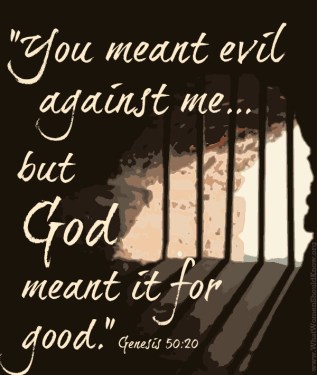 We have all faced times in our lives when we have looked up from our circumstances and wondered, “How God could truly love me and let me go through this.” If any man had a right to allow his circumstances to call into question the loving-kindness of God, it was Joseph. I can only imagine the horror he must have experienced when his brothers suddenly turned on him and cast him into a pit. That scene must have played over and over in his mind, perhaps even while he slept. That first bitter act put Joseph’s life on a course that would seem to be leading ever downward, from kidnapped victim, to slave, to convicted rapist; forgotten in a foreign prison cell. Many men, perhaps even most men, would allow these circumstances to harden them as they plotted revenge on those who ruined their life. But Joseph proved himself to be unlike most men when, instead of looking back with vengeful hate, he looked up and saw the hand of God redeeming what had been destroyed. Long before he found himself face to face with his brothers, Joseph had gotten face to face with God, and learned that the hand of God had been guiding his life for a single purpose – the salvation of souls. In what is one of the most beautiful and searching statements in scripture Joseph declares,
 Jim Gallagher