Psalm 97:10
“You who love the Lord, hate evil! He preserves the souls of His saints; He delivers them out of the hand of the wicked.”
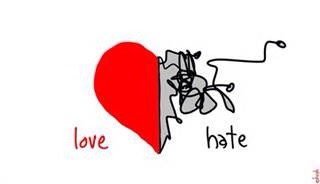 I find it striking that the Psalmist declares that hate is a necessary expression of true love. He explains that part of being in a healthy love relationship with Jesus is having a hatred for evil. Why is it necessary to hate evil? Why should we hate evil? I can think of at least three pretty strong reasons.
First, we should hate evil because of what evil does to creation. When sin entered the world, death entered and all of creation began to be in a state of decay. We observe this daily. People age and die, things deteriorate and break, everything goes from a state of useful to useless. Paul explains that creation itself even groans to be redeemed. If we could discern the voice of nature we would hear it crying out for redemption.
Second, we should hate evil because of what it does to us. Evil or sin separates man from God placing all humanity under its curse and penalty. Sin has devastated families, wreaked havoc on relationships, fueled racial prejudices, started wars, and will ultimately damn those who reject Christ to eternal separation from God. Even after we are redeemed, sin is like a cancer that eats away at the spiritual life of the believer. When we allow sin to reign in our mortal bodies, it creates distance between us and God, causing us to miss out on experiencing abundant life, for which he died. Instead of life, love, joy, peace, we find ourselves living under the weight of guilt and fear, suffering the consequences of our personal failures.
Finally, we must hate evil because of what it has done to God. His holiness demands that sinners are separated from Him, but His love drives Him to restore our broken fellowship. The only currency valuable enough to pay the cost for the human soul is the blood of God. It was because of sin that the blood of God was shed. We have all felt the weight of individual sin. We know the guilt and pain that we have been under, as a result of one sinful action. On the cross, Jesus bore the weight of every sin that every man has or will ever commit. The darkness of that day aptly illustrate the severe suffering that Christ endured as He cried out, “My God why have You forsaken Me?” It seems to me, the proper response for the child of God is to hate evil. It has been my experience that we avoid what we hate. A true hatred of evil will cause us to avoid sin, rather than living as close to it as possible. Will you join me in praying that we would have a healthy hatred of sin, and avoid it at all costs?
Pastor Jim
 This is certainly not the only record of Ahab’s sin. He was a man who long ago had given up on any desire to live a life that honors the Lord. This passage does however illustrate, quite strongly, the question asked by Jesus, when He said, “What will a man give in exchange for his soul?” (Matthew 16:24)
 Many of the cities throughout Israel were designated as “Cities of Refuge.” This meant, if a person accidentally caused the death of another, he could flee to one of these cites for protection from the revenge of the victim’s devastated family. The rules governing these cities were simple. If death was caused accidentally, the guilty could flee to the city, and remain safe within its borders, until the death of the reigning High Priest. After his death, the crime was completely forgiven and the individual was free to return to his normal life. This law was designed to curb vengeance, but also serves as a picture for us of the work of Christ.
 I am sure we have all heard the phrase, “What’s in it for me?” In fact, in all likelihood we have probably used the phrase ourselves. We might ask this as it relates to an investment or work related opportunity. Some suggest, the most important principle in business marketing, is to be sure to let the consumer know what’s in it for them. When it comes to salvation, the answer includes, but is not limited too: forgiveness of sin, restored relationship with God, a transformed life, and the free gift of eternal life. Without doubt, we would be exercising the height of folly to fail to receive all that is offered to us through a relationship with Christ.
  Galatians 3:13
 Moses goes into great detail to explain the sacrifices that were to be offered to the Lord. Every morning, and again, every evening, a spotless lamb was offered, with a grain and drink offering. On the Sabbath, new moon, and for each of the seven feast, additional sacrifices were added. As long as the Tabernacle or Temple stood, these offerings were to be continually presented to the Lord. An entire staff of priests was required to officiate at these offerings. Some were responsible to examine the offering for defect, others to perform the sacrifices, and still others to attend to the daily maintenance, and care for the Temple, itself. When the days work was completed, they understood the next day bore the same responsibilities. There was no end to the process. Yet people were still conscious of their sin and alienation from God.
 The Lord went to great detail to explain the garments that the High Priest would wear. He referred to them as holy garments, designed for glory and for beauty. In other words, they were designed to both look beautiful and to reveal some aspect of the Lord’s glory. These garments included a breastplate, an ephod, a robe, a skillfully woven tunic, a turban, and a sash. The most highly skilled artisans in all Israel were commissioned to create them. Once the day of consecration arrived, Aaron and his sons were dressed in the most beautiful and highly technical attire the world had ever seen, but as they approached the altar, something quite striking took place. An innocent ram was killed, it’s flesh offered upon the altar, it’s blood mixed with anointing oil, and this mixture placed upon the Priest. Imagine how shocking to see the High Priest all dressed up, then have blood splattered upon his garments. No longer would our attention be drawn to his beautiful turban, breastplate or sash, now all we would notice was the stain.
 Jim Gallagher