What Did You Say? 

James 3:5
“Even so the tongue is a little member and boasts great things.”

The largest mammal on the planet is a blue whale, whose tongue can weigh upwards of 2.5 tons. This is approximately the size of an adult elephant. In contrast, the human tongue, on average, is about 4 inches long and weighs less than 4 ounces. The tongue is certainly not one of the strongest muscles in the human body, yet it is perhaps the one capable of the most destruction. Many of us grew up with hearing “sticks and stones can break my bones, but words will never hurt me,” only to find that some of the deepest hurts we have ever felt, were caused by the unkind words of another. James explains, one of the great problems we all have is that with the same tongue we bless God and curse men.

The Bible points out the sinful uses of the tongue, of which we are all guilty:

COMPLAINING – Philippians 2:14 “Do all things without complaining and disputing . . .”

BACKBITING – Proverbs 25:23 “The north wind brings forth rain, and a backbiting tongue an angry countenance.”

GOSSIP – Proverbs 18:8 “The words of a talebearer are like tasty trifles, and they go down into the inmost body.”
                 Proverbs 26:20 “Where there is no wood, the fire goes out; and where there is no talebearer, strife ceases.”

TEASING – Proverbs 26:18-19 “Like a madman who throws firebrands, arrows, and death, is the man who deceives his neighbor, and says, ‘I was only joking!’”

PROFANITY – Colossians 3:8 “But now you yourselves are to put off all these: anger, wrath, malice, blasphemy, filthy language out of your mouth.”

BLASPHEME – James 2:7 “Do they not blaspheme that noble name by which you are called?”

We are all aware of the sins of the tongue, are guilty of committing them, and have been hurt by them. The question is, how can we avoid them? Jesus tells us the sins of the tongue are a matter of the heart.

Luke 6:45 “A good man out of the good treasure of his heart brings forth good; and an evil man out of the evil treasure of his heart brings forth evil. For out of the abundance of the heart his mouth speaks.”

The solution then, to overcoming the sins of the tongue, is to focus on what is coming into our lives, and finding residence within our hearts. A number of years ago, a friend of mine was counseling a man who was struggling with outbursts of wrath (anger issues). He could not control his tongue and would lash out at his family. As they finished their conversation and walked to the car, he saw that the passenger seat was filled with hard-core secular music cassettes; the kind that makes you want to bang your head against a wall. He had uncovered part of the cause of the problem. Constantly filling his head with screaming, made it a lot easier to scream at others. In the same way, if you have a problem with profanity, take inventory. What are you putting into your head? If you struggle with gossip, stop listening to it and you will stop spreading it. Garbage in garbage out! The more you fill your mind with the things of God, the more you will find that your tongue is used to bless God and be a blessing to others. Philippians 4:8 “Finally, brethren, whatever things are true, whatever things are noble, whatever things are just, whatever things are pure, whatever things are lovely, whatever things are of good report, if there is any virtue and if there is anything praiseworthy—meditate on these things.”

Pastor Jim

 

Locked Up

Jeremiah 32:2
“For then the king of Babylon’s army besieged Jerusalem, and Jeremiah the prophet was shut up in the court of the prison, which was in the king of Judah’s house.”

Judah was on the brink of disaster with the armies of Babylon were camped outside the city walls. Food, water and morale, were at risk of running out, and the only hope for the nation was locked away in a prison cell. The people were neglecting the one thing that could ensure victory over the enemy they were facing. That victory would be found in obeying the Word of God, spoken by the prophet Jeremiah.

Times have changed and circumstances differ, but we do the same thing today. When faced with a problem, trial, temptation or personal struggle, we often look everywhere else, before we resort to the promises of God. We think money, medicine, counsel, or some other natural thing, will provide us with deliverance. We neglect to go to the pages of God’s Word where we meet the Lord face to face.

Part of the reason Judah ignored the Jeremiah’s message was they did not like, nor want to hear, what he declared. His message was one that involved surrender, and God dealing with personal and national sin. He told them the secret to victory was in surrender to Babylon. Rather than accepting the ways of God, they chose to silence the Word of God.

Again, this is common today. Many who refuse to seek counsel from the Word, do so because they already know what God will say. His message will include a solution to the problem, but the solution will involve dealing with the sin that caused the problem.

If you are facing difficulty, don’t run away from the Word of God, instead run toward it. Open the pages of your Bible and allow God to speak into your life. Some of what He declares may be hard to handle, but in the end, He will always lead us in triumph through Christ.

Pastor Jim


Everlasting Love 

Jeremiah 31:3
“The Lord has appeared of old to me, saying: ‘Yes, I have loved you with an everlasting love;Therefore with lovingkindness I have drawn you.'”

One of the great pitfalls for every believer is failing to realize how God actually feels about us. Because so much of our experience in this life is based upon performance, we project that onto our relationship with God. We think, if we are doing the right things He loves us, but if we do something wrong, He is angry, disappointed, and may even shun us. How precious to hear the voice of God say to Jeremiah, “I love you with an everlasting love and I have drawn you to myself.” The basis of this love is not in the behavior of Jeremiah, but in the character of God.

Years ago, I heard a pastor say, “The only thing God expects from you is failure.” His point was simply that God understands who we are.  We are weak, and prone to stumble and fail, in our attempts to walk with Christ. This is not an excuse to sin, but a reality that we are going to get tripped up from time to time. The secret to continuing on in the Lord, is to realize that even at our worst, God loves us with an everlasting love.

Earlier this week, I was in the midst of a discussion with another believer about accountability. We spoke of the need to to be accountable to God first, and how the fear of the Lord is the greatest deterrent to personal sin. As the conversation continued, we began to reflect upon the mercy of God, and how even with our best attempts, we still fail to be adequately holy in all our behaviors. It is during these times,  we need to be particularly mindful of the everlasting love of God. Instead of allowing a momentary weakness to lead us into a permanent state of backsliding, we must realize the love of God is greater than all our sin, and once again draw near to Him.

God chose a number of ways to illustrate who He is, and how He feels about us. Not the least of which, is referring to Himself as our Heavenly Father. We can understand the father-son relationship, although none of us had the perfect father, and none of us is the perfect father. We can still relate to the fact that a father does not cast away his son because he fails. Instead, a father will bring his son close, and seek to help him succeed and overcome his failure.

How sweet it is to realize that the love of God is everlasting.

Pastor Jim


Journey Of A Lifetime

Jeremiah 30:2
“Thus speaks the Lord God of Israel, saying: ‘Write in a book for yourself all the words that I have spoken to you.'”

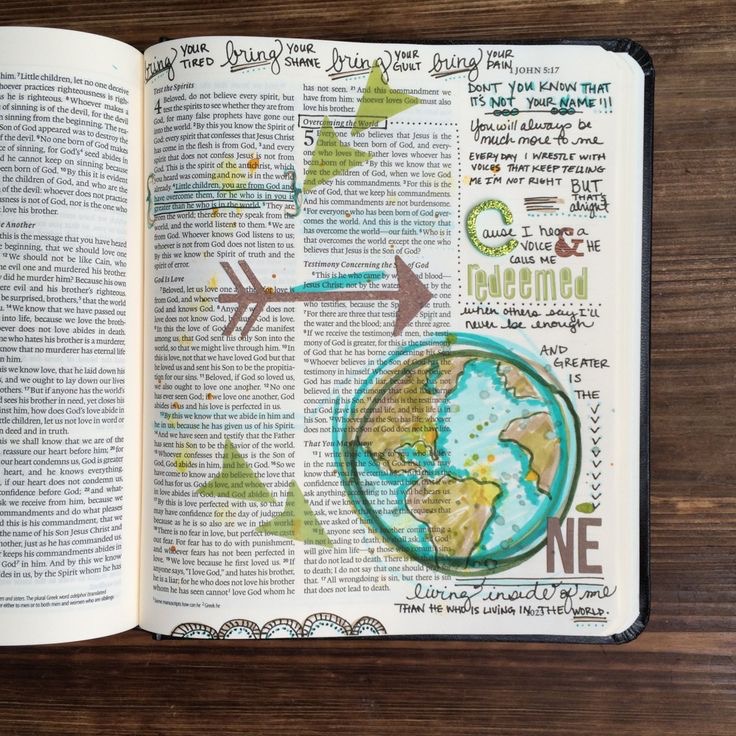
Years ago, when I first began walking with the Lord, I was given a study Bible as a gift. I remember being so excited to have such an amazing resource at my fingertips. It had a topical index in the front, as well as a concordance in the back, and was filled with cross references and commentary on various passages throughout. I purchased a good mechanical pencil and began my journey through the Word. I would read a passage and begin marking the text to help unlock its meaning. In the margin I would write comments, sometime my own, sometimes ones I heard in a message or read in a commentary. Day after day, I made my way through passage after passage until finally I had read, studied and commented on every one of the Bible’s 1189 chapters. Once I had reached the final chapter of Revelation, I was in no way done, nor was I an expert, but I had embarked on a journey that I wanted to continue for the rest of my life. As the years have passed, and my eye site weakened, that particular Bible has been retired to the bookshelf, and I have moved on to a bigger font, but the journey remains the same. As a child of God and a follower of Jesus, it is my desire to get to know Him through the pages of His word.

Will you join me?

Pastor Jim


Work In Progress 

James 2:14  “What does it profit, my brethren, if someone says he has faith but does not have works? Can faith save him?”

James 2:17 “Thus also faith by itself, if it does not have works, is dead.”

James asks a very important question, “What is the profit of faith without works?” He then adds, “Can that faith save?” To help lead us to the right answer, he uses an illustration which reminds us that talk of food will not always satisfy the appetite of a hungry man. In the same way, a dead faith cannot produce life. Right away James recognizes there will be objections to his teaching; some will say, “You have faith, I have works.” This seems to be the objection of those who think there is more than one way to God. They might say, “I am glad you have found something that works for you, but I don’t need that. I am a good person, and when I die, I will go to heaven because of the good things I have done.” James is in no way saying our good deeds will get us into heaven, but that true faith is always accompanied with good works. The person who truly believes, will have actions that support his claims.

Throughout history, James has gotten a whole lot of grief for writing this passage. Some have even gone so far as to suggest that this book does not belong in the Bible. I think it is important that we see James is not presenting a different doctrine than the rest of Scripture, but is in fact, explaining more clearly, the doctrine of justification by faith. James is not alone in teaching that faith without works is dead.

JEREMIAH TAUGHT IT

Jeremiah 7:8 “Behold, ye trust in lying words, that cannot profit.”

JOHN THE BAPTIST TAUGHT IT

Matthew 3:7-8 “But when he saw many of the Pharisees and Sadducees coming to his baptism, he said to them, “Brood of vipers! Who warned you to flee from the wrath to come? Therefore bear fruits worthy of repentance”

PAUL TAUGHT IT

Galatians 5:6 “For in Jesus Christ neither circumcision nor uncircumcision avails anything, but faith working through love.”

Titus 1:16 “They profess that they know God; but in works they deny Him, being abominable, and disobedient, and unto every good work reprobate.”

Ephesians 2:8-10 “For by grace are ye saved through faith; and that not of yourselves: it is the gift of God: Not of works, lest any man should boast. For we are his workmanship, created in Christ Jesus unto good works, which God has before ordained that we should walk in them.”

PETER TAUGHT IT

2 Peter 1:5 “And beside this, giving all diligence, add to your faith virtue; and to virtue knowledge; . . .”

JOHN TAUGHT IT

1 John 2:4 “He who says, ‘I know Him,’ and does not keep His commandments, is a liar, and the truth is not in him.”

JESUS TAUGHT IT

Luke 13:3 “I tell you, no; but unless you repent you will all likewise perish.”

Matthew 7:19-20 “Every tree that does not bear good fruit is cut down and thrown into the fire. Therefore by their fruits you will know them.”

Matthew 7:21-23,26,27 “Not every one that says unto me, Lord, Lord, shall enter into the kingdom of heaven; but he that does the will of my Father which is in heaven.”

James goes on to explain his teaching by stating, faith cannot be seen without action, “I will show you my faith by my works.” He then uses one of the most powerful sermon illustrations ever given. He declares the demons, who believe in God, show by their actions, they are not followers of God. In contrast to the demons, James reminds us of the father of faith. Who showed the reality of his faith with His obedience to the word of God. His action of placing his son on the altar, showed in a striking way, that God was his chief love (Genesis 22:1-12).

Jesus declared, the first commandment is to love God with ALL. This is evidenced in our lives, not simply by words, but by actions. With one final illustration, James brings up Rahab the harlot. Her past life was marked with open sin, although no details are given as to what led her down that path. All we know is when presented with the opportunity, she chose to depart from her old way of life, and determined to join with the believers and follow God. What about us? What are the works that show an account of our faith? In Matthew 7, Jesus stated, we must do the will of the Father. The first work to add to our faith is simple obedience.

Read your Bible and do what it says. When you come to a text that convicts you, make some changes in your living. It is not the change that saves you, but the saved will certainly change.

Pastor Jim


Promises

Jeremiah 29:11
“For I know the thoughts that I think toward you, says the Lord, thoughts of peace and not of evil, to give you a future and a hope.”

The Bible is like a treasure chest filled with great and precious promises. It is designed to help the child of God navigate his way through life, and provide comfort during times of difficulty. While these promises are seemingly endless, there are certain ones that have had tremendous impact upon believers, down through the ages. Jeremiah 29:11 is one such promise. Written to a group of believers facing dark and difficult times, this verse is designed to provide hope, help and consolation.

Due to years of wandering from the ways of God, the people of Israel were overthrown by Babylonian forces. In accordance with the practices of the day, the defeated were taken captive to Babylon. Now, living as prisoners of war in a foreign land, where they did not speak the language or know the customs, all seemed hopeless. The natural response would be to wallow in self pity, for how they had failed God and ruined their lives. Instead of writing a message to condemn them, Jeremiah gives them a promise that includes hope for now and for generations to come. He promises them that God not only thinks about them, but He thinks good thoughts that will provide them with a future. In a similar passage, Paul wrote concerning the child of God;

Ephesians 2:10

“For we are His workmanship, created in Christ Jesus for good works, which God prepared beforehand that we should walk in them.”

Those in a relationship with Christ, are now walking a path that will lead them into the plans God has designed for them. We will find abundant life and a purpose for living when we begin to walk according to the ways of God. We will begin to see crooked ways made straight, as God repairs relationships we destroyed, through a lifestyle of selfishness and sin. We will see God transform our homes, and make us a witness to others of His grace, love and goodness.

As beautiful as these promises are, they have no meaning if we are not willing to surrender our ways to the Lord. Those in Babylon who refused to trust God and obey His word, lived as those these promises were never given. They had the living Word of God at their disposal, and were unaffected by its promises. It might be worth taking a few minutes to evaluate yourself in light of the promises of God. Have you surrendered your life to Christ? Have you removed things that are not pleasing to Him from your lifestyle? Are you seeking to live a life that pleases Him? As you do, He will unwrap these promises and work them into your life.

Pastor Jim


I’m A Little Lost 

James 1:5
“If any of you lacks wisdom, let him ask of God, who gives to all liberally and without reproach, and it will be given to him.”

Wisdom might best be defined as “knowing what to do.” In life, we are constantly faced with circumstances in which we have no experience. We are left wondering what in the world we should do. When James writes, “If any man lacks wisdom…” he is not suggesting that only some of us are in circumstances for which we do not have solutions, but that ALL of us are in constant need of wisdom. The word “if” could also be translated as “since.” The question is not really if we need wisdom, but rather how do we get it?

Wisdom is received in at least 4 ways. First, wisdom comes from experience. If we touch the hot stove, we have learned not to touch it again. Second, wisdom can be received by listening to those who have gone before us. My children learned not to touch the hot stove, not by burning their fingers, but by heeding the warnings of mom and dad. Third, wisdom can be given supernaturally. One of the gifts of the Spirit, given to the child of God, is the “Word of Wisdom.” We saw it in action in the book of Acts when the church was facing an unfamiliar and perplexing dilemma. The solution is given to James that satisfied all involved and provided a solution to the problem (Acts 6:1-7). Finally, wisdom is also received through prayer. That is the subject of James’ exhortation.

Colossians 2:3 “. . . in whom are hidden all the treasures of wisdom and knowledge.”

Paul reminded the Colossians that all wisdom is hidden in Christ. There is no circumstance which we face that He does not know the best course of action. This wisdom, he says, is hidden in Christ, which requires that we seek Him in order to receive it. We seek that wisdom by taking our situation before the Lord in prayer. “Lord, I am facing this decision and I really do not know what to do. I pray you would show me the right way to navigate through this.” Once we have taken our request to the Lord, we must wait for an answer. This is often where the Christian sways. We forget, while prayer is the way we take our needs to the Lord, His Word is the way He communicates with us. If you want to hear from the Lord, you must crack open the pages of your Bible and read. In addition to daily reading through the Bible, it is a good idea to look up verses that directly target the circumstances you are in and put their teaching into practice in your life. It is through His Word that God will give wisdom to His children.

Pastor Jim


Trust In A Lie

Jeremiah 28:15
“Then the prophet Jeremiah said to Hananiah the prophet, ‘Hear now, Hananiah, the Lord has not sent you, but you make this people trust in a lie.'”

As far back as we have recorded history, we have people supposedly speaking for God. Here we find a self-proclaimed prophet named Hananiah, claiming God is OK with the behaviors of the people of Judah, and the warnings of judgment for sin should be ignored. He even went so far as to claim that the current lifestyle of the people would in fact result in the blessing of God, rather than His curse. It is interesting to look back and observe some of the things that culture has promoted as acceptable, while the Word of God has remained the same. There was a time when people of African descent were considered by culture to be less than fully human. This was never the position of the Bible, but of the culture. There were even those, like Hananiah, who twisted the Bible to fit their cultural view.

Today, culture has many views that are diametrically opposed to the teaching of the Word of God. There is no shortage of Hananiahs, who are willing to twist the Bible to make it support their view. I am not sure how much longer God will tarry before His Son returns, but I am sure that if He does, future generations will look back on much of what our culture claims as right, and be as embarrassed by it as we are of Manifest Destiny and slavery. Instead of letting culture shape the way we see life, let’s let the Bible shape our view of culture.

Pastor Jim

Testing Testing 123

Jeremiah 27:14
“Therefore do not listen to the words of the prophets who speak to you, saying, ‘You shall not serve the king of Babylon,’ for they prophesy a lie to you”

Not everyone who speaks is telling the truth. A salesman may tell you what he thinks you want to hear, rather that what is factual. A friend may tell you what they think is kind, so as not to hurt your feelings or damage the relationship. This principle is important to grasp, especially as it relates to those who claim to have the answer to spiritual questions. Just because a person showed up in Judah wearing a white robe, carrying a staff and speaking loudly, did not mean he was a prophet. In the same way, just because a person has an opinion about eternal life, godliness or spirituality, does not mean their opinion is valid. The litmus test used in Scripture to determine if a person was truly a prophet was the Word of God. Paul wrote,

1 Thessalonians 5:21 “Test all things; hold fast what is good.”

During my years as a high school teacher I wrote, administered, and graded a lot of tests. One common form of testing was to use a “scan-tron.” Before grading the test I would make an answer key, all other tests would be compared to this one. It was the standard by which all answers were compared. When it comes to determining the validity of someone’s claims about Christ, life, death, eternity, godliness, sin tolerance, righteousness, etc. we need to use the Word of God as the answer key. It is not what I think that is the highest standard, but rather what God has revealed in the pages of His Word.

Pastor Jim


Praise God 

Hebrews 13:15-16
“Therefore by Him let us continually offer the sacrifice of praise to God, that is, the fruit of our lips, giving thanks to His name. But do not forget to do good and to share; for with such sacrifices, God is well pleased.”

Worship is a very important part in the growth of every Christian. Many times, we measure God in light of the difficulties we are facing. We think there is little, or no hope for us, because our problem seems massive. It is in worship that we are able to see our life in light of the nature of God. We need to magnify God (which does not mean to make Him bigger, but to bring Him into focus) so we see life in light of His great love, mercy and power. As we magnify Him, we will see how little our problem is, compared to His ability. That becomes the source of great peace during trying times.

Here, in Hebrews 13, we see a couple of key elements that should be part of the worship life of the believer. First, we are told to offer the sacrifice of praise. Music is an amazing medium. Things that are often difficult to remember, seem to become fixed in our minds when put to song. How many times have you had a song “stuck in your head”, and no matter how hard you try, you cannot seem to get it out? I do not consider myself to be poetic in the least. In fact, I find it difficult to express to God the way I truly feel, but there are so many worship tunes that seem to say what I am feeling. When we gather for corporate worship, and I am able to follow the musicians as they play, I feel like my heart is finally able to express the things I wanted to say to God, but could not find the words.

Second, we are told worship must include thanksgiving. Just prior to these verses, we are warned against covetousness. To “covet” is to want what we do not have. It is often driven by failing to be content with what the Lord is currently doing in our lives. The children of Israel were known for grumbling and complaining during their wilderness travels. Instead of looking at what God was doing: providing water from rocks, miraculous food from heaven, a cloud covering from the sun, and a heavenly night-light to lead them, they chose to focus on the things they felt He was neglecting to do. They constantly complained about His provision, and threatened to turn from the Lord every time things got tough. Instead of focusing on the things that do not seem to be going your way, get your eyes on the Lord, and begin to thank Him for all He has done and is doing.

Finally, a life of worship, is a life that not only looks up, but also looks out. When we see God as He truly is, we cannot help but develop His heart for others. We are exhorted to include doing good to others, and sharing the things God has given us to benefit them. Worship is not something that is exclusively singing. While song is a great way to express how we feel about Him, it cannot be the only way we express praise. We must express it in actions toward one another. The Levitical Priesthood was composed of singers and musicians, but also included people who set up the tent, made the incense, baked the show bread, and a long list of other requirements, to make corporate worship possible. In God’s economy, those things are as much worship as playing guitar or leading in song. At our church, there are many who worship in the kitchen making coffee, or bring refreshments to make fellowship better. Others worship in the parking lot, assisting people to find a spot, and still others worship by inviting friends and neighbors to hear about Christ.

Don’t forget, doing good and sharing is as important to your worship life as singing, playing musical instruments, or expressing thanks

Pastor Jim