Hebrews 1:3
“…and upholding all things by the word of His power…
 When the children of Israel were in the wilderness, God supernaturally provided for their needs. Each morning, as the dew settled on the ground, a substance known simply as “manna” would appear. Manna was similar to a pastry sweetened with honey, and contained all the nutritional needs of the children of Israel, throughout their wilderness journey. When the kids arose and were hungry, they were given manna, at lunch time, manna, after school snack, manna, dinner, manna. No matter what the hunger, the answer was “manna”. For those who lost site of the miraculous nature of this “Angel Food”, this may have become somewhat monotonous.
A similar thing often happens with believers. We face a fear, struggle, temptation, disappointment, challenge, or trial, and when we seek counsel, we are told to read the Bible. We might even be given a prescription of a couple of key verses, and told to memorize them, and meditate upon them. There are times when we may feel like “Come on man, I am in real trouble and need some real help, how is a Bible verse going to help me?”
“…and upholding all things by the word of His power…
Hebrews 1 describes the value of the Word of God and why, no matter what the diagnosis, the prescription is more of the Word. We are told the entire universe is held together by the Word of His power. I remember learning that within the nucleus of an atom, are two opposing charges that should repel one another but are being held together with what scientists refer to as “atomic glue.” Two thousand years ago, the Bible described the atomic glue holding all things together, as the Word of God.
The reason we prescribe the Word to be ingested daily, is because there is no substance in the universe which carries the kind of power that the Word of God does. It has the power to reveal to the sinner their need for a Savior, leading them to Christ. It has the power to transform the life of the struggling Christian, giving him strength to withstand temptation, and follow after Jesus. It has the power to equip the saint for service, providing him with a “sharp, two-edged sword” (Hebrews 4:12), with which to influence others for the kingdom of heaven.
Don’t get tired of the Word. Don’t think because you ate from it yesterday that you can skip your meal today. Like Manna, we must arise every morning and partake of the Word if we are going to benefit from its miraculous power.
Pastor Jim



 Imagine walking into someone’s home, where, on the mantle, they had a picture of themselves with a famous or powerful person. As you looked closer, there was not one picture but many. You saw them having a meal together, strolling down the street, and perhaps even sailing the deep blue sea. If you are anything like me, you might begin to wonder how that was possible. How did they get to be so close to that person, so that they were able to be a part of their daily life?
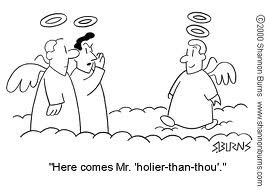 “Holier than thou” is defined by a modern dictionary as, “having a superior attitude or view of one’s self.” It is most commonly used as an accusation against a Christian who calls out sinful behavior. Have you ever been accused of being ‘holier than thou’? If you have, it was probably because you attempted to share Christ with someone. This verse is often coupled with Jesus’ command not to judge lest we be judged, and is used as a defense mechanism by those who are involved in ungodly practices. I think it is worth noting, this statement was actually first used by unbelievers who claimed they were holy enough on their own, and did not need a savior. In fact, anyone who refuses Christ and the cross, is essentially claiming to be ‘holier than thou’.
 I recently attended a communion service where we were encouraged to think back upon who we were and where we we going. My mind immediately took me back to being a carefree young man, who gave no regard to the things of God. I allowed myself to imagine what my life would be like had I continued on that course. I could see myself walking down a road in pursuit of pleasure, only to find that road leading to vanity. We were then encouraged to think about all Christ accomplished for us, and to reflect upon the things He has done in our lives. My mind immediately filled with images that would never have been there had I not said yes to Jesus. I reflected upon my marriage, family, and ministry. Soon my heart began to burst forth in praise, I could hardly contain the thanks I felt for my redemption and the sweet but painful experience of sanctification. Like Isaiah, I wanted to mention the loving-kindness, goodness and mercies of the Lord.
 As Isaiah looked at the present condition of his world, his heart cried out for the Lord to come. He was not alone in this cry, for the apostle John brought the book of Revelation to a close crying out for Jesus to return. Saints throughout the ages have echoed his plea. There will be a literal fulfillment of Isaiah’s prayer; Jesus will return for His church and He will set up His kingdom. That being said, Isaiah’s prayer has a much broader scope as well. I have found myself, on multiple occasions, praying for God to rend the heavens to meet with me. In times of quiet prayer, as I am about to face a situation that I know I am less than equipped for, my heart pleads for God to rend the heavens and meet with me. In times of corporate worship, as I lift my voice and raise my hands, I often cry for Him to rend the heavens to minister to His church.
 The purpose of the teachings of God’s Word is not simply information. We should not expect a test when we arrive in heaven or a pop quiz along the way. Instead, we learn the Word so we might behave right. Sound doctrine must lead us to sound living. Elsewhere, we read of the doctrine that accords with godliness. When our understanding of God is correct, we will worship, live, act, react and speak in ways that are pleasing to God. Here, Paul exhorts Titus to speak properly. While proper speaking would include praise, evangelism, and encouraging others, it also avoids gossip, slander, backbiting and complaining. Paul is referring specifically to the things Titus would be teaching within the church. He divides the body into groups based upon age, gender and vocation; encouraging proper behavior from each of them.
 Jim Gallagher