Ezra 5:2
“So Zerubbabel the son of Shealtiel and Jeshua the son of Jozadak rose up and began to build the house of God which is in Jerusalem; and the prophets of God were with them, helping them.”
 Not long after returning to Jerusalem, the people became greatly discouraged in the work of the Lord. Things were moving slowly, and they were facing a great deal of opposition from those around them. Soon, the work of the Lord ceased all together. It is worth noting what encouraged the people to resume the work, and finish the task to which God called them. We read simply, “the prophets of God were with them, helping them.” The help was provided in the form of exhortations to the people to continue in the work of God.
From the book of Haggai, we learn these discouraged people neglected the work of the house of God, and their efforts were spent building and remodeling their own homes. It seems they were experiencing the effects of having a divided heart. They had expressed a desire to help further the kingdom of God, only to be sidelined with pursuits of their own. Haggai’s message was simple,
Haggai 1:4 “Is it time for you yourselves to dwell in your paneled houses, and this temple to lie in ruins?”
I wonder how often we have found ourselves in the same situation. The difficulty of serving the Lord has caused us to neglect ministry. Perhaps all we need is a solid nudge to get back to work. Whatever we are facing, it is time to get involved in the work of the Lord.
Once the people determined to get back to work, they faced the same struggles which caused them to quit in the first place. The work was still difficult and the opposition great. It was at this point that Zechariah added to Haggai’s message. He declared,
Zechariah 4:6 “This is the word of the Lord to Zerubbabel: ‘Not by might nor by power, but by My Spirit,’ says the Lord of hosts.”
For years our yard was a mess. A hurricane had leveled trees, and a broken irrigation system caused nothing but the weeds to grow. My approach was to ignore it; I felt the job was just too big. After an extended period of time and gentle nudges from my wife, I finally decided to tackle the project; only to find I lacked the strength to accomplish it on my own. I quickly found I was not really on my own. Upon making a couple phone calls, others came to my aid. They helped remove tree stumps, weeds and unwanted thorn bushes. Too often, we neglect the work of God because it is too much for us to handle; not realizing we are not, in fact, on our own. The Spirit of God will always provide whatever we need, to do whatever He has called us to.
Pastor Jim
 The bible is filled with great and precious promises. Of these, the one recorded here may be the pinnacle. For the past two thousand years countless saints, facing a vast array of difficulties, have clung to this promise and found God to be ever faithful to His word. The promise itself is both simple and all encompassing. We are told, God is able to create good out of all things that life throws at us.
 Ezra tells the story of the children of Israel returning to Jerusalem, at the end of seventy years of captivity in Babylon. We find that while hundreds of thousands were taken captive, less than fifty thousand returned. I am relatively certain that many should have returned that didn’t, but we are also given insight into the ones that were willing to leave all and take up the challenge of engaging in the work of God.
 “Thus says The Lord” is a very common phrase in scripture. All in all, it is used over four hundred times. We find God speaking to priests, prophets, kings and commoners. It becomes very clear that the problem is rarely with God being silent, and is more often with man refusing to listen and obey.
 This chapter records the successful military endeavors of King David. We read of his defeating, or subduing, at least eight separate kingdoms, as he established Israel among the strongest of the nations. His military exploits resulted in peace and prosperity for Israel, and the entire region. However, I think it is worth noting that while we read, “David attacked, David defeated or David subdued”, scripture makes it clear, he did none of these things on his own. His exploits were accompanied by both the presence of the Lord and a host of faithful men. As the chapter concludes, we read of Joab, Jehoshaphat, Zadok, Abimelech, Shavsha, Benaiah and David’s sons, all of whom served alongside the king, making this success possible. David started out as a Lone Ranger, stepping into the valley of Elah when no one else would, but as time went on, a host of others teamed with him to accomplish the work of God.
 As I read through 1Chronicles, I am struck by the heroic actions of those who served alongside king David. His reign led Israel to the height of their success as a nation, and resulted in establishing peace with the surrounding nations. This success was not accomplished alone, but was a result of heroic men who stood tall in the midst of great difficulty and opposition. This seems to always be the case. One person put it this way, “Heroes are not born they are made”, and it is clear it is the circumstances they faced that made their actions heroic. In other words, Heroes are made when men and women stand up against insurmountable odds and risk their own lives for the sake of others.
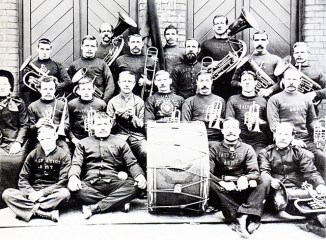 What an interesting phrase, “the service of song.” The word service is a translation of the Hebrew word “Yad”, meaning hand. The idea implies they were putting their hands to the task of serving the Lord with music. When I think of service, I usually think of some sort of labor. Lifting, carrying, working, and sweating are all words that come to mind when I consider service. However, here we are reminded, service can be as simple and as sweet as offering a song.
 Building the Temple was a massive undertaking. It was to be a structure like no other. Unlike the pagan temples that were built in an attempt to reach up to the gods, this temple was built so God could reach down to man. The entirety of this structure pointed to the fact that God made a way for sinful man to have relationship with a holy God. As soon as a person approached the temple, they would smell the sacrifices, and be reminded of their need for a substitute to die in their place; removing the guilt and penalty of sin. These sacrifices provided a temporary covering, and pointed forward to Christ, who would die once, for the sins of all. Without question, this was the most important building of the ancient world.
 As the sun begins to set on David’s life, he begins to recall how faithful the Lord has been. As king of a nation surrounded by hostile adversaries, he was faced with constant battles. With the poetic expression he became known for, he attributes his success to the Lord. It was never his strength that led to victory, but the enabling work of God.
 As the sun begins to set on Joshua’s life, he has yet, another encounter with the Lord. This time God refers to the age of his servant and to the work he is doing. Joshua is reminded that while he is old and has accomplished much for the kingdom, there still remains very much land to conquer and possess. The application of this truth for Joshua was that he needed to gather the tribes together and exhort them to get busy, finishing the work he had started. The application for you and me is that there is a lot God still wants to do in our lives, no matter how long we have walked with Him, or how much we have accomplished.
 Jim Gallagher