Isaiah 65:5
“Who say, ‘Keep to yourself,
Do not come near me,
For I am holier than you!'”
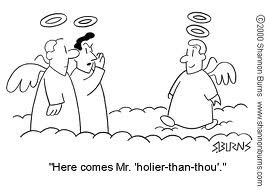 “Holier than thou” is defined by a modern dictionary as, “having a superior attitude or view of one’s self.” It is most commonly used as an accusation against a Christian who calls out sinful behavior. Have you ever been accused of being ‘holier than thou’? If you have, it was probably because you attempted to share Christ with someone. This verse is often coupled with Jesus’ command not to judge lest we be judged, and is used as a defense mechanism by those who are involved in ungodly practices. I think it is worth noting, this statement was actually first used by unbelievers who claimed they were holy enough on their own, and did not need a savior. In fact, anyone who refuses Christ and the cross, is essentially claiming to be ‘holier than thou’.
The fact is, the cross declares, universally, that all of mankind is not holy on their own. As Jesus pleaded with God in the garden of Gethsemane (Matthew 26:39), we realize salvation is not possible apart from the cross. It is there, and there alone, where sin can be pardoned. If we do not see our need for Christ as our Savior, we are confused about who God is, and who we are. If we truly examined the God of Scripture, we would find He is holy and just, and must judge sin. If we truly examine ourselves, we will find that we are sinners in need of salvation.
Instead of ignoring sin and thinking you are fine the way you are, take your sin before the cross and allow Jesus to wash you and make you new.
Pastor Jim
 “The Branch of the Lord” is a messianic title, meaning it is a description of Jesus our Savior. This phrase is used often by the prophets to speak of the work of Christ.
 When I was a child, my family lived in a house located at the bottom of one hill, and the top of another. Whenever one of the neighbors up the street would wash his car, a flowing river would form in the gutter outside the house. I can vividly remember using the debris to create obstacles, rapids, and even dams. I would run up the street with small plastic boats filled with passengers and drop them into the river. As they traveled downstream, they would be tossed about by the currents heading towards the rudimentary dam designed to stop them. Often, the flow would become so strong the dam would burst, sending the toy boat and its occupants rushing toward a large drain that went deep underground to the sewers. Frantically, I would run after the small boat, hoping to rescue it from impending doom. Whenever I read Paul’s description of the world, found in Ephesians 2, I am reminded of those toys heading toward destruction, and my frantic attempts to rescue them. Paul describes every person who has not yet received Jesus Christ, as being like a dead body floating downstream, and heading for eternal loss. He also describes God as the great Savior, who reached down to rescue all who will cry out to Him.
 The city of Samaria was under siege. The Syrian army with all it’s forces, had surrounded the city, and was starving out the people. The difficult times had caused the people to behave in deplorable ways. Sins so repulsive they are difficult to mention, ran rampant throughout the city. Within this scene, we read of four men living on the outskirts of the city. These men were lepers who were no longer living, as much as they were waiting to die. In this condition, they looked at one another and determined, starving to death was a worse way to die than being a Syrian POW. As a result, they decide to leave Samaria and surrender to the Syrian army.
 Jesus was magnetic! People from all walks of life were drawn to Him. Lepers, paralytics, rich men, beggars, fishermen, and even Pharisees were drawn to Jesus; to meet Him, hear Him speak, and be touched by Him. At times, we read of massive crowds that gave up all other pursuits, to listen for hours as He spoke about the Kingdom of God. What was it that drew people to Him? John tells us that His life was like a light in the darkness.
 Jim Gallagher