Psalm 74:1
“O God, why have You cast us off forever? Why does Your anger smoke against the sheep of Your pasture?”

Asaph describes Jerusalem being ransacked by Israel’s enemies. The sanctuary is being defiled and the city is destroyed. While this is happening, Asaph remembers the ancient victories wrought by God. He speaks of how God has;
Divided the seas
Broken heads of Leviathan in pieces.
Broke open the fountain and the flood.
You dried up mighty rivers.
Prepared the light and the sun.
Made summer and winter.
This causes him to ask why God had cast off His people. The answer is, God cast them off because they had turned from Him to serve other gods, and pursue their own ways. For years Israel ignored the warnings of the Word and the prophets, in order to continue in lifestyles that were abhorrent to God, and destructive to themselves. After years and years of extending His mercy, the time came when God allowed the enemies to defeat His people, as a form of judgment for their sins.
The same is true today. When we continually cast off the word of God to live however we want, we will find ourselves living in defeat rather than victory. We will one day look up and wonder how such a mighty God could allow such hardship in our lives. In some cases, the answer is that we have brought this upon ourselves, by ignoring God and His ways. It is always shocking to hear someone, who gives little regard to the ways of God, suddenly blame God or become angry with Him, when their life is suddenly met with upheaval. It may be that the difficulties you are facing are the consequences of ignoring God and are designed to awaken you so you will return to Him. It was after his world collapsed, that the prodigal son ran home to his father.
While God cast off Israel, He did not do so forever. Paul wrote,
Romans 11:1 “I say then, has God cast away His people? Certainly not! For I also am an Israelite, of the seed of Abraham, of the tribe of Benjamin.”
God has a future plan for Israel and He has one for you. No matter what your past has been, or how difficult your present might be, God has a plan for your future. It is possible for you to turn your life over to Him, be forgiven, and allow Him to redeem your life and use you for His glory.
Pastor Jim
Questions for Psalm 74
- In verse 10 David talks about the work of the enemy. How often do we feel like the work of the enemy is too great to handle? What can we do to find comfort?
- After David talks about the bad things the enemy has done, he says all the wonderful things God does (verse 12-15). What are some wonderful things God has done in your life?
 After seventy years of captivity Israel was allowed to return to the land and begin to rebuild their broken down Temple. Millions had been taken captive and only a fraction returned to get the task started. Even those who returned had become discouraged and had forsaken the work. It is in this setting that Zechariah declares,
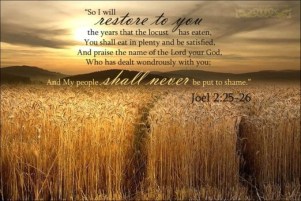 Sadly, the people of God had once again wandered from their God. The allure of idolatry, with its lack of morality, had seduced the people. They were now distant from God and beginning to suffer the consequences of a life lived apart from Him. Once again, the mercy of God is revealed as Joel encourages the people to turn back to YHWH and be restored. He explains the way back and the results.

 One of the primary themes of Paul’s letters to the Thessalonian church is the return of Jesus Christ. Paul lived with the expectation that Christ would return in his lifetime, and urged others to always be on guard. He had warned in his first letter that, “the day of the Lord so comes as a thief in the night” (1 Thessalonians 5:2). Looking around at the condition of the world they lived in, through the lens of Biblical prophecy, had caused some of them to be alarmed, and even gripped with fear. Paul mentions how they were shaken in mind and troubled. The term ‘shaken’ would describe a ship being tossed to and fro by the raging seas. The word ‘troubled’ carries the idea of crying out for help. Paul had written to a group of Christians facing turbulent times, with the purpose of encouraging them with the “blessed hope and glorious appearing of our great God and Savior Jesus Christ.” Yet the message designed to give them hope, had actually robbed them of peace, filled them with fear, and was causing them to cry out in despair.
 We are living in uncertain times. Violence rages in the Middle East, the threat of terrorism continues, even increases, despite all of our efforts to eradicate it, the rising threat of hostile nations developing nuclear capabilities, not to mention the domestic violence and uncertainty we face on our own soil. Just today, the headlines on some popular news sites include: “New York store owner funded ISIS,” “South Korea detains Americans,” at least 220 killed in a day in Syria.”
 Warning signs are all around us, cautioning us to beware of potential hazards. These signs warn the floor is slippery, the curve, sharp, the beam is low, or the dog is mean. As I sit here writing, my teacup reads, “Careful, the beverage you are about to enjoy is extremely hot.” Which seems obvious to me, since I did not order an iced drink. On the beaches in our community, there are signs warning of what to do in case of a tsunami; although we have never been hit by a tsunami, and experts tell us that the likelihood of such an event happening is almost zero. Because these warnings are so commonplace, we can become desensitized to them, and miss the ones that really matter.
 The stones that formed the Temple were massive. Their sheer size represented permanence. For the disciples, it would be difficult to imagine them ever being destroyed. When Jesus declared that a time was coming when the Temple would be leveled, the minds of the disciples jumped to the future. They asked;
 Jacob again hears the voice of God. This time he is being called to return to a place called Bethel, meaning “House of God.” This was the site of Jacob’s first encounter with the Lord. There, he had been the recipient of the great and precious promises that revealed the plans and purposes God had for his life. Decades have since passed, and Jacob has grown from a lonely bachelor, to a large and prosperous family. Jacob returns to the place where he had made a commitment to the Lord.
 As we read the story of Abraham, we find erecting altars was a regular part of his walk with God. On five separate occasions, he took time to build an altar and call on the name of the Lord. These altars were tangible ways for Abraham to express his commitment and devotion to the Lord for all God had done for him. The story behind this altar is of particular importance, as we seek to walk with God.
 Jim Gallagher