Psalms 64:2-3
“Hide me from the secret plots of the wicked, from the rebellion of the workers of iniquity, who sharpen their tongue like a sword, and bend their bows to shoot their arrows—bitter words”
David found himself on the receiving end of a barrage of carefully planned attacks. Like an army of well-trained soldiers who had rejected God, they came against the righteous. Their weapon of choice was not the sword, spear, bow or staff, but the tongue. Things have not changed much. The most effective weapon against the righteous today is the tongue. If a person takes a stand against the unrighteous trends that are being heralded as freedoms in our world today, they will receive an onslaught of verbal attacks. Should you decide to boldly declare the Gospel of Jesus Christ, calling sinners to turn to God, you will need to be ready to hide beneath the shelter of the Almighty, because attacks will come. This is not a new phenomenon, the early church experienced the same things. As they declared the message of Christ, those with the loudest voice sought to silence their message.
Acts 4:17 “But so that it spreads no further among the people, let us severely threaten them, that from now on they speak to no man in this name.”
Instead of cowering under the threats, the church gathered together and sought the Lord to embolden them to share Christ, regardless of the consequences.
Acts 4:29 “Now, Lord, look on their threats, and grant to Your servants that with all boldness they may speak Your word.”
The times we are living in are not times to be silent. The world is in a downward spiral because the devil wants to destroy the lives of all men. People are being led into destructive lifestyles that will have life long consequences, and we need to boldly declare the Gospel of Jesus Christ, because it alone has the power to save.
Perhaps more than ever, we need to remember the words of Jesus,
Matthew 10:28 “And do not fear those who kill the body but cannot kill the soul. But rather fear Him who is able to destroy both soul and body in hell.”
Pastor Jim



 On a night that probably started out like every other night, Pharaoh’s life was suddenly interrupted by the Divine. While sleeping, he had a dream, so vivid, he realized it must be a message from God. After unsuccessfully searching for the meaning, he was introduced to Joseph, who, under the influence of the Spirit of God, was able to explain the meaning of his dream. Without going into the details, we find that God revealed the future to Pharaoh. He was told what was coming and given the opportunity to prepare in advance.
 The sermons from Haggai and Zechariah stirred the people to return to the work of rebuilding the Temple. Because of their dedication, it did not take long before walls were erected and priestly ministry restored. The completed Temple had a dual affect upon the people. Some celebrated, while others wept. Those who wept did so because they remembered how glorious Solomon’s Temple had been, then they looked at the rudimentary structure they had built to replace it. Haggai’s message was directed to them. He declared, this new Temple was actually more glorious than the one it replaced. It’s glory was not in the expense required to build it, or in its intrinsic value, but in what would take place within it.
 Over the past year we have seen summits on global warming, protests against the cruelty to animals, and the unjust treatment of certain groups of individuals. It is clear that people feel justified in demanding the ethical treatment of the planet and its inhabitants. While it is clear that we bear a responsibility before God for the way we treat what He has given us to care for, it is also true, we can become consumed with other things and forget that the most valuable, and often most neglected resource in the world, is the human soul. Jonah wept over the mistreatment of a plant and cared little for the eternal souls of the inhabitants of Nineveh.
 The story of Jonah has two main themes. The first is to reveal the heart of God for the lost. However, before this can be fully developed we are introduced to the second theme, the disobedience of Jonah. Three of the four chapters teach us of the sin and suffering of a wayward prophet. His is the story of a man who experiences unnecessary suffering that could have been avoided through simple obedience.
 Amos, the shepherd-prophet, saw two consecutive visions that revealed the impending disaster looming over the nation. The first was a swarm of locust that would come just prior to harvest time. History records massive swarms of locusts in and around Israel, that had devastating affects upon the land, the people and the economy. One such incident describes a swarm so great, it devoured every crop in he field, took the bark off the trees, and even the thatch off the roof of many homes. The only thing that stopped this deadly swarm, was when they finally reached the Sea. So many locust died in the waters that a plague broke out and thousands of people died. The second vision was that of a fire that would consume the land. If these visions were fulfilled consecutively, the devastation would be catastrophic.
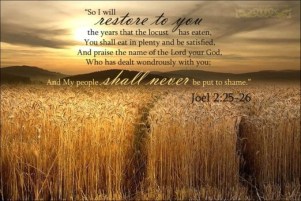 Sadly, the people of God had once again wandered from their God. The allure of idolatry, with its lack of morality, had seduced the people. They were now distant from God and beginning to suffer the consequences of a life lived apart from Him. Once again, the mercy of God is revealed as Joel encourages the people to turn back to YHWH and be restored. He explains the way back and the results.
 Jim Gallagher