Revelation 1:18
“I am He who lives, and was dead, and behold, I am alive forevermore. Amen. And I have the keys of Hades and of Death.”
 The final book of the Bible is aptly called Revelation, for it is a compilation of things that were revealed to John while banished to the Island of Patmos. In it, we will be given key insights into the future, but before the future is described, John takes time to describe Jesus. Instead of seeing the humble carpenter, meek and mild, John describes King Jesus in all His splendor and glory and refers to Him as “the ruler of the kings of the earth.” As ruler, Jesus declares He holds in His hands the keys to hell and death. As I read this, I have to ask, why would Jesus unlock the door to hell?
We have all seen the images of satan as the king of Hell, ruling over the fiery underworld. That image is not found anywhere in the Bible, but is taken from Greek mythology where Hades, the brother of Zeus, rules as a tyrant over the dead. The Bible paints an entirely different picture. Satan is not the king of Hell, but will be the chief prisoner. After all the havoc he has caused upon the earth, he will one day be bound and cast into the lake of fire. There he will forever pay for his rebellion against God, and the destruction he has caused mankind. The key in the hand of Jesus is used to unlock the door of hell to imprison the devil and his cohorts.
There is another reason why Jesus holds this key. The Bible teaches that, prior to coming to Christ, we are held captive to sin. Like a prisoner of war held behind enemy lines, we are bound in our sin and have no way of escape. Jesus holds the key; the way of escape out of sin and it’s penalty. Whenever, whoever, and wherever we are, when we call upon Christ, we are set free from sin, death and judgment, and given the free gift of eternal life. Jesus is the one who unlocks the door and sets us free.
Whatever sin may have its grip on you, if you cry out to Christ, He will set you free.
Pastor Jim

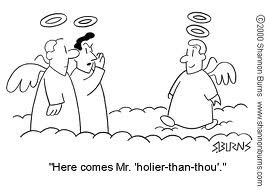 “Holier than thou” is defined by a modern dictionary as, “having a superior attitude or view of one’s self.” It is most commonly used as an accusation against a Christian who calls out sinful behavior. Have you ever been accused of being ‘holier than thou’? If you have, it was probably because you attempted to share Christ with someone. This verse is often coupled with Jesus’ command not to judge lest we be judged, and is used as a defense mechanism by those who are involved in ungodly practices. I think it is worth noting, this statement was actually first used by unbelievers who claimed they were holy enough on their own, and did not need a savior. In fact, anyone who refuses Christ and the cross, is essentially claiming to be ‘holier than thou’.
 Sheol is an Old Testament word for the abode of the wicked in death. The New Testament uses the words “Hades,” “Tartarus,” and “Gehenna.” Although different words are employed, they all refer to the final resting place for those who reject Christ, and as a result die in their sins. Isaiah gives a sobering picture when he writes, “Sheol has enlarged itself…” Suggesting that the boundaries of hell are expanding because of the unwillingness of people to respond to the call of God and the cries of the prophet. There are a few things we need to keep in mind.
 Between man and God there is a great gulf of separation. This gap is caused by sin, and makes it impossible for us to have fellowship with God. This is precisely the reason Jesus came. He bled and died on Calvary’s cross to bridge the gap; to make it possible for us to know God now, and spend eternity with Him. This life will come to an end, and when it does, only what we have done with Christ will really matter. In this story, the rich man reveals what happens to those who refuse Christ. Not only do they live separated from God, but they die that way.
 We have come to the most solemn and most important of all Biblical events. The entire life and ministry of Jesus, as well as the whole of human history, has been leading up to these events. Jesus declared, no one could take His life, but that He would lay it down (John 10:18). That day has finally arrived. Without a fight, Jesus, the creator and sustainer of heaven and earth, was taken by the mob, condemned by the the courts, beaten by the soldiers, and nailed to the cross. There on a cross of wood, amidst the clamor of the mob, He would bear the penalty for the sins of all humanity. Louder than all the jeering of the mockers, the laughing of the soldiers, the accusations of the pharisees and the weeping of the disciples, rang out the cry “My God, My God why have You forsaken Me?”
 Jim Gallagher