Job 19:25-26
“For I know that my Redeemer lives, And He shall stand at last on the earth; And after my skin is destroyed, this I know, that in my flesh I shall see God”
 Sometimes, the only comfort for the difficulties we face, is knowing where we are ultimately going. The sorrow Job faced could not be eased by the joys of this life. His only hope was to look beyond the boundaries of the temporal, into the glories of the eternal. Whatever we are facing today, if we have received Christ, we can be sure there is a day coming when we shall see God. Then, all the pains of this life will be consumed with the glories of eternity. Job reminds us of a few important truths that should keep us going during our darkest hours.
First, Job declares, our Redeemer lives. The grand message of Scripture is, Christ died for the ungodly. While we were yet sinners, the Son of God laid His life down for us. His death was substitutionary, meaning He died in our place. It was there, on the cross, where Jesus bore the penalty for sin so we might be forgiven. We know death could not hold Him, the grave could not keep Him. On the third day, He rose from the dead, conquering sin, death and hell. He ultimately ascended to the right hand of God the Father, where He lives to intercede for us and await our arrival.
Second, Job declares we will one day see God. So much of the difficulty we face, comes about because sin has marred our ability to see God. Everything we know about Him is found in the pages of His Word. However, we struggle to believe much of Old Testament, because we look at Him through the lens of personal experience, pain and loss. We wonder how a God of love could allow us to go through so much suffering. Isn’t it wonderful to know, a day is coming when the veil will be removed, and we will see Him face to face. All the questions which plague us will be answered, and we will know, as we are known.
Whatever you are facing, understand it will one day run its course, and we will stand together before the throne of Grace. On that day, rewards will be given revealing how we trusted Him through the times of trial. Until that day, we should seek to get to know Christ and share Him with others.
Pastor Jim
 When I was sixteen years old, driving to my first part-time job, a wild thought entered my mind. I thought, “I wonder what happens after we die?” I realized later I was grappling with one of the deepest philosophical questions man has ever attempted to answer, but at that time I had never considered anything like it before. As quickly as the question entered my mind, I came up with an answer, “When we die we go to heaven.” This was followed by the question, “What is heaven?” To which I answered, “Heaven is getting to do whatever you want for all of time.” I then asked a third question, “Who goes to heaven?” To which I replied,”Those who are good.” This of course brought me to a final question, “Who is good?” My final answer was a little more difficult to develop, but there on the way to work, I determined that I was good and anyone who lived up to my standard was also good and would be allowed into my heaven. In the few minutes that it took, I had asked and answered the most important questions that a person will ever be asked. I had also completely satisfied myself with my answers. Had anyone asked me what happens after we die, I would have spoken with authority, explaining the way to heaven and the purpose of life. As you can see, there was one obvious problem; it was all a product of my own imagination! My way of living, my heaven, even my god, were the product of my own imagination.
 As we read through the Word, it is important to remember the chapter breaks were added later to make it easier to find specific passages. At times, they can create a break in thought not intended by the author. This often causes us to miss something vital in the text. The thoughts of Romans 8 are an obvious conclusion of what Paul declared in Chapter 7. He referred to himself as carnal, a word meaning worldly; and wretched, meaning deeply afflicted, or extremely bad. The reason for his dire view is that he found himself incapable of living a proper Christian life. The Word of God clearly expresses the kind of life which pleases God, and the particular behaviors, thoughts, desires and actions that are regarded as sinful. By his own admission, Paul knew what was right, but lacked the power to accomplish these things. He writes,
 Much of what the Bible says is revolutionary. There are statements, not just shocking to us, but to every generation that ever lived. Jesus spoke to his disciples saying, “If anyone desires to come after Me, let him deny himself, and take up his cross, and follow Me. For whoever desires to save his life will lose it, but whoever loses his life for My sake will find it.” Matthew 16:24
 Paul boldly declares, because of the manifold grace of God, it is unreasonable for a Christian to continue living in sin. He explains why we should put our old lives behind us, and also gives practical steps on how that is to be accomplished. Notice, he explains what happened to us when we received Jesus Christ. Declaring, we were buried with Him through baptism into death.
 Josiah’s story is a common one. While few have ever been king of a country, everyone who has responded to the Lord has walked a similar path as he did. First, Josiah made a decision to follow the Lord. This decision soon led him to a discovery of the Word of God, which in turn led him to make dramatic changes in his personal life, and his sphere of influence. We read that after he made a stand for the Lord, he called others to stand with him and,
 The Gospel was the favorite subject of the Apostle Paul. He used the term four times in the first chapter of Romans, 15 times in the book, and a total of 71 times in his writings. It was the subject of every letter he wrote, and every message he preached.
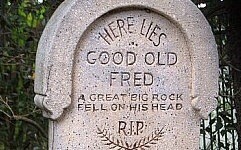 I can remember as a child, standing in line to enter Disney’s Haunted Mansion. While I have forgotten most of the details about this particular attraction, the epitaphs on the gravestones left an indelible mark on my memory. One read, “Here lies good old Fred, a great big rock fell on his head.” Another read, “Dear departed brother Dave, he chased a bear into a cave.” I wonder what will be said of me when my time reaches it’s end.
 When we are young we think we will live forever; death, even aging, is for other people. As we age, we still cannot imagine a world of which we are not a part. Yet, the Psalmist is making clear, we have been designed by God with a shelf life. In other words, one day we will expire. The bodies that we live in will no longer be able to sustain life, and we will move on to an eternal habitation. James put it like this, “For what is your life? It is even a vapor that appears for a little time and then vanishes away ” (James 4:14). The word ‘vapor’ is defined as, “diffused matter floating in the air impairing its transparency.” In other words, a vapor is only slightly more than nothing. It speaks of the fact that life on earth is transitory, not permanent. This does not mean that life is meaningless.
 When Jehu became king of Israel, he went on a rampage against those who had been loyal to Ahab, and his ungodly ways. At first glance, he seemed to be purging the nation to get the people ready to follow and serve the Lord. However, as time went on, it became clear that Jehu was only willing to go part way with the Lord. He removed some things, but failed to replace them with good. Today, it is not difficult to find people who approach their relationship with God just like Jehu did. They are those who are willing to go part way with the Lord, making a few changes, but are not willing to surrender all.
 Jim Gallagher