Psalm 70:4
“Let all those who seek You rejoice and be glad in You; and let those who love Your salvation say continually, ‘Let God be magnified!’”
 We can never be sure what the day in front of us holds. We can each testify of times in life, where our days were suddenly interrupted with something good or something bad. A phone call, text, email, or visit to the doctor, can suddenly change the course of our day and even our lives. David exhorts us that regardless of what life throws our way, we should always respond by magnifying the Lord.
The word magnify has two related, yet almost opposite, meanings. In certain cases, it can mean to take something that is too small to see and enlarge it. Scientists use highly advanced microscopes to look at things hidden from the naked eye. However, the word magnify can also mean to take things that are too far away to see and bring them closer. Years ago, my wife and I were walking around an outdoor mall in Southern California where a large telescope had been set up in the courtyard. For a few dollars, we were able to use it to look at the moons of Jupiter. What was impossible to see, suddenly came to light. Magnifying God is like using a highly sophisticated telescope to bring the person and work of God into view in our daily circumstances.
It is quite common for us to question God when our life is interrupted with unsettling circumstances. It is during those times that it is all the more important to fix our eyes upon the Lord, and begin to magnify Him. As we look heavenward with hearts of worship, we will be reminded of His mercy, grace, power, love and presence. If you are in the midst of a particularly trying time, perhaps it would do you good to take your eyes of the circumstances, and begin to magnify the Lord.
Pastor Jim
Questions for Psalm 70
- David is pleading with God to come quickly. Have you had those moments when you’re empty and broken? By all means cry out like David did “O Lord, do not delay!”
- In the midst of his turmoil and panic David remembers to do something in verse 4. Can you spot it? Sometimes we treat God like a vending machine and forget to thank Him for what he has done and to worship Him for who he is. Even when we become afraid and terrified– forget not His benefits.
 Psalm 67 was written by an unknown author. We cannot know for sure who wrote it or what circumstances influenced its content. The one thing we know for sure is that it was penned by a person with a desire for others to come to the Lord. He pleads with God for mercy in his own life, in order that the world around him may come to a saving knowledge of God. The Psalmist is not alone in this. Paul declared
 Where we can go to see God work?
 We cannot be certain of the occasion that stirred David to write this psalm. It may have been a time of great difficulty, opposition or trial. He may have been facing severe attacks from Saul, the Philistines or one of the neighboring kingdoms. It is also possible the struggles he faced were not external. It may have been that David was engaged in that great inner struggle between his desire to do what is right in the eyes of God, and his own human weaknesses. Whatever caused the dilemma, he concluded that the only solution was to cry out to the Lord. Crying out to God should include at least three things.
 Sometimes knowing the setting in which a psalm was written is beneficial to understanding its content. Other times, like in this psalm, the setting is not given because the truth is universal. Whatever our condition, whether we would classify it as good or bad, blessing or trial, God remains the same and is always worthy of the highest praise. The truths tucked away in this psalm transcend every experience the child of God endures. Whatever state you are currently facing, it is a good idea to clap your hands and shout out the loudest praise.
 There are times in life when words seem like a raging fire building within us and we are almost forced to speak. This can be positive, like when Jeremiah wrote of being so discouraged he no longer wanted to share the words of God with anyone, until those words became like a fire within him and he could no longer contain them. Or this can be negative, like when gossip burns within us, pleading to be passed on to others; or when in the midst of an argument, we lash out with hurtful words that shatter someone we love.
 In this Psalm, we find David enduring the consequences of sin. Like all of us, he was drawn into something forbidden and chose to trespass, because sin always makes promises it cannot keep. He was, no doubt, hoping to find some level of pleasure by disobeying the law of God. Whatever enjoyment he derived from his sin, was soon eclipsed by the pain and sorrow sin always brings. Here we find David in travail of soul and under severe attack from his enemies. He describes himself as being pierced by arrows of conviction, being under the heavy weight of guilt, and even undergoing attack from others who think that he deserves the sufferings he is facing.
 We cannot be sure the exact situation that stirred David to write this Psalm, but we do know that he seemed to be under continual attack. From the start, he had to deal with those who continually came against him. His father neglected him, his brothers tormented him, the Giants ridiculed him, the king hunted him, and the neighboring nations sent armies to attack him. As a result, it would be fair to say David was an expert on warfare and he knew how to fight on many different fronts. In this Psalm, he reveals the secret behind his success. When under attack, David looked to God for defense.
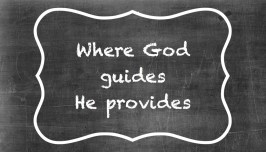 One of the great benefits of being a Christian is the promise that God will provide for the needs of His people. This same truth is repeated throughout scripture in a variety of ways. Abraham heard God say He would be his shield and his reward, the Levites were promised that God would be their inheritance, the widow was told her oil would be multiplied, and Jesus promised to care for us as He does for the lilies and the sparrows. It is not difficult to find promises declaring that God will meet our needs, but at times, it is very difficult to trust them.
 Jim Gallagher