1 Kings 14:26-27
“And he took away the treasures of the house of the Lord and the treasures of the king’s house; he took away everything. He also took away all the gold shields which Solomon had made. Then King Rehoboam made bronze shields in their place, and committed them to the hands of the captains of the guard, who guarded the doorway of the king’s house.”
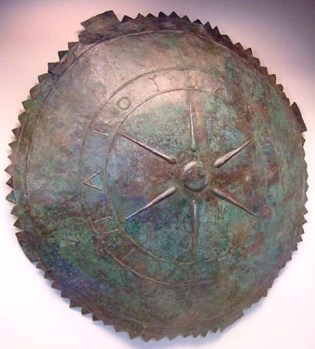 Rehoboam is known for being the king that split the nation of Israel. His greed drove him to make decisions that ultimately divided the kingdom. Sadly however, this was not the worst policy he implemented. During his seventeen year reign, he continued to ignore the Word of God and to introduce idolatry to the nation. As a result, this once powerful nation fell prey to their enemies. Like a shark smelling blood in the water, Egypt saw the weakness of Israel and sent troops to Jerusalem. Their armies easily overcame any and all resistance and began to loot the city. Just a few short decades after the Temple was completed, it was ransacked by foreigners and its prize articles were stolen. Among the items Shishak took, were the golden shields that hung as a symbol of Israel’s strength. Rather than turning to God, Rehoboam decided to hang bronze shields in their place. After all, from a distance, who would really be able to tell the difference. What a different story this would have been if Rehoboam would have fallen on his knees and turned back to the Lord.
Often, when a person begins to backslide, their response is much like Rehoboam’s. Instead of addressing the real issue and focussing upon returning to the Lord, they begin to pretend that everything is fine. Church attendance continues, they may even keep talking the Christian lingo, but they have stopped abiding in Christ and begun to drift from Him. If that describes you, don’t hang bronze shields on your wall, pretending that everything is OK. Call a friend, confess whatever sin you are struggling with, and get back to walking with the Lord. Remember, His mercies are new every morning
Pastor Jim
 Jeroboam had been called and anointed as king of Israel. He was given the same opportunities and promises that David was given. His problem was, instead of drawing near to the Lord, he followed the gods of the surrounding nations, and turned Israel away from the Lord. God, in His unparalleled mercy, sent an unnamed prophet to win Jeroboam back to the ways of the Lord. The man of God declared a powerful message of rebuke to the king; and with a stunning show of the power of God, the altar split in two. Jeroboam’s heart had become so hardened, his response was to demand this young man be imprisoned. As the king’s hand stretched forth condemning the prophet, his hand suddenly withered. With a withered hand, and a broken altar, the king pleaded with the prophet to pray for him. Sadly, his prayer was not one of repentance, he simply wanted things restored to the way they were.
 A youth pastor I once knew had a plaque posted on his wall that read, “Hire a teenager while they still know everything.” Every parent and high school teacher can attest to the fact that young people are often stubborn and insist they know better than the generations that have gone before them. I think part of this is God given and healthy. I think there is great value, especially to the church, in allowing a fresh set of eyes to give us a different perspective on how to best approach ministry. That being said, I also believe this can be unhealthy, and even destructive, when it is not curbed and directed by the wisdom of those who have walked before us.
 It is almost eerie to compare the similarities between Solomon and Saul, and Jeroboam and David. As a result of personal sin, Solomon, like Saul, had the kingdom taken from him. While Jeroboam, like David, was chosen by God, to rise to the challenge and lead a new nation. Sadly, both men failed miserably. The root cause of Solomon’s sin is explained earlier.
 Webster’s dictionary defines numerology as “the secret meaning of numbers.” Clearly, as we read through the Bible, we find specific numbers used to emphasize certain truths. The number seven seems to speak of a complete cycle, and is used to illustrate perfection. In the book of Revelation, we read of the “Seven Spirits of God”, which does not mean there are seven Holy Spirits, but refers to the perfect work of the Spirit. The number forty seems to speak of judgment. The children of Israel spent forty years in the wilderness because of their sin, and Paul was beaten by the Jews “forty times minus one.” One was subtracted to show mercy, thus thirty-nine became a number for mercy. In the book of Revelation, we are told that six is the number of man, and the number of the “beast” is 666.
 Seven years, hundreds of thousands of man hours, and countless wealth, was invested in the building of the Temple. When it was completed, it was one of the most glorious buildings of the ancient world. The best architects, builders, artists, and specialist had been commissioned to accomplish a feat that still boggles the minds of historians today. One can only imagine what it must have been like to stand on the Temple mount, looking up at this glorious building, and looking down upon the city of David. Yet, with all it’s splendor, Solomon is struck with the realization, it is simply way too small.
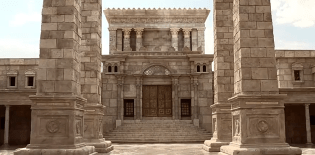 Four hundred and eighty years after entering the promised land the Tabernacle was replaced with the Temple. The Temple was an elaborate structure, sitting above the city of David, on what had been the threshing floor of Ornan. This forty five foot tall building was the prize of Israel, and could be seen from miles away. The inside of the Temple was even more glorious than its exterior. The floor, walls, and ceiling, were made of intricately carved cedar and overlaid in gold. The rooms were decorated with tapestries and furnishings designed by God, and built by he finest craftsmen of the time. It is no wonder the whole nation gathered to celebrate when the Temple was finally completed.
 Building the Temple was a massive undertaking. It was to be a structure like no other. Unlike the pagan temples that were built in an attempt to reach up to the gods, this temple was built so God could reach down to man. The entirety of this structure pointed to the fact that God made a way for sinful man to have relationship with a holy God. As soon as a person approached the temple, they would smell the sacrifices, and be reminded of their need for a substitute to die in their place; removing the guilt and penalty of sin. These sacrifices provided a temporary covering, and pointed forward to Christ, who would die once, for the sins of all. Without question, this was the most important building of the ancient world.
 Solomon was known for his great wisdom. We are told his understanding of psychology, botany and biology surpassed the great teachers of his day. We find people from all over the Middle East would travel to hear him speak, and when they left, they declared that the rumors of his intellect did not do justice to how brilliant he really was. The most remarkable thing about his abilities is where they came from. As we read his Biblical biography, we find these gifts were God-given and purchased through prayer.
 Throughout his life Solomon showed evidence of his love for the Lord. He wrote three thousand proverbs to instruct young men how to walk pleasing to the Lord. Although only a few remain, we are told he also wrote over one thousand songs. Because of the influence of his father, it is safe to say, most of these would have been songs of worship. Solomon also spent the early years of his reign building the Temple, so Israel would have a permanent structure in which to worship he Lord. All of this attests to the statement that, “Solomon loved The Lord.” The problem arises when we continue reading the verse and find, along with his love, he had what the text calls “an exception.” Solomon loved The Lord except…”
 Jim Gallagher