1 Kings 22:7-8
“And Jehoshaphat said, ‘Is there not still a prophet of the Lord here, that we may inquire of Him?’So the king of Israel said to Jehoshaphat, ‘There is still one man, Micaiah the son of Imlah, by whom we may inquire of the Lord; but I hate him, because he does not prophesy good concerning me, but evil.’ And Jehoshaphat said, ‘Let not the king say such things!’”
 Syrian forces occupied land that belonged to Israel and Ahab was determined to get it back. When Jehoshaphat, king of Judah, arrived for a visit, Ahab seized the opportunity to enlist Judah as an ally in his campaign against Syria. Not wanting to bring his people into an unnecessary war, Jehoshaphat wanted to take a moment to hear from the Lord, so he asked to hear from a prophet. Ahab paraded a host of prophets before the king who all declared victory in battle. The problem was, they were not prophets of God, but were a variety of fetish priests who worshiped idols. Jehoshaphat objected to their counsel and sought to hear the Word of God. It is here where the true heart of Ahab is revealed. He declares,
“There is still one man, Micaiah the son of Imlah, by whom we may inquire of the Lord; but I hate him, because he does not prophesy good concerning me, but evil.”
The king of Israel had no interest in hearing the truth. In fact, as the story unfolds, we find that Micaiah will be thrown in prison for speaking the word of God. Ahab’s desire was to silence anyone who did not declare the truth as he saw it.
What a sad parallel to much of what we see happening in our world today. We have accepted a worldview where tolerance is the highest form of morality. We are required to accept the choices people make as though every choice was equal, and those who would dare speak out against certain behaviors as immoral, are immediately silenced. The approach of silencing the word of God was not good for Ahab and Israel, and it will not turn out positively for us either.
Proverbs 14:34 “Righteousness exalts a nation, but sin is a reproach to any people.”
Pastor Jim
 If you are a parent, you understand conditional promises. Almost daily you find yourself saying things like “If you keep your room clean, then…” Or “if you get good grades, then…” Basically you are declaring that if certain conditions are met, certain rewards will be given.
 Solomon’s reign was the golden age for Israel. David’s exploits had created peace, which allowed for the economy to flourish and the nation to go through a building boom. Across the landscape, Israel was building lavish structures for the king and his kingdom. When it came time for the plans to be enacted and the work to begin, Solomon brought in a skilled builder from Tyre named Huram. The text gives us three interesting details regarding this man. First He was filled with wisdom, second he was skillful, and third he was the son of a Jewish woman and a man from Tyre. Tyre was a Phoenician city on the Mediterranean coast north of Israel. This meant it is likely that Huram was the son of a believing mother and unbelieving father. Like Timothy, he would have grown up in a mixed home. This often creates confusion in children, but in this case, he grew to be mightily used by God for the kingdom, by using his talents for the Lord.
 This is certainly not the only record of Ahab’s sin. He was a man who long ago had given up on any desire to live a life that honors the Lord. This passage does however illustrate, quite strongly, the question asked by Jesus, when He said, “What will a man give in exchange for his soul?” (Matthew 16:24)
 Israel was facing almost certain annihilation; the forces of Syria had mounted against them and poised to attack. The troops and resources of Syria far outweighed that of Israel; and in a word, things looked bleak. It was with this backdrop that we are introduced to an unnamed prophet, who brought an almost unbelievable message. The message was that God would deliver Israel from the threat and he would do it through the young and inexperienced leaders.
 Elijah was a man devoted to God. Publicly and privately, he showed commitment and faithfulness to the Lord. His most recent experiences had led him to a face-to-face conflict with the one who most opposed the ways of God. After experiencing great personal victory, Elijah was plagued with a deep depression. He felt as though he could no longer continue serving the Lord, for the opposition was simply too great. Instead of surrounding himself with others who loved and served the Lord, Elijah isolated himself, and his depression grew deeper and darker. The farther he ran, the worse things became, until he found himself miles from home, cowering in a deserted cave, deep in the wilderness.
 For thousands of years, men have stood in the valley of decision, unwillingly to make a complete commitment to the Lord. Fear, guilt, weakness, sin, and the influence of others, hold us back from surrendering to the Lord. The words of Elijah are as needful today as ever. He calls us to carefully consider the Lord, and make a decision to commit our lives to Him.
 Sometimes, God chooses the most unlikely candidate as His teaching vessel. Here, and again in New Testament, we find poor widows, with almost no resources, being used to illustrate the principle of giving.
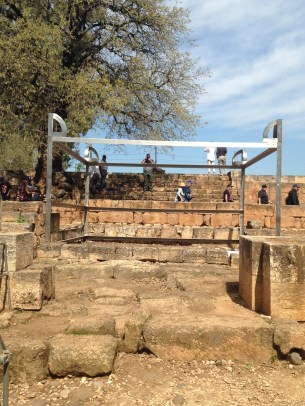 If a traveler from a distant land were to arrive in Israel during the reign of Ahab, there would be little to convince him that these were a people chosen by God. If he entered from the north, the first thing to catch his eye would have been a massive altar built on a high hill in the area of Dan. This altar was erected to give worship to a massive golden cow the people revered as their god. If he came from the south, he would see a similar site erected in Bethel. If he made his way into the heart of the nation, to the newly built city of Samaria, he would find the focal point of the city was an altar built to Baal, the god of fertility. If our traveler were to continue through the towns and villages of Israel, he would see a wide variety of altars and high places built to almost every imaginable god under the son. Essentially, Israel had deteriorated from a nation whose purpose was to glorify YHWH, and be a beacon of light to the world, to a nation just like their neighbors. They had all the same problems, and addressed them with all the same solutions, as those who had never met the Lord.
 We recently had a friend visiting who we had not seen in a number of years. One of his first comments was how much our children had grown. When he last saw them, they were pre-teens, now they are young men. He was shocked at how they had changed, in what seemed to be such a brief period of time. For us, the changes do not seem quite as drastic, because we are watching what happens from day to day. It is only when we bring up a photo or video that we see how much things have really changed.
 Jim Gallagher