Exodus 6:9
“So Moses spoke thus to the children of Israel; but they did not heed Moses, because of anguish of spirit and cruel bondage.”
 Over the centuries, one of the most lucrative businesses was the spice trade. There were times when certain spices were worth their weight in gold. Names like Magellan, Columbus and Sir Francis Drake, are just of few of the names associated with those who would journey the world, in search of new found flavors. At one time, salt was so valuable the phrase “he’s not worth his weight in salt”, was a common way to express the value of an individual. The word “salary” is actually derived from the Latin word for salt.
As valuable as spices may have become, they were always intended to be flavor enhancers, and never to be the main course. Emotions are much like that. God designed us with the ability to experience great emotion, but these feelings were designed to enhance life, not to rule life. The children of Israel found themselves doubting the promises of God, and refusing to walk in the ways of God, because of the anguish they were experiencing. The difficulties they were experiencing, and the pain they had to endure, were driving their decisions and making it difficult for them to follow God.
This is a common phenomenon. We often allow emotions to drive, when they were designed to simply flavor the way. Over the years, I have had many opportunities to travel and teach pastors, missionaries and Bible students. In almost every case, my journeys have been filled with a variety of emotions, not the least of which have been fear and trepidation. I love my family, my church, and my home, and really have little desire to ever be apart from them. When the time arrives for me to board another plane, I almost always wish I wasn’t doing it, but I move forward because emotions are never the best way to make decisions.
If we want to effectively follow and serve the Lord, we must understand that the emotions we face, no matter how severe, are emotions, and the real driving force behind our lives must be a determination to do the will of God, at all cost. Regardless of what your emotions are telling you to do, regarding your marriage, family, occupation, or fellowship, take time to look at the Word of God, and allow it to light your path and drive your decisions.
Pastor Jim
 While I do not want to tackle the subject of the eternal destiny of Judas, I do see in him an illustration of how the Christian often deals with personal failure or sin. After the initial pleasure received from sin, we are filled with remorse or guilt. That guilt can become overwhelming and lead to discouragement, depression, and even despair. Too often, we follow the example of Judas, attempting to remove our guilt.
 Since the incarnation, this is all the more true. He has seen oppression with the eyes of man. He watched the brutal way in which men oppressed men. He saw tax collectors steal from men, to support their sinful lifestyles, soldiers abuse their authority, instilling fear in the people, and religious leaders manipulate the people, to gain power over their lives and attain positions of prominence.
 The book of Exodus begins with a love story. A young man and a young woman meet, fall in love, marry and have a beautiful child named Moses. What might have promised a lifetime of happiness, was suddenly interrupted by conditions beyond their control. An edict from the king, put the soldiers on high alert, ordered to put to death all male Hebrew children. These conditions forced Moses’ parents to do the unthinkable, they placed their young child in a crude raft, and set him adrift in the Nile river. Years later, the writer of Hebrews explains that it was not fear, but faith that drove their decision.
 Matthew 26 and 27 record the final events in the life of Jesus. The hostility toward Him has reached a climax, and His opponents are seeking to kill Him. Theirs is the most heinous of sins, the murder of the Son of God! But the text reveals that their sin was motivated by what commonly drives you and I to sin; the fear of man. The fear of man might simply be defined as being more concerned with what man thinks, than what God thinks. On the other hand, the fear of God is being more concerned with what God thinks, than what man thinks. Solomon wrote
 The conditions of life were growing worse and worse for the people of God living in Egypt. They had once been a highly favored part of the nation, even receiving special treatment. Now they were being persecuted, and faced annihilation. Their freedoms had been taken away, and their children’s future seemed bleak. As the story unfolds, we are told one of their own will rise to a place of prominence within the nation. What hope must have stirred within the people, when they learned that the prince, the son of Pharaoh’s daughter, was actually a believer. It would seem, it was only a matter of time before the political climate would change, and the people of God would be favored again. Sadly, that was not the case. The story progresses and we find Moses, the man of God, is incapable of rescuing Israel from bondage, and must flee to the wilderness. All hope seemed lost for the people of God. Little did they know, God had a plan. He would deliver His people, but it would not be through political reform.
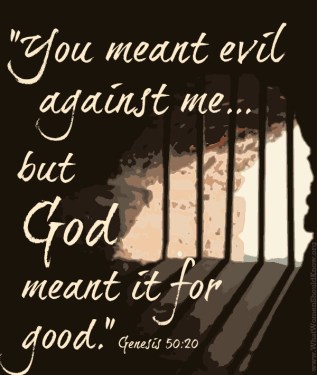 We have all faced times in our lives when we have looked up from our circumstances and wondered, “How God could truly love me and let me go through this.” If any man had a right to allow his circumstances to call into question the loving-kindness of God, it was Joseph. I can only imagine the horror he must have experienced when his brothers suddenly turned on him and cast him into a pit. That scene must have played over and over in his mind, perhaps even while he slept. That first bitter act put Joseph’s life on a course that would seem to be leading ever downward, from kidnapped victim, to slave, to convicted rapist; forgotten in a foreign prison cell. Many men, perhaps even most men, would allow these circumstances to harden them as they plotted revenge on those who ruined their life. But Joseph proved himself to be unlike most men when, instead of looking back with vengeful hate, he looked up and saw the hand of God redeeming what had been destroyed. Long before he found himself face to face with his brothers, Joseph had gotten face to face with God, and learned that the hand of God had been guiding his life for a single purpose – the salvation of souls. In what is one of the most beautiful and searching statements in scripture Joseph declares,
 Chapter 25 seems to be about being ready. Jesus warns about a final day of reckoning, when the sheep will be separated from goats. To ensure that we are ready for what is coming, Jesus gives two parables. The first explains the need to be born again, the second the need to be busy about the Lord’s business.
 As the day of his death rapidly approached, Jacob gathered his children together and spoke regarding what lay ahead. The writer of Hebrews summed up this chapter by saying,
 As the book of Genesis unwinds, we find Jacob getting very close to the end of his life. He knows, just about the only thing left is his departure. While he may not have a whole lot of life in front of him, he does have decades to look back upon. As he reflects upon his life, it is easy for him to see how the hand of God was with him all the way. As he looks back, he focuses upon two things.
 Jim Gallagher