Isaiah 27:1
“In that day the Lord with His severe sword, great and strong, Will punish Leviathan the fleeing serpent, Leviathan that twisted serpent; And He will slay the reptile that is in the sea.”
 The Bible often uses figurative language to enhance our understanding of spiritual things. Jesus is referred to as a Lion so we would reflect upon His power and a Lamb so we would understand His humility and willingness to be sacrificed for our sin. The devil is also represented with figurative language. He is referred to as an angel of light who goes about to deceive and a roaring lion who seeks to devour his prey. Here in this text it seems likely that Isaiah is referring to Satan as a twisted serpent who will ultimately be destroyed by the sword of the Lord. Satan is referred to as a serpent in other texts. In fact the first mention of him is in the garden where he appears as a serpent to deceive Eve and lead her into rebellion against God. Later, the book of Revelation takes us into the future where we see the dragon defeated, chained and cast into the bottomless pit.
I find it interesting that in the midst of the spiritual, social and economic chaos that Israel was facing during the time of Isaiah the he would draw the attention of the people to a time when the devil will ultimately be judged. I also find the weapon of choice quite interesting; He uses the “great and strong sword of the Lord.” The weapon that will ultimately defeat the devil is the same weapon that is needed to deal with his attacks on a daily basis. Paul referred to the Bible as “the sword of the Spirit” and Jesus used the scriptures to forge a counterattack against the temptations He faced in the wilderness. It is through the word of God that Satan will ultimately be defeated and it is with the Word of God that we will have victory over him on a daily basis.
The Bible teaches that Satan casts fiery darts into the mind of the believer. These darts come in the form of thoughts that are ungodly in nature. We are made aware of a situation and are immediately filled with thoughts of fear, worry, unforgiveness or even rage. It is at that point when we must wield the sword of the Spirit and counterattack our thoughts with what the Bible teaches. Instead of continuing down a train of thought that leads us to ungodly action we must choose to let the sword defeat the dragon. Because of the importance of the God’s word it is no wonder that the first spiritual attack recorded in Scripture was a frontal assault against the validity and trustworthiness of the Bible. The serpent said, “has God really said…”
What comfort there is in knowing that a day is coming when the dragon will be defeated and we will be free of all the trouble he has created.
Jim

 This psalm recounts the faithfulness of God during the days of the patriarchs. After mentioning Abraham, Isaac and Jacob, the Psalmist reminds us of the struggles Joseph faced after being sold into slavery by his own brothers. We know he experienced betrayal, beating, false accusations and imprisonment. Each trial he faced was a means by which the Word of God put him to the test.
 It seems the devil and the Lord both understand the importance of the church. The Lord exhorts us regarding the need to be in fellowship, and the devil uses a wide array of tactics to keep us away. We have all heard phrases like,
 Life is filled with important things and with essential things. Often, what is important will overshadow what is essential. David was an important man with many responsibilities; he was a husband, father, musician, soldier and a king. Each role he played added new responsibilities and threatened his time with God. To guard against this, David learned to fall in love with the house of the Lord, because there he could experience the glory of God.
 The book of Malachi brings the Old Testament to a close. For a period of 1,100 years God at various times and in diverse manners spoke to His people through the prophets. That time had now concluded and for the next 400 years heaven was silent. It was not until the angel appeared to Zechariah and Elizabeth, that this silence was broken. Knowing that this time was coming, God exhorted the people to think back upon His written Word.
 Ezekiel is establishing some rules that will guide the people as they worship at the Temple. Some of these guidelines were clearly spelled out by Moses hundreds of years earlier, while others seem to be brand new. One such regulation required the people to leave the city from the opposite gate from which they had entered. If they came in from the south, they had to leave from the north, and vice-versa. No clear explanation is given, but it is not too difficult to draw some application for the believer today. Simply put, we should leave worship different than how we arrived.
 The Bible is the most popular book of all time. It has been translated into almost three thousand languages, and has been distributed on every continent. In America, almost every household contains a Bible, and in many cases, they own more than one. Some Christians seem to be collectors of Bibles. Their bookshelves contain multiple translations of the Bible, and with the advent of smart devices, we can have a cornucopia of translations at our fingertips. All that being said, there seems to be a common problem around the world; people do not read the Bible. John’s encounter with this angelic being gives some beautiful insights into what we should do with our Bibles, and what our Bibles will do to us.
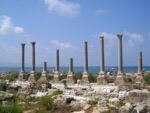 Predictive prophecy is one of the greatest evidences of the inspiration of Scripture. Peter explained, it was like a light shining in a dark place (2 Peter 1:19). Scripture is filled with two types of predictive prophecy. The first have already been fulfilled. They were future in the life of the prophet, but are in our past.
 The world never has a shortage of people who claim to have the answer to spiritual questions. It seems almost everyone has an opinion regarding the purpose of life, and what awaits us after death. The same was true in Ezekiel’s day. The streets were filled with men and women who claimed to know what God wanted from the people. Ezekiel referred to these men and women as false prophets, because their message contradicted the Word of God. I find it interesting that the message Ezekiel delivered to them was simply, “hear the Word of the Lord.”
 Jim Gallagher