I Thessalonians 1:1
“Paul, Silvanus, and Timothy . . .”
 Serving Jesus is a team sport. If we are going to be effective, we must establish godly relationships with others who want to follow and serve Christ. Their lives, and commitment to Christ, will serve to propel us forward, just as ours does the same for them. In my earliest years of following Christ, a particular song was sung for almost every altar call, or response time, after a message. One line went, “I have decided to follow Jesus, though none go with me still I will follow, no turning back.” I remember clearly, grappling with the idea that if everyone of my friends walked away from the Lord, I would remain following Him. I believe we all must come to the point where we decide we will live for Christ, regardless of what others do. At the same time, I also realized, I needed help if I would succeed in this venture. I began to look for others who were committed to Christ, others whose example I could follow, and whose life would propel me to serve Christ more. Even the Apostle Paul understood this. We find when he ventured out to serve the Lord, he did not do it alone.
“Paul, Silvanus, and Timothy . . .”
We know a lot about Paul and Timothy. Much of the Book of Acts tells Paul’s story, and many of the New Testament books were written by him. Timothy was an early traveling companion of Paul, who later became a pastor, and was the recipient of two of Paul’s letters. Silvanus (also called Silas) is a little more obscure character in Scripture; although with a little digging, we can learn much from his life. We are first introduced to him in Acts 15, where he accompanies Paul and others, delivering a letter written by the Apostles to the gentile believers, outside the borders of Israel. He is called a prophet, and described as a man who, “risked his life for the name of Christ” (Acts 15:26). After delivering the letter, Silas joined Paul and Barnabas in the ministry at the church in Antioch. It was there Silas saw a remarkable difference in the atmosphere of the church. While Jerusalem was constantly doing battle with legalist who wanted to add regulations to relationship with Christ, Antioch was marked by the grace of God. The atmosphere of the ministry was one that allowed Jesus to get a hold of people’s lives and transform them, by the Spirit, and through the Word. Having seen this, Silvanus decided not to return to Jerusalem, but to join Paul in his ministry endeavors.
“But Paul chose Silas . . .” Acts 15:40
Not long after joining the ministry team in Antioch, Silas was asked to join Paul, as he ventured out on his second missionary journey. They would visit the churches he had started on his first trip, and take the Gospel to further unreached areas. From this point, Silas became a vital part of the mission work of the early church. While their travel was filled with wild experiences and great adventure, Silas is perhaps most well know for what happened in Philippi. It was there, he and Paul were arrested and imprisoned. Rather than complaining about the trial and how unfair it was for a child of God to suffer, they took the solitude as an opportunity to worship. Acts 16 records how, in the middle of the night, bearing the wounds of being beaten, and wearing the chains of incarceration, Paul and Silas began to worship. Of all the musicians who have ever been recorded, I wish we had a CD of those songs. Two men, facing great suffering, and perhaps even execution, lifting up their voices and celebrating the Lord.
It is exciting to read the stories of men who risked their lives for Christ. Their time has passed, and the mantle must be passed on to another generation. Will you pick it up? Will you be willing to commit yourself to Christ, and surround yourself with others who will propel you forward, as you follow and serve Jesus?
Pastor Jim
 As this letter comes to a close, Paul is careful to thank the Philippian church for their generosity. On numerous occasions they had sent aid to Paul, enabling him to continue in the ministry. Although he was not their pastor, they placed a high value on the activities he was undertaking for the kingdom, and sent financial support, as he took the Gospel around the world. Because of the sensitivity of the subject of giving, Paul is careful to sandwich it between two very important ministry principles.
 Prior to the death and resurrection of Christ, the prescribed manner of worship of God included an elaborate system of sacrifices. Every morning, every evening, and on prescribed dates throughout the year, animals were offered as burnt offerings to provide atonement for the sins of the people. Each of the sacrifices pointed in one way or another to Christ. As the Son of God, His death provided more than all the offerings could ever do. Peter wrote,
 Ezra tells the story of the children of Israel returning to Jerusalem, at the end of seventy years of captivity in Babylon. We find that while hundreds of thousands were taken captive, less than fifty thousand returned. I am relatively certain that many should have returned that didn’t, but we are also given insight into the ones that were willing to leave all and take up the challenge of engaging in the work of God.
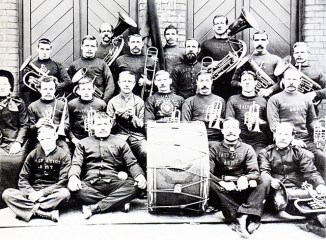 What an interesting phrase, “the service of song.” The word service is a translation of the Hebrew word “Yad”, meaning hand. The idea implies they were putting their hands to the task of serving the Lord with music. When I think of service, I usually think of some sort of labor. Lifting, carrying, working, and sweating are all words that come to mind when I consider service. However, here we are reminded, service can be as simple and as sweet as offering a song.
 Six times in Exodus we read of a man named Bezalel, and five times of Aholiab. These men are recipients of the highest of all honors; their names and accomplishments are recorded in the eternal Word of God. When heaven and earth have passed away, and all of this life is but a distant memory, the accomplishments of these two men will remain forever chronicled alongside Moses, Joshua, David, Daniel and Paul. They are honored even though there is no reference to them ever wielding a sword like Joshua, having a face to face encounter with God, like Moses, writing worship songs like David, or winning others to Christ, like Paul. These men are honored because they took the talents they had received from the Lord and used them for His kingdom, and His glory. In order for the Tabernacle to be built, talented men must give of their time, effort and energy. Bezalel and Aholiab rose to the call. We read,
 Chapter 25 seems to be about being ready. Jesus warns about a final day of reckoning, when the sheep will be separated from goats. To ensure that we are ready for what is coming, Jesus gives two parables. The first explains the need to be born again, the second the need to be busy about the Lord’s business.
 Jim Gallagher