Pray For Our Leaders 

Exodus 22:28
“You shall not revile God, nor curse a ruler of your people.”

The purpose of Israel’s time at Mount Sinai was to develop as a nation upon the foundation stone of the Word of God. Moses went up the mountain alone, and came down the mountain with clear and detailed instructions from heaven regarding how the people should live. These instructions are referred to simply as “the Law” and can be divided into three groups. The Moral Law is a list of unchanging standards God set upon mankind. The Religious Law was designed to instruct the people regarding relationship with God.  The Civil Law was created to keep order. Since God was forming this traveling band into a nation, it would be necessary to also establish leadership, and because of the nature of men, it would not be long before the people would begin to complain about those who are in charge. Knowing this was coming, God declares,

Exodus 22:28 “You shall not revile God, nor curse a ruler of your people.”

Simply put, God made it illegal for the people to curse their rulers. This is not because the rulers would always prove to be faultless, nor did it mean they were above the law, or their actions could not be questioned. In fact, God always puts a higher standard on rulers, than he does on the rest of the people. What this law was designed to do was point out the folly of sitting around complaining about those who are in charge.

Instead of grousing about our leaders, the laws, or the direction the nation is heading, the Bible gives us a far more productive way to handle poor leadership, and a declining culture. God instructs us to pray for our leadership, and to infiltrate culture with the Gospel of Jesus Christ.

I wonder what would happen, if we took half the time we spent complaining about the condition of our nation, and invested that time in prayer and seeking effective ways to bring the Gospel message to others.

Pastor Jim

Smoke 

Hosea 13:3
“Therefore they shall be like the morning cloud and like the early dew that passes away, like chaff blown off from a threshing floor and like smoke from a chimney.”

When we are young everything seems to take forever, but the older we get, the more we realize how brief life really is. It seems as though I finally get used to writing the calendar year, and suddenly it’s time to change the last a digit. There is nothing we can do to change the brevity of life, but there is much we can do to ensure that our life has a lasting impact on others.

The Bible declares the life of the wicked is like smoke from a chimney that rises and is gone. The righteous, on the other hand, leave a lasting impact on the world. We don’t have to invent the light bulb or discover a planet to leave an impact on the world. Instead, we must leave a righteous standard for others to follow.

A praying grandma, bible reading father, or faithful mom who serves alongside her children at their local church, will have a long lasting impact upon the generations to come. I cannot tell you how often I hear someone tell me their uncle, brother, grandpa or dad was a pastor, and it is usually in the context of them returning to the Lord, or desiring to serve Him more. I have a friend who spent years in the business world, only to one day decide to follow in his father’s footsteps and become a pastor. He now pastors a large church where many are being impacted for the kingdom of heaven.

Let’s live like our life matters, seeking to store up treasures in heaven and leaving a pattern for others to follow.

Pastor Jim


The End Is Near 

1 Peter 4:7-10
“But the end of all things is at hand; therefore be serious and watchful in your prayers. And above all things have fervent love for one another, for “love will cover a multitude of sins.” Be hospitable to one another without grumbling. As each one has received a gift, minister it to one another.”

Peter gives a series of exhortations, all predicated upon the fact that the end is near. When the Bible refers to the end of all things, it does so, not out of fear or despair, but out of joy and anticipation. For the believer, the end of all things means Christ will call His church home, and ultimately return to set up His earthly kingdom, where He will reign and rule in righteousness.

This end was the anticipation of the prophets of old, who spoke of things like righteousness covering the earth, as the waters cover the sea; or the lion and the lamb lying down together; and weapons of war being turned into instruments of agriculture; and men learning war no more. Peter is reminding us that Christ will come back and make things right.

In addition to filling us with hope, the reality of His return should stir us to proper behavior. Peter lists four areas of life that should be impacted by the expectation of Christ’s return. First, we must be watchful in prayer. I think there are two very important things we must watch for in prayer. One, we must watch that we are praying. Too often, prayer becomes our last resort, instead of our first instinct. If we want to see God accomplish the things He promises, we must be men and women of prayer. James said we have not, because we ask not (James 4:2). Also, we must watch that we are praying according to the Word of God. The Bible is filled with promises predicated upon asking. James went on to explain, the reason we do not see God accomplish what He promises is that we ask amiss (James 4:3). In other words, we are asking for things He has no intention of doing, while neglecting to ask Him to do what He promised.

Second, Peter exhorts us to love one another. Love is the greatest of all the commandments. Jesus said our first love must be directed to God. If we truly love God, it will be expressed in love for each other. John asked, “How you can love God whom you cannot see, if you do not love others who you do see” (1 John 4:20)?  One way this love is expressed is through covering the faults of another. Peter is not suggesting that we condone sin. The Bible clearly teaches, if a Christian is in sin, we must confront him, to help rescue him from impending danger. What we are exhorted to do is look beyond the failures of one another, and love each other. This is where forgiveness is a huge expression of love. The proper way to have a relationship is to be willing to forgive and press forward.

Third, Peter speaks of being hospitable. The Greek word translated hospitable is a compound word literally meaning “to love strangers.” As we are to love each other, we are also to love those who do not yet know Christ. One of the great ministries of the early church was breaking bread from house to house. They turned their homes into places where others were welcome to come and learn about Jesus. We should be those who are always looking for ways to express the love of Christ to those who have not yet come to Christ.

Finally, Peter declares that as we await the arrival of Jesus, we must be involved in ministry. Sadly, many Christians think ministry is to be done by the professionals; when the Bible clearly teaches that every Christian has been called to ministry. The church was designed by Jesus as a place where the Bible would be taught so the Christian could grow and impact others. It was also to be a place where the Gospel would be declared, so Christians can bring their friends and family to hear about Jesus and be saved. As we await Christ’s return, let’s be busy serving the Lord.

Pastor Jim


Seek Counsel 

Jeremiah 40:16
“But Gedaliah the son of Ahikam said to Johanan the son of Kareah, ‘You shall not do this thing, for you speak falsely concerning Ishmael.'”

After taking Jerusalem, Nebuchadnezzar appointed Gedaliah as governor of the province of Judah. No longer living in a free state, the people would now be subject to Babylon. In order to make things as safe and comfortable as possible, Gedaliah exhorted the people to put their weapons away and serve the king of Babylon. As things began to settle, many who had fled for safety to the countryside returned to Jerusalem. Among them was a man named Ishmael, who had been a captain of the Judean forces. He was a man who publicly showed submission to Gedaliah, but privately was planning to overthrow the governor and mount a rebellion against Babylon. Some of the other leaders began to suspect Ishmael of treason and reported it to Gedaliah, who dismissed the report as false. Sadly, as the story unfolds, Ishmael will kill Gedaliah and turn the Babylonian forces, once again, on Jerusalem.

Nothing in the text gives us any real clear insight into the spiritual condition of Gedaliah. He may not have been a believer at all, or may have been a believer who simply failed to take the warning he received to the Lord. Whatever the case, his story reminds me of the failure to take things to the Lord. Had the governor taken this warning seriously, gotten alone with God or sought counsel from the prophet, he may very well have avoided death and secured the safety of his people.

As a follower of Christ, we have been given the privilege of access to God. Jesus is our heavenly counselor who seeks to guide us, as we navigate our way through life. When we face obstacles, difficulty or indecision, we don’t have to lean upon our own understanding, but can seek counsel from God. Whatever you are facing, don’t go it alone. Take some time today to seek guidance from the Lord. Who knows what pitfalls a little time of prayer may help you avoid.

Pastor Jim


Mighty Things 

Jeremiah 33:3
“Call to Me, and I will answer you, and show you great and mighty things, which you do not know.”

Each stage of life takes us down a road we have never traveled before. When I was first married, I had never been a husband and Kristie had never been a wife, when our son was born we had never been parents, and with each additional child, we had never met them before their birth. As they grew, we had to grow alongside them, facing each stage of their life for the first time. One of the great truths that guided us along this journey is recorded in this verse by Jeremiah. God makes a simple promise, that if we take it  to heart, and apply it  to life, we will begin to realize the sweet intimacy He desires to have with us.

Jeremiah 33:3 ‘Call to Me, and I will answer you, and show you great and mighty things, which you do not know.’

The first thing I notice is the promise is conditional. That means the promise will not be granted, unless a basic condition is met. The condition is quite simple, we must call upon the Lord. Years later, and in very different circumstances, James recorded a similar promise when he wrote, “you have not because you ask not” (James 4:2). In both cases, we find the solution is hidden with God and is accessed through simple prayer. God desires to intervene in our lives and provide what is lacking. The problem is, we often neglect to ask God, or we become impatient and expect His answer in our timing.

The second thing I notice is, the promise is in two parts. God not only promises to answer, He also promises to show us certain things. He calls the things He wants to show us ‘great and mighty things which you do not know.’ The idea is, God not only wants to answer the questions life throws at us, but He wants to do it in a way that teaches us things about Himself. As we go through life, we try to avoid any circumstances that would make us dependent upon God. We are careful to maintain our health, store up adequate savings for emergencies, and plan for retirement. When something interrupts our plans, it often sends us spinning out of control. We wonder where God is or how He could love us and allow such a thing. What we are often forgetting is that God wants to teach us eternal things, He will sometimes interrupt our comforts, in order to teach us great and mighty things about Himself. I have often wondered, if we were to ask Daniel about the worse day of His life, if he would tell us about the day he was arrested and thrown to the lions. That certainly sounds like a bad day. I wonder if we asked about His best day, if he would tell us about the time God sent His angels and protected him from the lions. Without that trial, Daniel would never have learned of the great and mighty things of the Lord.

Whatever you are facing today, look up, and call out to God for help and instruction.

Pastor Jim


I’m A Little Lost 

James 1:5
“If any of you lacks wisdom, let him ask of God, who gives to all liberally and without reproach, and it will be given to him.”

Wisdom might best be defined as “knowing what to do.” In life, we are constantly faced with circumstances in which we have no experience. We are left wondering what in the world we should do. When James writes, “If any man lacks wisdom…” he is not suggesting that only some of us are in circumstances for which we do not have solutions, but that ALL of us are in constant need of wisdom. The word “if” could also be translated as “since.” The question is not really if we need wisdom, but rather how do we get it?

Wisdom is received in at least 4 ways. First, wisdom comes from experience. If we touch the hot stove, we have learned not to touch it again. Second, wisdom can be received by listening to those who have gone before us. My children learned not to touch the hot stove, not by burning their fingers, but by heeding the warnings of mom and dad. Third, wisdom can be given supernaturally. One of the gifts of the Spirit, given to the child of God, is the “Word of Wisdom.” We saw it in action in the book of Acts when the church was facing an unfamiliar and perplexing dilemma. The solution is given to James that satisfied all involved and provided a solution to the problem (Acts 6:1-7). Finally, wisdom is also received through prayer. That is the subject of James’ exhortation.

Colossians 2:3 “. . . in whom are hidden all the treasures of wisdom and knowledge.”

Paul reminded the Colossians that all wisdom is hidden in Christ. There is no circumstance which we face that He does not know the best course of action. This wisdom, he says, is hidden in Christ, which requires that we seek Him in order to receive it. We seek that wisdom by taking our situation before the Lord in prayer. “Lord, I am facing this decision and I really do not know what to do. I pray you would show me the right way to navigate through this.” Once we have taken our request to the Lord, we must wait for an answer. This is often where the Christian sways. We forget, while prayer is the way we take our needs to the Lord, His Word is the way He communicates with us. If you want to hear from the Lord, you must crack open the pages of your Bible and read. In addition to daily reading through the Bible, it is a good idea to look up verses that directly target the circumstances you are in and put their teaching into practice in your life. It is through His Word that God will give wisdom to His children.

Pastor Jim


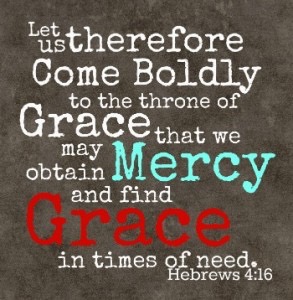
Throne Of Grace 

Hebrews 4:16
“Let us therefore come boldly to the throne of grace, that we may obtain mercy and find grace to help in time of need.”

It seems the Apostle Thomas sometimes spoke what the others were thinking. On one occasion, when Jesus spoke of where He was going, Thomas replied, “Lord we don’t know where You are going or how to get there” (John 14:5). To which Jesus stated, “I am the way, the truth and the life, no one comes to the father except through me” (John 14:6). It was through the cross that Jesus made a way. On the cross He bore our sins and their penalty, opening a doorway, for any and all who trust in Christ, to have access to God. That access to God has two applications. First, when we die, we attain heaven. Jesus was declaring, as emphatically as possible, that heaven is awarded to those, and only those, who trust Christ for salvation. This is not the only time this truth is declared.

John 3:3 “Jesus answered and said to him, ‘Most assuredly, I say to you, unless one is born again, he cannot see the kingdom of God.’”

Acts 4:12 “Nor is their salvation in any other, for there is no other name under heaven given among men by which we must be saved.”

But there is a second application this doorway into heaven provides. Hebrews 4 states, while we live, we have access to the throne of God. For the Christian, this is not a throne of judgment, where we are penalized for the things we have done wrong, or things we have neglected to do. Instead, it is a throne of grace, where we are able to receive from God the things that we need while here on earth. The word grace speaks of the giving nature of God. Because of His love for us, and our relationship with Him, He desires to give good things to His children. He will not hold back anything from us that would help us to become more like Him, or assist us in making it to the end of our journey and enter glory. Notice, at the throne of grace, we receive two things. First, there is mercy provided for the failures of the past. Second, there is grace given to help us not fall into those same snares in the future.

The way has been made to a throne of magnificent grace. All that remains is that we come boldly, consistently, and expectantly. I want to encourage you to take some time right now to sit before the Throne of Grace, pouring out your heart and receiving mercy and grace to help.

Pastor Jim


Should I Pray? 

Jeremiah 7:16

“Therefore do not pray for this people, nor lift up a cry or prayer for them, nor make intercession to Me; for I will not hear you.”

The Bible is filled with commands from God, which place requirements upon man. Bible scholars tell us there are over 600 distinct commands in the Old Testament alone. On one occasion, Jesus was approached by a man who was seeking to list these commands in order of importance. He asked “which is the greatest commandment?” To which Jesus replied, “love God…” (Matthew 22:26—37)

Of all the commands, this one in Jeremiah has to rank among the strangest. The prophet was instructed NOT to pray for the people. It is easy to understand commands such as: have no other gods, no graven images, or do not steal. But what could be the reason God commanded his prophet not to pray?

Keep in mind, Jeremiah had been calling upon the people to turn from their wicked lifestyles and return to the Lord. He exhorted them time and time again to “amend their ways”; which means to make things right. Sadly, the people ignored the Word of God and the pleas of the prophet. Despite the fact that they were living in sin, they expected to receive the blessing and favor of God. Jeremiah was instructed not to pray for blessing on their lives. Living outside the will of God, takes us outside the favor of God; we cannot expect His promises to apply to us.

The Bible is filled with conditional promises. These promises are reserved for those who have received Christ and walked away from their former lifestyles. If we refuse to give up our sin, we cannot expect to be filled with the fullness of God.

Pastor Jim


Drifting Away 

Hebrews 2:1
Therefore we must give the more earnest heed to the things we have heard, lest we drift away.”

Sadly, we have all seen Christians fall by the wayside. People who at one time were walking with the Lord, but have fallen back into the life from which they were once delivered. We see this happen to new believers and old. We may have even been victims ourselves. How does that happen? I can think of at least four things that result in a person finding themselves away from the Lord.

First, we are warned against falling away. This is caused by giving into temptation instead of resisting it. One of the necessary elements of success in your Christian life is to deny the flesh’s desire for sin. When we let our guard down, or think we are mature enough to handle a little sin, we will fall captive to its snare.

Second, we are warned against walking away. Sometimes, the difficulties of life can cause us to accuse God of wrong doing. Soon, we become embittered toward Him and deliberately turn away, going back into our old life. This was a constant problem for Moses in the wilderness. As the people faced the struggles of wilderness living, they attempted, on numerous occasions, to turn back to Egypt.

Third, we are warned against being led astray. Jesus told us to be on the lookout for wolves, false prophets, false teachers and false christs. The Christian walk has no shortage of people claiming to know more than the Bible, and leading unlearned Christians away from the Lord.

“Therefore we must give the more earnest heed to the things we have heard, lest we drift away.”

Our text warns of a fourth danger; drifting away. We are told drifting is caused by neglect. Drifting is the danger faced by those who travel by sea. Since the surface the ship sits upon is constantly moving, and often not moving in the direction the pilot wants the vessel to go, constant attention must be given to avoid drifting into pitfalls like rocks, reef or even other ships. Anchors play an important role in keeping a ship from drifting, but another key is moving. A moving vessel will be less likely to drift into danger than a stationary one. If we want to avoid ending up on the rocks, one key is to keep moving forward with the Lord. This is possible only by keeping the first things first. If you are like me, when you first received Christ, you were told to read the Bible, pray, fellowship with others, and tell someone about your decision for Christ. Now that I have been a Christian for almost 30 years, I still need to read the Bible, pray, fellowship and tell others. The faster you are moving forward, the less likely you will be to drift away.

Pastor Jim


Waiting Room 

Isaiah 40:31
“But those who wait on the Lord
Shall renew their strength;
They shall mount up with wings like eagles,
They shall run and not be weary,
They shall walk and not faint.”

The Psalmist declared we are fearfully and wonderfully made (Psalm 139:14). The implication is that we were designed by God and everything about us is purposeful. We are the way we are, not by accident, but by design. God created us with weaknesses so we would have to rely upon His strength. One of those weaknesses is the fact that our bodies, like a motor, run out of gas and need to be recharged. No matter how strong we think we are, we get tired. Obviously, there are natural things we can do to “recharge our batteries.” At the end of each day, or perhaps even for a short period in the midst of it, we sleep. During that time the body has a way of strengthening itself. What looked impossible when we were tired, seems to be a whole lot easier with a fresh set of eyes. What we often forget is, in addition to rest, God has designed us with a need to wait on Him. He promises if we do, we will receive new strength which enables us to accomplish what He designed us to do.

Waiting on the Lord is more than being patient for God to act. It involves spending time with Him, as well as being involved in the work of God. Think of it this way, to wait on the Lord, is to set aside time to pray and read the Bible. Prayer gives us an opportunity to take our needs to the Lord. I am able to examine my life, see the things that are difficult and lay them out before God. Jesus taught us to pray without ceasing until we receive an answer. Bible reading allows me to hear the voice of God. It is too common among Christians to pray, without taking the time to look into the Word for answers to our prayers. His Word is like a lamp designed to light the path we are supposed to walk. Sitting before the Lord, laying out my struggles, and looking into His Word for answers, will provide strength to the weakest of Christians.

There is perhaps another concept involved in waiting on the Lord. Think of the last time you went to a restaurant. You were seated, a waiter approached you and began to serve. He probably took orders from you, and sought to fulfill those orders in a timely and efficient manner. Drinks, bread, appetizers, and the main course, were delivered to you. When you were done, he even cleaned up the mess. Waiting on the Lord does not mean we do nothing else. Sometimes the best way to be strengthened in the work is to get involved in the work. Jesus was so weary he could not continue the journey with the Twelve into the city to purchase lunch. Instead, He sat by a well and rested. It was there, Jesus met a woman and shared the Gospel with her. Upon their return, the disciples found Jesus was fully rested. When they encouraged Him to eat, He explained that serving the Father was like food, strengthening Him from within (John 4:6-34).

If you are weary, don’t neglect waiting upon the Lord as your number one source of strength.

Pastor Jim