Psalm 47:1
“Oh, clap your hands, all you peoples!
Shout to God with the voice of triumph!”
 Sometimes knowing the setting in which a psalm was written is beneficial to understanding its content. Other times, like in this psalm, the setting is not given because the truth is universal. Whatever our condition, whether we would classify it as good or bad, blessing or trial, God remains the same and is always worthy of the highest praise. The truths tucked away in this psalm transcend every experience the child of God endures. Whatever state you are currently facing, it is a good idea to clap your hands and shout out the loudest praise.
The Psalmist declares that God is awesome because He is the great King who subdues all things under His feet. Our praise is often lost when we become frightened or overwhelmed by circumstances beyond our control. We wonder how anything good could come from the difficulties we are facing. It is during those times that we must realize God is King of all the earth, and capable of moving mountains in order to accomplish His purposes. We can then learn to celebrate Him, even when are circumstances seem bleak.
The Psalmist declares that God will select our inheritance for us because He loves us dearly. For Israel, the inheritance speaks of the land allotted to each tribe. For the Christian, our inheritance is the blessed life God desires us to experience. Israel needed to trust God beyond fear and circumstance if they were to walk in the land. We must do the same if we are going to walk out the life God intends for us. We must be willing to set emotion and selfish desire aside, take up our cross, and walk after the things of Christ if we want to find the inheritance He has laid aside for each of us.
Finally, the Psalmist speaks of the shields of the earth belonging to God. What a blessing it is when we realize, the safest place to be is in the center of God’s will. Sometimes, walking with the Lord will make us vulnerable and that can lead to worry and fear, unless we realize the center of His will is the safest place for us. Israel’s fear kept them from entering Canaan, which in turn put them outside of the protective care of God. What frightened them was the very thing keeping them from experiencing the protective care of God.
“Oh, clap your hands, all you peoples!
Shout to God with the voice of triumph!”
Pastor Jim
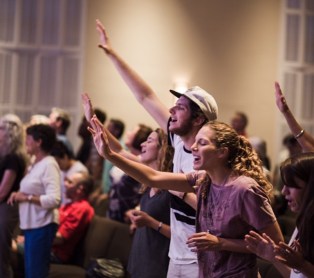 Life is filled with important things and with essential things. Often, what is important will overshadow what is essential. David was an important man with many responsibilities; he was a husband, father, musician, soldier and a king. Each role he played added new responsibilities and threatened his time with God. To guard against this, David learned to fall in love with the house of the Lord, because there he could experience the glory of God.
 I imagine what the scene must have been like in the Synagogue that day. The crowd had gathered like they did every Sabbath. For some it was no more than a religious duty, for others, it was how they expressed their devotion to God. The scene suddenly shifts from the normal activities of prayer and Bible reading to a woman with a serious medical condition. She had been suffering for eighteen years and nothing could be done for her. Without hesitation, Jesus called her to Himself, and when she responded to the call, He healed her. Imagine being there! Imagine the joy that would fill her, perhaps like the lame man in Acts 3, she leaped with joy, celebrating what Jesus had done for her. I would expect to read that the service changed that morning, as the people broke out in unrestrained praise. Sadly however, rather than hearing praise, we hear the sound of objection.
 While the tribulation continues on earth, John’s attention is drawn once again to the scene in heaven. The contrast alone should be enough to persuade us to surrender to Christ. Earth is experiencing the wrath of God, while heaven is being filled with sweet and continuous praise. Those who have been rescued from the tyrannical reign of the Antichrist stand before the throne and worship.
 John looked into the future of mankind and saw the day when the heavens will open, not to speak, but to call home all who have trusted in Christ for salvation. Paul explained that the dead in Christ would rise first, and we who are alive and remain will be caught up together in the air (1 Thessalonians 4:16-17). What a day that will be, when we are no longer looking through a glass dimly, but we are face to face with Christ (I Corinthians 13:12) steeped in His glory.
 Isaiah promises a time when violence and destruction will be replaced with salvation and praise. Clearly, we have not yet entered that time. Violence is one of the major themes of our day. While this is true everywhere, it is especially true in the Middle East. It seems as though, not a day goes by where we are not faced with reports of violence, war, and terrorism.
 At the time of Isaiah’s prophecy, Israel was resisting the Lord. They decided following God restricted them from really moving forward, so they began a quest pursuing the gods of other nations. Sadly, their pursuit not only left them empty, but at odds with God. Part of the Prophet’s ministry was to remind the people of the blessings that would become theirs once they returned to the Lord. One of the greatest of these benefits was experiencing grace.
 Sometimes, worship can have a tired feel to it because we are singing the same songs over and over again. It is so refreshing when the worship team brings a new song; partly because new songs come out of new experiences with the Lord. I spent many weeks of my early years of ministry serving at a Christian camp. Those days were filled with lessons I still benefit from today. One afternoon, while sitting by the pool, I struck up a conversation with the worship leaders wife. While her children were in the pool, she was relaxing in the sun, but her husband was noticeably absent. I will never forget her response when I asked where he was, she said, “He is taking some time alone with Jesus because that is where the songs come from.” He realized, in order to have a new song to sing, he needed a fresh experience with the Lord. Anything done over and over again can become tedious or stale, even our relationship with the Lord. We might wake up each day, read a chapter or two, get the kids up, make breakfast, clean up, make lunch, clean up, make dinner, clean up, run out of energy, go to bed, and start it all over again the next day. Our days become routine, and soon our relationship with the Lord has grown stale. How can we have new experiences with Jesus that result in new songs of praise?
 Bible writers use a variety of adjectives to help us better understand God. The Psalmist chooses the word great. Great is a word with vast meaning. It can indicate size; one dictionary defines it as “very large and imposing.” It can also mean important, distinguished, superior and preeminent. It is clear, the Psalmist is declaring God is above all His creation. One way he chooses to express the greatness of God, is to refer to His infinite understanding. There is nothing God does not know. The Psalmist declares,
 Jim Gallagher