Numbers 7:9
“But to the sons of Kohath he gave none, because theirs was the service of the holy things, which they carried on their shoulders.”
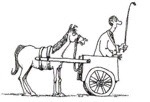
 About 600 years after these events somebody got it into his head that it would be a great idea to take the Ark of the Covenant into battle. He had lost sight of who God was and thought the Ark of the Covenant was the presence of God. So, seizing the Ark, the army marched into battle, assuming it would ensure victory. They were defeated. The Philistines captured the Ark and took it into their camp. As a result, God began to plague the Philistines, so they put the Ark on a cart hitched to oxen, and sent the cart back to the nation of Israel where it remained in the house of Abinadab until the time of David.
Later in I Chronicles 13, David is on the throne, looking at the spiritual condition of the nation, and realized something was lacking. God was not the central focus of the people, or the nation. So he decided to bring the Ark to Jerusalem and place it in the Tabernacle; symbolizing the centrality of God to Israel. He sent a letter to all the leaders in Israel, asking, “I’ve got this idea, what do you think?” They replied, “Great idea, let’s return the Ark to its rightful place in the Tabernacle.” Then they talked to the people, and the people agreed, “Wonderful idea! Let’s do it!” So they placed the Ark on a brand new cart, and appointed Uzza as driver. The people joined in with a big celebration of singing and rejoicing in the Lord; until they hit a pothole and the cart tipped. Uzza reached back to keep the Ark from falling out and being damaged. When he grabbed the Ark, God struck him and he died. As you can imagine, at that point, the celebration stopped, the people were in shock and David became angry with Lord. Perhaps he thought, “I’m bringing this Ark to the Tabernacle, I’m trying to glorify You, I’m trying to raise the spiritual level in the nation of Israel, and this is what You do?” And so, he stores the Ark in Obed Edom’s house and goes home.
After 3 months, David realized how he had erred. He asked the people if they thought it was a good idea, he asked the leaders if they thought it was a good idea, but he didn’t ask the Lord. He did not go to the Scriptures and see what God said about moving the holy things. So David opened his Bible and began to read. He, no doubt, went to Numbers Chapter 7. He saw that God never intended for the Ark to be carried on a cart. Gathering together the priests and the sons of Kohath, he instructed them. “You can’t look at the Ark, so we need to have the priests cover it first. After it is covered you need to put the Ark on your shoulders.” So the priests covered the Ark, and the sons of Kohath carried it on their shoulders. As they brought the Ark into Jerusalem, they began to worship the Lord again, and set it up in a tent that David had erected for it.
But why? I understand that David broke the rules; but what was the point of the rule? Why did God not allow the Ark and the utensils to be placed on a cart?
Numbers 7:9
“But to the sons of Kohath he gave none, because theirs was the service of the holy things”
I think this is one of those biblical principles that is so foundational in our service to the Lord. The things of the Lord, (the holy things, our service unto the Lord), move differently than the things of the world. It’s OK to throw curtains on a cart, and it’s OK to throw silver blocks on the cart. However, when it comes to the holy things, the things that represent the nature and character of God, they move in a different way. God does things differently.
So many events that happen in the church, happen out of people’s great desire to raise the level of spirituality in the church, or even in the nation . “We’ve got to impact our community. We want to see people come to the Lord, so here’s what we’ll do: we’ll imitate the world’s methods, take the Ark, throw it on a cart, get a bunch of musicians, and start marching to Jerusalem.” Failing to recognize, God is not only interested in the end, He’s also interested in the means. God has a way of doing things, and that way often flies in the face of the way we think. Some things that work wonderfully in the business world, don’t have any place in the church. And so He says, “Here’s what you’re going to do. You’re going to carry it. It’s going to take you longer. It’s going to be more difficult. You’re going to be more fatigued. But, ultimately, I’m going to be glorified. So don’t get carts or oxen.”
There are many models in todays approach to ministry. It seems, every time I open my mail, I am introduced to another tactic on taking the Gospel to the world, or building up the body of Christ. I know, in many cases, they are devised by people who sincerely want to minister to others. The question is, what is the right model? I am so thankful to have God’s way of ministry modeled for us in the book of Acts. I want to encourage you, if you desire to serve the Lord, look to the book of Acts, and follow the only approach to ministry that is actually divine in nature. We need to be careful, when we seek to serve the Lord, that we are not looking to the world for a model, but instead we are looking to the Word.
Pastor Jim
 Josiah had a tremendous ministry with wide spreading impact. His personal commitment to the Lord resulted in a national revival that even drew people from other nations to commit themselves to YHWH. While we could discuss in detail the long lasting affects of his ministry, I was struck by what cut it short. We read that he began to meddle in things that were not the Lord’s call on his life. He started fighting the wrong battle, and it cost him his life. A few verses come to mind when I think of the premature death of Josiah.
 1Chronicles 9 is a record of those who lived and served in the city of Jerusalem. Because the Temple resided in this city, it became the religious capital of the nation, and the place where much of the service of God took place. Here, we read about a vast array of people with diverse gifts and callings coming together to accomplish the work of God. Among those listed are leaders, priests, Levites, gatekeepers and singers. Each person had a different calling which required unique skills and gifts. It was when each one served faithfully within his own calling, that the ministry was accomplished in a way that glorified God.
 Israel faced a constant threat from the Philistines. They had come into the territory promised to Israel, taken land, and threatened the people. Earlier in 1 Samuel, the nation mustered all its strength to drive the Philistines out of their territories, only to suffer a devastating loss. In that earlier battle, the people gathered around a religious artifact, went forth in all the strength they had, and were defeated. Now, some years later, we find them once again facing the same threat. This time, however, their efforts resulted in a great victory. What was the difference? How were they able to defeat an enemy which had plagued them for so many years?
 Philip was one of the men selected to serve tables at the church in Jerusalem. Now we find him heading out to Samaria as a missionary and winning many souls to the Kingdom. His ministry became so effective, it drew the attention of the apostles, who came to aid him in discipling those who had been saved. As quickly as he arrived in Samaria, Philip leaves. God calls him away from the masses, to reach an individual with the message of salvation through faith in Christ. After a muddy baptism in the desert, he headed out once again, this time making his way to Caesarea, where he settled down and raised a family of followers of Jesus.
  The book of Acts is a sequel to the Gospel account, written by Luke. He declares, in this opening verse, the purpose for writing the Gospel account and the book of Acts. He states that the Gospel records what Jesus began to do; and the book of Acts, what He continues to do. Since Jesus is alive from the dead, the story of the Bible is a continuing one. John closed his Gospel account declaring that all the books in the world could not hold all that Jesus did for humanity. As amazing as it may seem, Jesus is not finished. The resurrection is not the end of the story. It is the transition point where the work of Jesus transfers from being accomplished outwardly through His life on earth, to the inward working of His Spirit in the life of all who believe.
 The chief trait of this Pharisee was the idea that he did not need God. A modern equivalent would be the person who, with
  When the Lord calls us to serve Him, there seems to be a universal response. Our hearts cry out, “I can’t.” This was the same response of Moses, Saul and Gideon. We feel this way because the Lord always seems to call us to do what is beyond our capacities. A young woman with small children senses a call to teach in children’s church, or a retired couple hears the call to the mission field, or a young man has a burning in his heart to become a pastor, and the voice in our head cries out “I can’t.” I think there is something encouraging here as Jesus calls the twelve. He is sending them out to serve Him. They will encounter many with needs beyond their capabilities to handle. They will cross paths with the sick, who will look to them for the answer, the demoniacs, who are held under by the powers of the devil, and some will will oppose the work of God. For their journey they are told to take nothing; no money, no provisions, no extra stuff. These things will not equip them for the ministry. Jesus wants them to understand that those are not the things that enable them, nor will a lack of those things restrict them. Instead, Jesus provides everything that is necessary. We read, “He gave them power and authority” All of their objections, and ours, should be silenced by these six words. Whatever reasons they had for objecting to the call, whatever lack they may have felt, must be silenced when Jesus declares, “I have given you power and authority.” Just as their objections are silenced by His promise, so must ours be silenced. Whatever objections you have to the call of God on your life, understand what He calls us to, He equips us for. As He said to Gideon, He says to you “Mighty man of valor… Go in this might of yours”(Judges 6:14). Will you go?
 In order for the Old Testament priest to serve the Lord, he must be clothed in the proper attire. Moses referred to his clothing as the garments of ministry. These garments included an ephod, breastplate, robe, tunic and a turban. It was clear that those who were to do the work of the Lord, must be clothed in the garments of the Lord. Things have not changed. Just as the Old Testament priest must be clothed in the garments of ministry, so the New Testament saint must don the proper attire if he/she is going to serve Christ. Our garments include at least four things.
 A few years ago I heard a word I had never heard before, or ever dreamed could be real. That word was “glamping.” “Glamping,” according to the urban dictionary, is “a form of glamorous camping done by urban types.” Those who “glamp” turn tents into elaborate structures with all the comforts of home. Once inside the tent, you are sure to forget you are in the wild. Of all the glamorous tents ever constructed by these wanna be campers, none could compare in beauty or cost to the Tabernacle Israel built in the wilderness. At the current value of an ounce of gold, the Tabernacle would have cost more than $50 million just in materials. The question is, where did all that money come from?
 Jim Gallagher