Psalm 109:2
“My knees are weak through fasting, and my flesh is feeble from lack of fatness.”
 When I read the songs of David, I am fascinated with the level in which He knew the Lord. He expresses praise in a way that reveals the depths in which he understood the majesty of God. He speaks of mercy, grace and loving-kindness, not as one who studied it in a classroom, but as one who experienced it daily. This psalm reveals the level in which David understood the justice of God. If this Psalm seems harsh, it may be partly due to the limited understanding we have of God’s justice. We live in a world that finds it difficult to reconcile love, mercy and justice. We see it as unloving to punish an offender, yet we know it to be unjust to allow them to go free. It is common to project our limited understanding of righteousness on the Lord, only to then accuse Him of wrongdoing when He judges the ungodly. We must never forget, God is a holy and just God. When sin is committed it must be judged, God will bring justice upon those who have rebelled against Him, and mistreated His children. Ultimately, this judgment will be punitive and those who have rejected Christ will be separated from God.
CS Lewis put it like this, “God in the end really gives people what they want, including freedom from Himself. What could be more fair?”
But until then, the judgment of God is meant to draw people to Himself. God does not want the rebellious to continue in their sin, ignorant of how He feels about it. Instead, He desires all men everywhere to be saved.
Before we are too hard on David for the intensity of his prayer regarding the wicked, I think we have to visit where he had been. I am not talking about going through the kind of hardship that make us callous to others, but rather I am referring to the statement David makes in verse 24,
“My knees are weak through fasting, and my flesh is feeble from lack of fatness.”
To be honest, I am humbled by these words. David describes the physical weakness he experienced as a result of the intensity in which he was seeking the Lord. His prayer for the wicked to be judged was not birthed out of their mistreatment of him, but rather out of his time spent seeking the Lord on their behalf. The best thing for those who are living in rebellion against God is to taste a little of His severity, if it will bring them to a place of repentance that they might avoid eternal judgment.
As you seek to understand this Psalm, take a few moments to pray for your loved ones who are still living apart from Christ. Pray that they would surrender all without having to go through any more of the severity of God.
Pastor Jim
 It is a common advertising strategy to attempt to sell an item by comparing it to something else. We might see a car commercial with a cheetah running, to convince us of the speed of the vehicle; or a flowing river, to reveal the thirst quenching power of a soft drink. David is, in a sense, attempting to sell us on the greatness of God. He knows the Lord and wants everyone to taste and see for themselves that the Lord is good. To do this he makes a series of comparisons, to convince us to trust in God.
 As we seek to follow Christ, we often fall along the way. Sometimes, we may only slightly stumble, while at other times, we may take quite a hard fall. It is not uncommon after failing, falling, or having a set back, that we may feel as though we can no longer follow or serve Christ. Without even knowing it, we have turned our relationship with the Lord into something reward based. We think we are blessed when we do what is right, and once we fail, we are no longer worthy of His love, favor or calling. Without a doubt, the low point in David’s life was when he fell into sin with Bathsheba. How remarkable to find that the next king of Israel would be her son, Solomon. The grace of God is an ocean so deep we could never fathom its depth or stop its flow. No matter how far we have fallen, He is able to redeem us completely.
 I find it striking that the Psalmist declares that hate is a necessary expression of true love. He explains that part of being in a healthy love relationship with Jesus is having a hatred for evil. Why is it necessary to hate evil? Why should we hate evil? I can think of at least three pretty strong reasons.
 One of my favorite movie lines of all times is at the end of “The Princess Bride.” As the narrator comments upon the kiss of Wesley and Buttercup, he states, “Since the invention of the kiss, there have only been five kisses that were rated the most passionate, the most pure. This one left them all behind.” That statement, while nothing more than a poetic expression in the film, would certainly be true of the statement the Psalmist makes here.
 Memory is a funny thing. There are certain things that no matter how hard I try, I cannot seem to remember, and other things I can never forget. Names are particularly hard for me. It is not that I don’t care, or don’t want to remember; I just have a mental block. I have tried all the tricks: concentrating when the person introduces themselves, repeating the name back to them, using it in the conversation, and even relating their name to something else. Still, if some time has passed, and I encounter them again, the file that holds their name has been corrupted, and my memory refuses to access it.
 If these questions were posed to us on a theology test, we would all answer “No, no, six times no.” We know that He promises:
 This Psalm is fulfilled in at least three ways. First, it expresses an actual time in the life of David. His enemies have mounted up against him with such great force that he feels like one who is drowning in a mighty flood. The enemies he faces are those who have sided with Saul, to seek his life; those who were against him because he had chosen to follow God, and finally, and perhaps his greatest enemy, is his own sin. In the midst of the battle for his own life, sin had mounted up like an army, seeking to destroy him. David’s victory over these enemies is found as He seeks the mercy of God. He writes, “Hear me, O Lord, for Your lovingkindness is good; turn to me according to the multitude of Your tender mercies.” Psalm 69:16
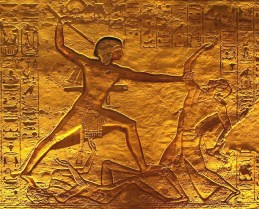
 Rehoboam is known for being the king that split the nation of Israel. His greed drove him to make decisions that ultimately divided the kingdom. Sadly however, this was not the worst policy he implemented. During his seventeen year reign, he continued to ignore the Word of God and to introduce idolatry to the nation. As a result, this once powerful nation fell prey to their enemies. Like a shark smelling blood in the water, Egypt saw the weakness of Israel and sent troops to Jerusalem. Their armies easily overcame any and all resistance and began to loot the city. Just a few short decades after the Temple was completed, it was ransacked by foreigners and its prize articles were stolen. Among the items Shishak took, were the golden shields that hung as a symbol of Israel’s strength. Rather than turning to God, Rehoboam decided to hang bronze shields in their place. After all, from a distance, who would really be able to tell the difference. What a different story this would have been if Rehoboam would have fallen on his knees and turned back to the Lord.
 Although David wrote this Psalm as an expression of the experiences he was facing, it has a much bigger application than he ever could have conceived. It was on the cross that Jesus uttered the opening words to this great Psalm.
 Jim Gallagher