Genesis 22:2
“Then He said, ‘Take now your son, your only son Isaac, whom you love, and go to the land of Moriah, and offer him there as a burnt offering on one of the mountains of which I shall tell you.’”
 Jesus declared the whole Bible testified of Him. Sometimes, the testimony is the form of prophecy, other times, it is in the form of a type, or illustration. Here, we find a vivid illustrative picture of the cross of Christ. Let’s examine the details.
Abraham was instructed to take his only son, whom he loved, on a three day journey to Moriah, and offer him as a burnt offering. Upon arriving, his son, who would have been close to twenty years old, willingly allowed himself to be tied to the altar. Just as the knife was approaching his throat, God spoke and provided a ram as a substitute for Isaac. We see many parallels to the cross.
First, the sending of Jesus was a plan orchestrated in the council chambers of heaven. In other words, it was the plan of God. Peter declared, Jesus was crucified according to “the determined purpose and foreknowledge of God” (Acts 2:23).
Second, it was the only Son of God who was sent as the ransom for mankind. The Psalmist declared the salvation of the soul is costly (Psalm 49:8). At the cross we see just how costly. No angel, man, or amount of cash, would suffice to pay for the sins of the world. Nothing short of the blood of God would be sufficient. Peter wrote,
“. . . knowing that you were not redeemed with corruptible things, like silver or gold, from your aimless conduct received by tradition from your fathers, but with the precious blood of Christ, as of a lamb without blemish and without spot.” 1Peter 1:18-19
Third, the crucifixion took place on the mountain range of Moriah, where Jesus willingly offered Himself as the sacrifice for humanity. Jesus had openly declared, no one could take His life from Him but that He would willingly lay it down (John 10:18). We read, in the Garden of Gethsemane, Jesus surrendered to the will of the Father, and submitted to the cross. He was taken by force, condemned, beaten, and crucified to provide forgiveness for our sins.
At this point, Isaac no longer serves as a picture of Christ, but as a picture of mankind. As the knife approaches his throat, God stops Abraham’s hand, and we see two things vividly. First, God will have nothing to do with human sacrifice. That is not how the wrath of God is appeased. Second, no sacrifice, no matter how great, can cover our sin; there must be a substitute. In the bushes, a ram is caught, and becomes the substitute for Isaac. A promise is then given for all of mankind that God would later provide Himself as the substitute for our sins (Genesis 22:8).
Whatever joy must have filled the heart of Abraham, knowing that his son was rescued, pales in comparison to the joy that we should celebrate, knowing that Christ took our place and paid for all our sins.
Pastor Jim
 These twelve ordinary men were chosen, empowered, and sent by Jesus into the world with the simple message of salvation. As a result, their lives have transformed the world.
 This chapter introduces us to a man who is facing one of life’s greatest challenges; that of a terrible physical disorder. Being a paralytic would mean he not only missed out on much of the experiences of life that we take for granted, but also, he would be totally dependant upon others. He was not even capable of getting to this home on his own.
 Abram’s encounter with Melchizedek is one of the most interesting and encouraging stories in Scripture. The scene is set for their meeting in the previous chapter, where we find Lot departing from Abram, and moving to the plains outside the city of Sodom. What seemed to be a brilliant business decision, turned out to be a costly moral one, as Lot is soon caught up in the ways of Sodom. When fighting breaks out between nations, Lot finds himself taken captive as a POW, and led to Elam where he will become a slave. The news of Sodom’s defeat, and Lot’s capture, reaches the ears of Abram, who gathers his 318 servants and heads out in hot pursuit. Abram is attempting to do with 318 farmers, what five armies could not do; defeat the forces of Chedorlaomer.
 The longer I live, the more I have come to realize, so much in life is passing. Things I once coveted and had to have, are bundled up and given to the Salvation Army. That “new car smell” has been replaced with “what’s that smell?” Even relationships that were once so close, have grown distant. The words of Christ shout a deafening cry,
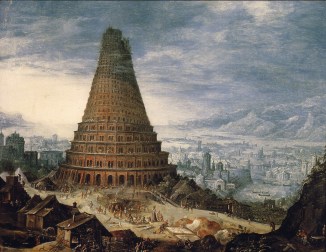 Genesis is the book of beginnings. In it, we are introduced to many things which play a prominent role as the rest of Scripture unfolds. Here, in Chapter 10, we are introduced to the city of Babylon, which becomes a major player in the Biblical narrative. It is mentioned 257 times in the Bible. We learn Babylon was built by a man named Nimrod (whose name means rebellion); he built Babylon in defiance of God. His purpose in building the city is recorded in Genesis 11:4
 People seem to be fascinated with fighting. I can remember being in Jr. High School and hearing the word “FIGHT” resonate across the playground. All activities stopped and the whole student body ran in an attempt to get a front row seat to view the scene. Things have not changed; people gather to watch boxing matches, UFC events and even hockey games, all for the thrill of the fight.
 The last time Noah heard the voice of God he was instructed to enter the ark and shut the doors. Since that time, forty-seven days have passed. These were days of difficulty, unrest, fear and anxiety, as Noah and his family stepped out into the unknown. In a time when Noah needed the voice of God more than ever, it seemed that heaven had gone silent. What a blessing it is to read “God remembered Noah…”
 As the drama of Genesis unfolds, we are introduced to two of Adam’s sons, and given a glimpse into their lives and occupations. Abel, the younger, was a shepherd, while his older brother Cain was a farmer. It was not their occupations, but their character that determined their destinies. We read, Abel brought an offering of the flocks, while Cain brought the fruit of the ground; God respected Abel’s offering and rejected Cain’s. The question we must answer is why? What was wrong with Cain’s offering?
 Jim Gallagher