Ephesians 3:20
“Now to Him who is able to do exceedingly abundantly above all that we ask or think, according to the power that works in us”
 Prayer is the great privilege of the Christian. With it, we are given access to the throne of God. Every care, no matter how small, can be cast at His feet. Every mountain, no matter how large, can be removed through prayer. Prayer was a daily activity in the life of Christ. He rose early for prayer; stayed up late into the night praying. He prayed before making decisions, facing obstacles or simply to give thanks to the Father for what He had provided.
Prayer was an important part of the life of the Apostles. They were taught to pray, by Jesus. After His resurrection, they often gathered for prayer. Through prayer, they learned to wait on the promises of God, seek the mind of God, and receive strength from God.
Prayer is a common subject in the Epistles. Just as the Apostles were taught by Jesus to pray, and had seen the effectiveness of prayer in their lives and ministries, it was important they teach us to pray. Why then do we often neglect to pray? Is it possible we neglect praying because we are afraid that it may not work? Sometimes, when faced with obstacles, we try using our own strength, wisdom and resources. When that does not work, we seek the strength, wisdom and resources of others. It is only when those fail that, as a last resort, we begin to pray.
“Now to Him who is able to do exceedingly abundantly above all that we ask or think, according to the power that works in us”
Paul had a different view of prayer. He believed the power of God was sufficient to do all that he asked. No matter what obstacles Paul faced, he knew God was able. But his view of the ability of God did not stop there. He also believed God was able to do more than he asked. He describes the power of God as exceedingly, abundantly above whatever obstacle he was facing; and we know the apostle faced some pretty serious obstacles. He believed in a big God, and as a result, was not afraid to ask big things from God. He even prayed that we would be “filled with the fullness of God.”
That view of prayer comes from good theology and good practices. In other words, Paul knew who God was. He had read story after story of men and women facing obstacles much bigger than themselves. Rather than relying on their own resources, they sought God and found Him able. Paul did not stop with the stories of others. When faced with his own obstacles, he sought God, and as he prayed, he found that God was able. Prayer is something that is best learned by doing. Classes on prayer have their place, but nothing beats falling down before the Lord, crying out to Him, and seeing Him do exceedingly, abundantly above what we asked for.
Can you Imagine, you are given a key that gives you access to the vault of the world’s largest bank? Whenever you are faced with a financial crisis, all you have to do is take out the key, and access the vault. Can you also imagine the folly of not using the key because you are concerned that it might not work?
Let’s pray!
Pastor Jim
 When I was a child, my family lived in a house located at the bottom of one hill, and the top of another. Whenever one of the neighbors up the street would wash his car, a flowing river would form in the gutter outside the house. I can vividly remember using the debris to create obstacles, rapids, and even dams. I would run up the street with small plastic boats filled with passengers and drop them into the river. As they traveled downstream, they would be tossed about by the currents heading towards the rudimentary dam designed to stop them. Often, the flow would become so strong the dam would burst, sending the toy boat and its occupants rushing toward a large drain that went deep underground to the sewers. Frantically, I would run after the small boat, hoping to rescue it from impending doom. Whenever I read Paul’s description of the world, found in Ephesians 2, I am reminded of those toys heading toward destruction, and my frantic attempts to rescue them. Paul describes every person who has not yet received Jesus Christ, as being like a dead body floating downstream, and heading for eternal loss. He also describes God as the great Savior, who reached down to rescue all who will cry out to Him.
 There is an interesting progression of commands found in Galatians 5. We are exhorted to stand, run and walk. Each of these terms, reveals something important about how to follow Jesus.
 The book of Ecclesiastes is a bit like an experiment. Solomon looked at life the way a scientist does an experiment. He sought to discover the meaning of life by asking questions, doing research, creating an hypothesis, and drawing a conclusion. It is here, at the end, that he makes his discovery known to his readers. His conclusion, after years of experimentation, is that the purpose of life will be found in fearing God and keeping His Word.
 Paul is reminding the Galatians that many of the behaviors and activities they were involved in, before coming to Christ, are no longer fitting. Before accepting Christ, much of our existence is spent trying to find the meaning of life, or at least some semblance of meaning. We realize something is missing, and continually search for it. We may party for while, thinking that will make us happy, or get involved in a relationship or multiple relationships, all in pursuit of filling a void or adding something to life. Some are able to realize the inability of these cravings to satisfy, and move on to something else. However, many become addicted and find themselves in bondage to the very pursuits that falsely promised freedom. Whatever your story is, you will not find life’s missing puzzle piece until you come to Christ. It is in Christ that we are made complete. “. . .and you are complete in Him, . . .” Colossians 2 :10
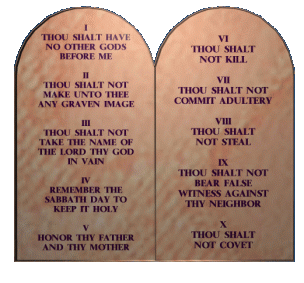 The law Paul refers to is what is commonly known as the Ten Commandments. This law is distinct from all other laws in its source and in its purpose. We are surrounded by laws written by men and designed to be kept. The Law of God was written by the hand of God; its purpose, to reveal that we are incapable of living up to His standard of righteousness. When confronted with the Gospel, many will claim they are good people, trying to honor God by keeping the commandments. Anyone who makes that statement, completely misunderstands the commands of God. Let’s take a look at a few of them and see how we measure up.
 This verse carries two vital commands. First, we are told to examine ourselves, then we are told to test ourselves. Both carry the idea of looking at our lives in the light of the Word of God, to determine whether or not we are truly saved. Not all exams are of equal importance, but this is a test we must not avoid, or fail. What is at stake is not a low-grade in class, or the possibility of summer school, but where we will spend eternity.
 A few years ago, I stumbled across a pretty cool website designed to help create photo albums. In a few minutes, I was able to design a picture book capturing a recent family trip. Ecclesiastes is a bit like a photo album, capturing the travels of Solomon, in pursuit of the meaning of life. Solomon had the unique combination of great wealth and intellect. As a result, nothing was beyond his reach as he searched for the meaning of life, in the midst of living. His journeys took him down many different roads. Sadly, he found no matter what road he traveled, he seemed to end at the same destination. A place he called “Vanity of Vanities.”
 In the previous chapter, Job made a list of all the good things he had done. He speaks of being a good husband, caring for his employees, giving to charity, being a religious man and avoiding evil actions. These are all notable qualities and should be a part of our lives, but not one of them is capable of making us righteous or justified before God. Job made the mistake of thinking he could earn his way to heaven. He assumed his good works would outweigh the bad things he had done. CS Lewis sought to express the problem with self-righteousness in his book “The Great Divorce.” He speaks of a man who refuses to enter heaven. He thinks he is above those who have gone in through the doorway of grace. In response Paul would declare,
 A few years ago, I watched a very interesting story on the news. An armored vehicle, after leaving a local bank, had neglected to properly close the rear truck door. Upon making a turn, bags of money fell out of the truck and broke open on the street. People, seeing what had happened, went nuts, rushing into the street, picking up cash and shoving it into their pockets. In the midst of the chaos, a young boy grabbed a handful of coins and ran off. That night, he felt so guilty he could not sleep. The next day at school, the little boy dropped eighty-five cents on his teacher’s desk and told her about the event. She, wanting to encourage him for doing the right thing, contacted the bank to arrange for the return of the money. Since more than $200,000 was lost that day, and only eighty-five cents returned, the bank wanted to honor this young man and asked him to come to the bank to receive an award. When the mayor of the city heard of his deed, he also wanted to honor the child with a public gathering. Later, word reached the executives at Disney, who decided to honor the young man. They invited him, and his whole class, to Disney World; all expenses paid. What a remarkable picture of grace. One young man took what did not belong to him and gave it back to the rightful owners, and in return, was richly honored and showered with blessings.
 Jim Gallagher