Hebrews 8:1
“Now this is the main point of the things we are saying: We have such a High Priest, who is seated at the right hand of the throne of the Majesty in the heavens, . . .”
 Under the Levitical priesthood, on the Day of Atonement, the High Priest would enter into the Holy of Holies bringing atonement to the Lord on behalf of the people. His job was basically to represent the people to the Lord, and the Lord to the people. If memory serves me, I believe the Latin word for high priest means “bridge builder.” The role of the priest was to make a way for man to be right with God. Hebrews 8 reminds us, Christ is our High Priest and having made a way for us to be right with God, He is in heaven representing us to the Father.
As the High priest’s garments were stained red with the blood of the sacrifice, so Christ bears the scars of the cross, as a reminder of the atonement provided at Calvary. When we sin and the devil brings charges against us, our High Priest bridges the gap, perhaps by showing His scarred hands and feet, declaring that the price has been paid, and forgiveness is given.
When we are facing trials, obstacles or temptations, and it looks as though we may fail under the pressure of the test, our High Priest stands in the gap and prays for us. Like Aaron and Hur holding up the hands of Moses, Jesus holds up our hands that hang down and strengthens our feeble knees. It is His constant prayer and encouragement that enables us to press through the trials and onward with the Lord.
With eyes of love, our High Priests watches our every move. Not because He is hoping we will fail and He might rebuke, correct, and chasten us, but because He loves us as a father loves his son. There is never a moment when we are beyond His gaze. In one of the most magnificent promises in the Bible, we are told He sings over us (Zephaniah 3:17). Imagine the throne room of God, where the songs of the saints accompany the angelic choruses giving praise to Jehovah God. Then a voice rises high above all others and begins to sing a love song, and you are the subject of His song.
It is no wonder the writer of Hebrews declares that this is a better covenant.
Pastor Jim
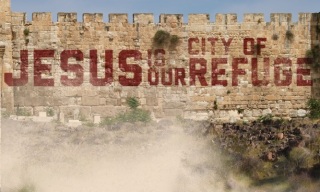 Deuteronomy is a compound word meaning “Second Law”, and is a recap of the instructions Moses gave to the first generation of believers who had been delivered from Egypt. Forty years have passed and a new generation has arisen in Israel. Consequently, it became necessary to rehearse the Law before the people entered the land of promise. Much of what is found in Deuteronomy is a recap of what was first presented in Exodus, Leviticus or Numbers. This is true of the law regarding cities of refuge. Numbers 35 gives us much greater detail regarding these cities. In it we find:
 Jim Gallagher