2 Peter 2:22
“But it has happened to them according to the true proverb: ‘A dog returns to his own vomit,’ and, ‘a sow, having washed, to her wallowing in the mire.’”
 A few years ago, I was in northern Ghana with a group of people from our church. Our purpose was to bring the Gospel to remote villages that had yet to be reached for Christ. Just as Paul developed a custom of going first to the synagogue, then to the market squares, we too, had developed our own custom. Because of the practices of their culture, it is customary, when a traveler arrives at their home, to gather the family, offer the traveler a drink and ask “What brings you here and do you have a message for us?” As you can imagine, this provides a wide open door to share Christ.
On one particular day, as we were walking through a village, going from hut to hut with the gospel, I turned a corner and startled a large pig. He immediately arose from his mud hole and walked off. When he stirred up the mud, the stink was so strong it almost knocked me over. I continued down the path, then turned back, thinking of this verse in 2 Peter 2, wondering what would happen next. Sure enough, as soon as he thought it was safe, the pig walked back to the mire and plopped down.
Peter explains, while it is expected for a pig to return to its mire, you are not a pig. Once you have come to Christ, it is unnatural for you to turn back to the sins from which He saved you. He writes that returning to our past lives, results in being in a worse condition than we were prior to being saved. That worse condition is caused by the hardening of our hearts.
Each time we take a step away from the Lord, the Holy Spirit convicts us, reminding us of the promises of the Word, and the danger of that course of action. When we ignore His warnings and continue to move toward sin and away from God, our hearts become just a little harder. Soon we are able to sin without feelings of guilt or remorse. That is in no way a sign of freedom, but of extreme bondage. When sin no longer shames us, we are shackled by its deadly grip.
A good application from this text would be to take inventory. Are you allowing things back into your life that might lead you away from the Lord and back into your old life style? Turn those things back over to the Lord, before you find yourself neck-deep in the mire.
Pastor Jim
 Jeremiah is describing the judgment that will fall upon Moab. He explains, in vivid fashion, that one of the chief causes of their wickedness was the fact that they were like a vessel which had never been cleaned. Their failure to allow the difficulties of life to purify their actions, ultimately lead to their judgment and destruction.
 Certain garments are necessary for certain activities. People wear football apparel to play football, a suit for the office, and a wedding gown for the wedding day. In the same way, appropriate apparel is required for entrance to heaven. Isaiah called these the garments of salvation. These clothes can only be purchased by placing faith in Christ. When we do that, our old filthy rags of self-righteousness are replaced with a robe of righteousness, and we are welcomed into the banqueting hall of the Lord. Jesus put it this way;
 Over the years I have discovered something about myself, I am better at projects than I am at maintenance. My yard is a classic example. We worked hard to irrigate, lay sod, and plant trees, and our yard looked good for a little while. As time went on however, we discovered that neglect undid much of our labors, and before long, things looked rather unkept. It seems like Azariah had a similar problem; while he desired to live pleasing to the Lord and made great strides, he still neglected certain areas that needed his attention. One area in particular, was the “high places”, where altars were built to false gods. These shrines were destructive to the nation because they served as an open door to lead the people away from the true and living God. The only way to properly deal with the high places was to aggressively attack the problem. Azariah needed to mount an offensive and destroy the altars.
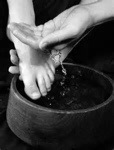 Living in Israel at the time of Christ, it was impossible to walk the streets of Jerusalem without getting dirty. Open-toed sandals in a desert climate made for dirty streets and dirty feet. One solution was the custom of foot washing. Whenever a guest entered a home, the host was responsible for ensuring that the feet of the guest were washed. When Jesus gathered with the disciples for the Passover meal, he took on the role of the host, and began to wash their feet. As expected, Peter had something to say about the actions of Jesus. First he resisted, to which Jesus explained,
 According to Webster’s dictionary, the word ‘dedicate’ means, “to devote to worship or to set apart for sacred use.” As Leviticus comes to a close, Moses instructs the people to dedicate their homes to the Lord. Since the family is the foundation of society, the key to Israel’s future success was in each and every household dedicated themselves to the Lord.
 Leprosy is a skin disease that effects the nervous system; resulting in spreading rash-like symptoms, disfiguration, pain, and ultimately, death. Due to the fact that leprosy is contagious, the nation of Israel was instructed to quarantine lepers until they were healed. Since leprosy was incurable in the ancient world, it would require an act of God for a leper to be healed. Because of the similarities in the growth, spread, and debilitating effects of the disease, leprosy has been considered to be an illustration of sin and it’s consequences.
 If we go back to the call of Abraham, we realize Israel was a nation chosen and established by God. Abraham was told that through his seed all the nations of the earth would be blessed. Later, we read God’s purpose in choosing Israel was for them to be a light to the rest of the world. God’s idea was for the world to know who He was, through the witness of His people. One factor that would make their light shine more brightly was living by a higher standard than the world around them. This is part of the reason for the dietary laws.
 Perhaps, the clearest message from the Book of Leviticus is, God is Holy and requires holiness from His people. Rather than leaving it to us to determine what is holy and what is not, God has given us His Word. In the pages of Scripture, we will learn how to “distinguish between holy and unholy, and between unclean and clean.” Holiness was first achieved through the Old Testament sacrifices. God established a system by which sin could be forgiven through the shedding of blood. These sacrifices are no longer required because Jesus Christ, the Son of God, paid the penalty for all sin, when He died on the cross. We are made holy when we receive Christ, and our sins are forever washed away. Those who have been made holy are required to live holy. Holiness carries the idea of being set apart. A person who is holy is a person who has set themselves apart from others, by determining that he/she wants to live to please the Lord. It is the holy person who is looking into the pages of their Bible to determine the meaning of life and how to live. It is the holy person who, when faced with a decision, will seek answers from the Word of God, or when facing conflict will seek to solve it through the Wisdom of the Word. Holiness is achieved when we set ourselves apart to the Lord, and live out His Word.
 Sin is a plague that has infected every man. As Paul explained to the Romans, it was by one man (Adam) that sin entered the world, but that sin spread to all men because all have sinned (Romans 5:12). David, looking out at the world, and looking in at his own heart, declared, there were none righteous, not even one (Psalm 53:3). Most of us are familiar with the story of the woman who was caught in an adulterous relationship and brought before Jesus. After hearing the charges brought against her by her accusers, Jesus responded by inviting those in the crowd who were without sin, to throw the first stone. One by one her accusers dropped the rocks and departed, for they were all sinners (John 8:3-4). The truth that we have all sinned, makes Solomon’s question all the more striking. Is it possible for anyone to proclaim that their heart is clean, and they are pure of all sin? Scripture boldly declares that it is.
 Jim Gallagher