Hebrews 12:15
“. . . looking carefully lest anyone fall short of the grace of God; lest any root of bitterness springing up cause trouble, and by this many become defiled; . . .”
 Bitterness is the byproduct of being unwilling to forgive. We are warned against allowing bitterness to take root in our lives, thus springing up and defiling us. Roots, for the most part, are the unseen part of the tree. We understand for a large tree to be able to support itself, its roots must go deep and spread wide. Bitterness begins to develop its root system in us the moment we choose to keep record of wrong, rather than forgive the wrong doings of others. While we are able to continue on for some time unaffected by it, this unforgiveness will soon spring up and bitterness will reveal itself.
It seems to me, bitterness may have been one of the chief causes behind Moses’ failure, which kept him from entering the promised land. Scripture records that the children of Israel once again complained about their circumstances in the desert. They were thirsty, and rather than trusting in the provision of God, they looked to Moses and began to complain that their needs were not being met. Moses went to the Lord with the problem and was told to speak to the rock and water would be provided for the people. Instead of speaking to the rock, Moses unleashed his fury on the people, then in his rage he struck the rock. God, in His mercy, provided for the people. However, Moses was disciplined for his disobedience; he was forbidden to enter Canaan. The punishment might seem severe if we do not keep in mind that the spiritual leaders must rightly represent the Lord to the people, or they will develop a wrong view of God. This was not the first time God provided water in the wilderness, He had done it years earlier, and in response, Moses named the place “Meribah” meaning contention.
This has always struck me. Moses took a stick, struck a rock and water, enough for two million people, was provided in the desert. Rather than naming the place “God is Awesome” or “Great Provision”, or something else that would forever remind the people of how amazing the Lord is, Moses chose to remember the failure of the people. Now we find him, years later, facing similar circumstances. His unforgiveness has birthed bitterness, and his bitterness springs up as he lashes out in rage against the people.
While bitterness is the byproduct of being unwilling to forgive; forgiveness stems from looking at the cross and realizing all that Jesus has forgiven you. The forgiveness of God is complete. Paul wrote, our sins were nailed to the cross never to be brought up again. Forgiveness means to treat someone as though they had never done the thing that hurt you, or that has made it hard to be kind to them. Choosing to forgive is sometimes very difficult, but being unwilling to forgive has much greater consequences. If there is anyone who you are harboring bitterness toward, take some time right now and pray that God would help you to forgive them and treat them as though they had never hurt you in the first place. Do it now before the roots take hold of you.
Pastor Jim
 Job lost his health, wealth, family and friends, yet he “Did not sin nor charge God with wrong” (Job 1:22),No matter what the devil threw at him, he remained faithful to the Lord. When his wife told him he should curse God and die, he responded, “Shall we indeed accept good from God, and shall we not accept adversity?”(Job 2:10) We are told “In all this Job did not sin with his lips.” However, by the end of the book, Job, in fact, sinned and charged God with doing wrong. It wasn’t his circumstances or the attacks of the devil that led Job to sin, but the treatment he received from his friends. What Satan was unable to do, his friends did. Their treatment led him to sin with his mouth. It is no wonder Job declared,
 Crucifixion was a violent and public form of execution. The display was designed not only to punish the condemned, but to dissuade others from violating the law of Rome. It is difficult for me to comprehend the emotions that would flood those who watched, as Jesus was beaten and crucified.
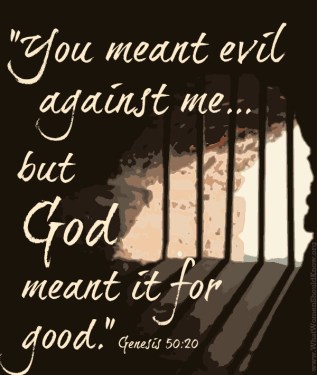 We have all faced times in our lives when we have looked up from our circumstances and wondered, “How God could truly love me and let me go through this.” If any man had a right to allow his circumstances to call into question the loving-kindness of God, it was Joseph. I can only imagine the horror he must have experienced when his brothers suddenly turned on him and cast him into a pit. That scene must have played over and over in his mind, perhaps even while he slept. That first bitter act put Joseph’s life on a course that would seem to be leading ever downward, from kidnapped victim, to slave, to convicted rapist; forgotten in a foreign prison cell. Many men, perhaps even most men, would allow these circumstances to harden them as they plotted revenge on those who ruined their life. But Joseph proved himself to be unlike most men when, instead of looking back with vengeful hate, he looked up and saw the hand of God redeeming what had been destroyed. Long before he found himself face to face with his brothers, Joseph had gotten face to face with God, and learned that the hand of God had been guiding his life for a single purpose – the salvation of souls. In what is one of the most beautiful and searching statements in scripture Joseph declares,
 I think Peter had a little more insight into the mind of God than he gets credit for. In the passage leading up to this, Jesus spoke regarding confronting those who are in sin. He spoke of going to a sinning brother, bringing others and going a second time, then telling the church of his sin, and finally treating the unrepentant as you would an unbeliever (which of course means that you want to do all you can to win them back to Christ). It is in response to this that Peter asks regarding forgiveness.
 I am sure we have all been complimented, at one time or another, for how we looked, or what we were wearing. Of all the compliments I have received, none has been quite like what Jacob said to Esau. After not seeing his brother for 20 years, Jacob said, “you look a lot like God.” Jacob is not saying God is a six foot tall man with red hair, but that the actions of Esau were, in some way, reflective of the character of God. What was Esau doing that was so godlike?
 Jim Gallagher