Psalms 67:2
“That Your way may be known on earth, Your salvation among all nations.”
 Psalm 67 was written by an unknown author. We cannot know for sure who wrote it or what circumstances influenced its content. The one thing we know for sure is that it was penned by a person with a desire for others to come to the Lord. He pleads with God for mercy in his own life, in order that the world around him may come to a saving knowledge of God. The Psalmist is not alone in this. Paul declared
“Brethren, my heart’s desire and prayer to God for Israel is that they may be saved” (Romans 10:1).
As a result of this desire, Paul risked his life to bring the gospel message to his countrymen. At the conclusion of his third missionary journey, Paul made his way to Jerusalem with one goal in mind, he wanted to tell others about Christ. He received continual warnings regarding the danger he would face and the beating and imprisonment that lay ahead. Regardless of these threats, Paul pressed forward because his desire was for others to come to Christ.
The pattern of Paul has been followed by saints down through the centuries. Men, like Saint Patrick, who in the 6th century brought the gospel to the unreached pagans of Ireland and his contemporary, Saint Augustine, who brought the gospel to England. Saint Boniface, who in the 8th century brought the gospel to Germany, Hudson Taylor, whose efforts brought the Gospel deep into China, in the 19th century. CT Studd gave up a life of wealth and comfort to bring the Gospel into Africa. Or the countless unnamed Methodist circuit preachers who took the Gospel to the settlers in the United States.
What the world needs today are men and women with a desire to see others come to Christ, regardless the personal cost.
Psalms 67:2 “That Your way may be known on earth, Your salvation among all nations.”
Pastor Jim
Questions for Psalm 67
- This psalm clearly looks forward to the Lord Jesus’ return and His reign on earth. It also speaks of the fulfillment of something great, turn in your bibles to the gospel of Matthew 28:18-20. Why are the nations going to be glad and singing for joy?
- In verse 7 what is meant by the use of the word “fear”
Old Testament:
Psalm 68- The Spoils
1 Kings 13- Pray For Me
1 Kings 14- Faking It
 Have you ever noticed, when movie stars are walking the red carpet, for one of their many awards presentations, they are not asked what they are wearing, but who they are wearing? One of the marks of success is getting a particular designer to make you a one-of-a-kind outfit.
 Have you ever had one of those times when you are craving something, but you are not sure what it is? When that happens to me I tend to keep trying things, in an attempt to satisfy a craving that I cannot define. What is true with physical hunger, is also true in the spiritual realm. God created us with a need for Him. This need evidences itself with a desire to find meaning in life, answers to what lies beyond this life, and a craving to worship.
 David found himself on the receiving end of a barrage of carefully planned attacks. Like an army of well trained soldiers those who had rejected God came against the righteous. Their weapon of choice was not the sword, spear, bow or staff but the tongue. Things have not changed much. The most effective weapon against the righteousness today is the tongue. If a person takes a stand against the unrighteousness trends that are being heralded as freedoms in our world today they will receive an onslaught of verbal attacks. Should you decide to boldly declare the Gospel of Jesus Christ calling sinners to turn to God you will need to be ready to hide beneath the shelter of the Almighty because attacks will come. This is not a new phenomenon, the early church experienced the same things as they declared the message of Christ those with the loudest voice sought to silence their message.
 We cannot be certain of the occasion that stirred David to write this psalm. It may have been a time of great difficulty, opposition or trial. He may have been facing severe attacks from Saul, the Philistines or one of the neighboring kingdoms. It is also possible the struggles he faced were not external. It may have been that David was engaged in that great inner struggle between his desire to do what is right in the eyes of God, and his own human weaknesses. Whatever caused the dilemma, he concluded that the only solution was to cry out to the Lord. Crying out to God should include at least three things.
 In the early eighties, a well-known Christian band wrote a song called “God Rules.” In some ways, it became the anthem of many young Christians. I remember having a “God Rules” bumper sticker on my car, and proudly writing it on my school notebook. To me, that phrase was a slang term meaning little more than the fact God was best. I believe the Psalmist is saying much more than that, he is speaking of the sovereignty of God. The word sovereign means ‘to possess supreme power.’ David is declaring that God has supreme power over His people.
 No matter where we live, we are faced with the storms of life. Growing up in California, I was constantly reminded of the great earthquake that was looming on the horizon. We were told that because of the fault lines, one day California would fall into the sea. Upon moving to Florida, the new fear was the hurricane. A few years back, a particularly large hurricane had developed in the warm waters of the South Atlantic. The atmospheric conditions were such to allow this storm to grow larger and larger as it traveled north. All of the models had it making landfall just outside of my home town. Having never experienced a hurricane before, I was glued to the Weather Channel for information. A hurricane this large had never been tracked before; it was larger than the state of Texas, and had wind speeds over 140 mph. People up and down the coast of Florida, Georgia, and South Carolina were heading west for safety. One news station reported that hotels, as far as Kentucky were filling up, as people searched for a safe place in the storm. I felt stuck. I did not know where to go. In a last-minute decision, we drove across the state and stayed with friends, figuring though we might not be avoiding the storm, at least we would have the comfort of going through it together. Fortunately, the storm moved north, missing Florida all together, and reducing in size drastically as it met cooler waters. I came to the realization, no matter where we live, we are faced with the storms of life, and must determine where we will run for safety.
 David was facing an extremely difficult season in life. The more things began to unfold the more he desired to run away and hide. He writes of his desire to flee to the wilderness far away from the problems and the people that surrounded him. He writes of desiring to have wings that could carry him far from his problems. I don’t think the psalmist is alone in this. I know I have felt this way and have met many believers who long for a way to escape the difficulties of life. I wonder how many of us have wished for our own private get away far from the problems and issues of life? While there is no island or mountain hideaway where we can be saved from the issues of life, there is a place the child of God can run for refuge.
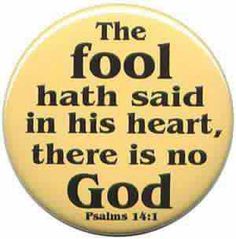 Biblically speaking atheism is considered folly because God has gone to great lengths to reveal himself to mankind. Paul, when writing to the Roman church divided God’s revelation of himself into two categories; he spoke of things being manifested “to us and in us.”
 David makes reference to the fact that he was born into sin. He realizes that his sin is not just a mistake that he made but a consequence of his very nature. The bible teaches that sin was passed down to us from Adam and has affected all of us making all of us sinners. Reforms are good and necessary both individually and nationally but these reforms cannot change our nature. We can become better husbands, fathers, neighbors and citizens but until we are born again we still have a nature that is unredeemed and we will be forbidden access to heaven.
