1 Corinthians 4:6-7
“. . . that none of you may be puffed up on behalf of one against the other. For who makes you differ from another? And what do you have that you did not receive? Now if you did indeed receive it, why do you boast as if you had not received it?”
 Paul warns of the danger of pride. He refers to it as being puffed up; a term that has withstood the test of time, and is still used today. When we see someone who is filled with pride, we might say they are filled with self, puffed up, or even that they have a big head. Paul reminds us of the folly of elevating ourselves above one another, by exhorting us that what we have, we received from the Lord.
This passage reminds me of the story of Absalom, the son of King David, whose life was marked with pride and whose death was fitting. We are told, in the heat of battle, while fleeing from Joab, he rode under a low hanging tree branch and his head was stuck. Moments later, Joab arrived and slew Absalom. He literally died because his head was too big. Absalom was a man born into privilege. He was the son of the king, raised in the palace, given the best education and upbringing available at the time. His palace life would afford him connections with the most prominent people of the day, and provide him with a life of influence. In addition, the Bible describes him as an extremely good-looking man. He was praised throughout the nation for his looks. No doubt women were wooed by him, and men envious of him. But rather than looking at these as gifts from the Lord, and opportunities to be useful for the kingdom of heaven, Absalom was filled with pride. We are told, he was so in love with himself, that at the end of every year he would get a haircut, weigh his hair and publish the results. Of all the things we take pride in, that has to be one of the most ridiculous.
What have you done to determine the amount of hair that you have? The answer is nothing, it is hereditary. If you are bald or if you have a flowing mane, it is not because of something you accomplished, it is like being proud that you are tall. Paul reminds us, “what do you have that you did not receive? Now, if you did indeed receive it, why do you boast as if you had not received it?” Everything we have is an evidence of the grace of God. Rather than thinking of ourselves as better than another, we should use the gifts, privileges and opportunities we have been given, to serve one another, and to further the kingdom of heaven.
Pastor Jim
Questions for 1 Corinthians 4
- Paul says that he is a servant of God and a steward of the (previously hidden) truths of God. A steward is a person who manages things that another possesses. In verse 2 we are told the one primary requirement for a servant/steward of God. What is that?
- Read Proverbs 29:25. Paul is not the least bit concerned with any kind of judgment that people would make concerning him. Why is this? (Read verses 3-4) Do you find yourself overly concerned with what people think of you?
- Paul advises us to be careful about making judgments until the Lord’s coming. He tells us three things that will happen at that time. What are they? (verse 5)
- Paul uses an interesting phrase in verse 6, “learn in us not to think beyond what is written, that none of you may be puffed up on behalf of one against the other”. What does this verse mean? What are some ways that people think beyond what is written? How does this cause them to look down on others?
- Paul asks three questions in verse 7, starting with who, what and why. Ask these questions of yourself.
- In verses 8-14 Paul chastises the Corinthians for their pride. He does this by putting into perspective their “talk” with his “walk”. What are some of the things that Paul had gone through that validated his apostleship? (there are at least 10 in these verses)
- Paul tells them that although they have a lot of good teachers, they don’t have many spiritual fathers. What are some of the differences between a teacher and a father?
- What does Paul tell them in verse 16? Look up 1Cor 11:1. Can you say this as well?
- Paul sums up this chapter in verse 20. Walking the walk, not just talking the talk. Examining your own life, do you pay Jesus lip service only, or do you pay Him life service?
Old Testament:
Esther 3- Living Differently
Esther 4- Platforms
 Paul mentions four types of people in the opening verses of this chapter. He refers to mere men (some versions read natural man), babes in Christ, carnal men, and finally spiritual men. These terms represent a natural development in the spiritual life of an individual. Natural man refers to a person before they place their faith in Christ. The natural man is living, breathing, walking, talking, perhaps even loving, giving, sharing and caring, but the natural man is separated from God, and living in sin. It is when the natural man hears the message of the cross, recognizes his need for a savior, and places his faith in Christ, that his sin is forgiven and he is born again into the family of God. At that point, he becomes a babe in Christ. Like all babies, the new Christian must be cared for. He needs constant companionship, encouragement, example, and a diet of the simple teachings of the Word of God.
 The things God has planned for each of us are better than anything we could ever imagine. Rather than leaving us to our imagination, Paul declares these things are revealed to us by the Spirit of God. It is the desire of God that we know Him, and we understand the things He has planned for each of us.
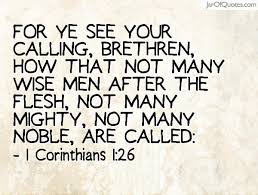 Paul reminded Timothy that Jesus Christ came into the world to save sinners. That was His purpose, His passion, and what He labored diligently towards. After the resurrection, Jesus called His church to be involved in this same purpose. He commissioned men to “Go into all the world and preach the Gospel.” This is the greatest of all vocations and carries with it the highest honor. Charles Spurgeon once wrote, “If God has called you to preach do not stoop along the way to become a king.”
 Years ago, I received a letter; I had been selected to be awarded for my accomplishments as a teacher. Upon reading the first paragraph, I was honored and somewhat humbled. My ego was stroked, as I was being told of the great responsibility I was fulfilling by teaching others. However, as I continued to read, I discovered any teacher who was willing to purchase the hundred-dollar, leather-bound book, would have their name listed in it. Even though I knew it was a scam, I was still slightly tempted to have my name in a book honoring me for my accomplishments.
 This chapter contains many prayers of which this is the first. Paul is praying that the church might be like-minded, or rather, have one mind. As we look at the church today we see it is anything but one-minded. Worship styles vary from rock bands to congregational hymns; some churches meet in traditional buildings, while others meet in schools, parks or store fronts. Doctrinally, some churches are Calvinistic, Arminian, or somewhere in between. We have pre-, post- and mid-tribulation teachings, and there are even different views on how to perform a baptism.
 A Christian by the name of John Donne (1572-1631), is credited for the saying, “No man is an island.” He wrote it in a devotional message speaking of how our lives affect one another. Paul is writing about the same idea, because we are part of the body of Christ, our lives effect one another. The decision I make to follow the Lord will have an impact upon those around me, and their decision will impact me. In more recent times, a song was written with the chorus, “I don’t need anyone, I am really having fun being all alone, I am an island.” The song was a parody, where the artist was addressing the modern idea that our lives are our own, and our sins do not effect anyone else. Paul goes on to write,
 I can remember times, as a child, when I had to wake up very early for an event I was looking forward to. I would set my alarm, and a backup, then wake up over and over again through the night to check the time. I did not want to sleep in and miss out. I recall, one morning, hearing the alarm go off, getting out of bed, getting dressed and walking out to the living room, where I put on my shoes. After a few moments, I heard my mom’s voice asking me what I was doing. As I began to answer, I noticed all the lights were on and my parents were watching television. It was eleven p.m., I had only been asleep for about an hour, and had dreamt I heard the sound of my alarm clock.
 Over the years, I have found most of us are trying to determine God’s will for our lives. We have come to understand, His ways are better than our ways and if we desire abundant life, we want to be in the center of His will. Most of us have heard the story of Jonah, a man who refused to go where God wanted him and was consequently swallowed by a large fish. I do not want to spend any time in the belly of the beast, and would much rather go where God wants, and do what God wants. Part of His will can be difficult to decipher and is only determined by following the example of Mary, sitting at His feet. If you are trying to decide what job to take, who to marry, or if you should have another child, the best thing to do is spend time with Jesus.
 Paul is referring to one of the most difficult times in the life of the prophet Elijah. He lived during a time when the nation of Israel had turned from the Lord and had become steeped in idolatry. As the people stood in the valley of decision, swaying between a decision to follow Jehovah or become more like the world around them, Elijah stood boldly for the Lord and saw the beginnings of a national revival. This did not come without a price. Jezebel, the queen who was openly opposed to the ways of God, began a campaign to see Elijah killed. These were not idle threats, for she had been responsible for the death of many of the prophets of God. Elijah saw no other course of action except to flee. He ran from Mount Carmel in the north of Israel, all the way to the wilderness where Moses had received the Law of God. There, in a place of solitude, he began to cry out to God. “I alone am left of the prophets of God and they seek to take my life.” He truly believed that his life was over and there was no escape from certain death. His fears led his heart to speak, but in the midst of his trial, he heard another voice saying,
