Today’s Daily Reading: Jeremiah 45-46 & 1 Peter 5
Old Testament Reading: Jeremiah 45 – Self-Promotion
“Thus says the Lord: ‘Behold, what I have built I am breaking down, and what I have planted I am plucking up… And do you seek great things for yourself?'” – Jeremiah 45:4-5
 As the nation teeters on the brink of collapse, Jeremiah is given a prophetic message for one man, Baruch. Baruch was an assistant to Jeremiah. One of his main roles was that of a scribe. He was responsible for writing down Jeremiah’s messages in book form and delivering them to the kings. We have every reason to believe that Baruch served Jeremiah, and the Lord, faithfully. But even faithful men are in need of correction from time to time. Often Christian service goes unnoticed, especially when we are in a support role in ministry. We might… Read More
Old Testament Reading: Jeremiah 46 – Armed and Dangerous
“Order the buckler and shield,
And draw near to battle!
Harness the horses,
And mount up, you horsemen!
Stand forth with your helmets,
Polish the spears,
Put on the armor!” – Jeremiah 46:3-4
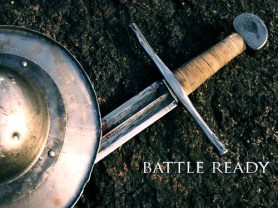 As the forces of Egypt prepared to go to battle with Babylon, Jeremiah describes the battle scene. He paints a picture of soldiers with weapons in hand and clad with armor. His battle scene has been repeated countless times over in human history, as one force prepares to defend itself against another. I cannot help but notice a few similarities to the battle we face as believers. First, it is critical that we…Read More
New Testament Reading: 1 Peter 5 – Throw It All Away
“. . .casting all your care upon Him, for He cares for you.” – 1 Peter 5:7
 Cares, concerns, worries, and anxiety are all relatively synonymous terms. They speak of the things in life that fill us with fear, rob us of peace, overwhelm us, and stress us out. There are numerous things that create this kind of anxiety; some of them are real and others irrational, but all of them seem to have the same effect upon us…Read More
Visit the top menu to search blogs by blog and chapter.
 After the fall of Jerusalem to Nebuchadnezzar’s forces, the inhabitants of Judah began to look to Egypt as a place of refuge. Jeremiah warned them that fleeing to Pharaoh would result in further death and destruction. The same people who refused to listen when the prophet told them to willingly go to Babylon, are the people who are now fleeing to Egypt. On the one hand, the Word of God told them to go, on the other…
 God warned the people not to flee to Egypt for help. He knew the Babylonians would soon defeat Egypt and any who were In allegiance with her. Despite these warnings, many of the people chose to depart from Jerusalem and Judah, making their way to Egypt. When questioned by Jeremiah as to why they chose to disobey the clear commands of God, they responded that life was easier when they worshipped the “queen of heaven.” The real reason they fled the commands of the Lord was they wanted to worship other things…
  Peter gives a series of exhortations, all predicated upon the fact that the end is near. When the Bible refers to the end of all things, it does so, not out of fear or despair, but out of joy and anticipation. For the believer, the end of all things means Christ will call His church home, and ultimately return to set up His earthly kingdom, where He will reign and rule in righteousness…
  After conquering Judah and Jerusalem, Nebuchadnezzar appointed Gedaliah governor over the people. He allowed many of the Jews to remain in the land, and gavethem certain freedoms regarding their worship. Soon, those who had fled from Jerusalem…
  A few years back I attended a men’s conference where this verse was shared during a worship session. Like most, I was encouraged by the sentiment of it, until I recalled the context. You see, as beautiful as the verse is, it is declared by a group of people who have no real intention of doing what the Lord says. The verse might better read, “we will obey as long as the Lord tells us what we want to hear…
  Shortly after coming to Christ, I was driving down PCH in Southern California and found myself stuck at one of the many red lights, waiting for the arrow to turn green so I could continue to my destination. It was a summer day, and since my car did not have AC, my windows were rolled down. A car pulled up next to me and the driver called out to get my attention. I had never seen him before, and to my knowledge have never seen him since, but what he said…


 Jehoiachin, the last King of Judah, will forever be known as the one sitting on the throne when the nation fell. The collapse was not entirely his fault, although his wickedness did play a part. While very few details are preserved regarding his actual reign, we are told that after 37 years in prison, he was suddenly released and treated favorably. Jeremiah does not give an explanation of the details leading up to his release, but as Scripture unfolds, we can uncover the heavenly reasons behind it.
 As Jeremiah writes this, Jerusalem is smoldering in the rubble of its own destruction. Babylonian forces have taken the people captive, burned the city to the ground, and set up their own government to rule over Israel. Since the cause of Judah’s fall was their stubborn rebellion against the Word of the Lord, it would seem logical to conclude that God had forsaken His people. Jeremiah declares that those who are in covenant relationship with God, will not be utterly forsaken, even when we have sinned against Him.
 One of the greatest benefits of being in a relationship with God is the forgiveness of sin. God explains that although we have transgressed His laws, the covenant provides pardon. In Israel’s case, it was through temple sacrifice, in ours, it is through the blood Christ shed at Calvary. The forgiveness He offers is complete. All sin, and it’s penalties, are washed away in the priceless blood of Christ. When God forgives, nothing will ever be brought up again.
 Some things never change. The sun will always rise in the East and set in the West, water will always be wet, and a person in a backslidden state will always deceive themselves, about their spiritual condition. This was true 2600 years ago in Ammon, and it is true today.
 Jeremiah is describing the judgment that will fall upon Moab. He explains, in vivid fashion, that one of the chief causes of their wickedness was the fact that they were like a vessel which had never been cleaned. Their failure to allow the difficulties of life to purify their actions, ultimately lead to their judgment and destruction.
 Jim Gallagher