Isaiah 58:6
“Is this not the fast that I have chosen:
To loose the bonds of wickedness,
To undo the heavy burdens,
To let the oppressed go free,
And that you break every yoke?”
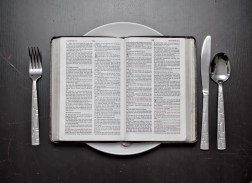 In one of His longest recorded sermons, Jesus spoke of 3 spiritual exercises that every believer should be practicing. He spoke of giving, praying and fasting. Fasting is the practice of giving up food for a period of time in order to learn to deny ourselves and to devote more attention to the things of God. Sadly, instead of viewing fasting as a way to draw near to God the people in Isaiah’s day were treating it as a religious responsibility. It was almost as though it was part of their checklist. They felt that fasting itself made them spiritual and they saw little need for their lives to be affected by their professed relationship with God. Isaiah declares that a real fast will will give evidence of a transformed life.
William Booth was the man behind the Salvation Army. About one hundred years ago he was asked what he thought were the greatest dangers the church was facing in the years ahead. His response is quite intriguing. He said:
“The chief danger that confronts the coming century will be religion without the Holy Ghost, Christianity without Christ, forgiveness without repentance, salvation without regeneration, politics without God, heaven without hell.”
In other words he spoke of a form of Christianity that has little impact upon the way a person lives their life. He foresaw churches filled with people who raise their hands in worship, drop checks in the offering box and perhaps even sign up for ministry opportunities yet they fail to allow the Spirit of God and the Word of God to transform their lives.
Instead of emphasizing religious duties we should be seeking to become like Jesus in every possible way. A real commitment to Christ will show itself in a life that is changed.
Jim
 Isaiah foresaw a day when people from all nations would be adopted into the family of God. He saw salvation reaching beyond the borders of Israel to the uttermost parts of the earth. Seven hundred years later Jesus entered into the temple and saw the outer courts turned into a marketplace. Instead of people being encouraged to to come to God they were being hindered. The religious leaders for the sake of financial gain and status among the people were actually keeping people from the Lord. At some point a sign was placed on the entrance of the temple warning Gentiles not to enter under the threat of death. When Jesus saw the actions of the leaders He was outraged. He began to overturn the tables and drive out those who were buying and selling. It was at that point that He quoted from this passage,
 It seems as though people have always had “bucket lists.” In ancient times a man put together a list of the seven wonders of the ancient world. It was like a travel guide for the wealthy, of things needed to be seen before they died. Things have not changed much. People still have their wish lists of the sites they hope to see before they are too old to enjoy them. Of all the beautiful things we could see I don’t imagine anything more amazing than seeing a person who has come to our rescue. Imagine being abandoned on a remote island and seeing a Helicopter, or being held captive by an assailant and seeing the prison doors burst open and police have come or being under siege by an enemy and the cavalry has appeared. Of all the beautiful sites their are to see none can compare to seeing the one who has come to set us free.
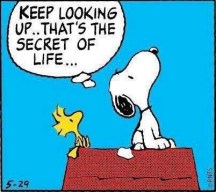 We use filters every day to keep things pure. A coffee filter keeps the grinds out of the cup, an air filter helps to eliminate dirt and pollens from the air and a water filter keeps harmful impurities out of our drinking water. Isaiah suggests that it is a good idea for us to have a filter for our eyes. He declares that we should look up at the heavens and down upon the earth. The purpose of his “eye filter” is to help us see the difference between the temporal and the eternal. Too often we get fixated upon things that will not last while ignoring the eternal. Jesus echoed the words of Isaiah when He said; “Heaven and earth will pass away but my words will by no means pass away.” Peter wrote that the heavens will melt with a fervent heat and John spoke of a new heaven and earth replacing the one we live in.
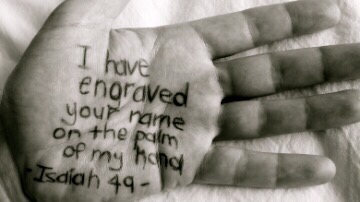 Back in the stone ages, when I was in middle school, it was common for the guys who “liked” a girl to write her name on their notebook or on the side of their shoe. I remember liking a girl named Carol, but being afraid to really admit it, so I wrote her name on the soul of my shoe. It didn’t take long before her name wore off (and the relationship didn’t last much longer than that). I am so glad when I read that God has inscribed our names upon the palm of His hand. What a beautiful description this is of the love He has for us. The word “inscribed” in its noun form means lawgiver. It speaks of the one who inscribed His word on tablets of stone. His love for us is as unchanging as His word.
 Sitting in the dust, like wearing sackcloth or throwing dirt in the air was a sign of mourning. It was not uncommon in the ancient world for a person stricken with grief to express it outwardly. Those who lost a loved one, or were burdened by personal sin were easily identifiable to the people around them.
 In Isaiah’s time, it was a common practice, among the people, to fashion gods out of metal, wood, or clay. These little idols formed by their hands, were a reflection, not of the God of Scripture, but rather of the imaginations of men. Their idols were designed to bring them comfort in times of trouble. When things became difficult, they might hold their idol close like a small child with a stuffed doll. The problem, of course, was the comfort these idols brought was merely psychological. These graven images could not heal a sickness, provide during times of need, deliver from oppression, or give eternal life.
 The Bible often uses figurative language to enhance our understanding of spiritual things. Jesus is referred to as a Lion so we would reflect upon His power and a Lamb so we would understand His humility and willingness to be sacrificed for our sin. The devil is also represented with figurative language. He is referred to as an angel of light who goes about to deceive and a roaring lion who seeks to devour his prey. Here in this text it seems likely that Isaiah is referring to Satan as a twisted serpent who will ultimately be destroyed by the sword of the Lord. Satan is referred to as a serpent in other texts. In fact the first mention of him is in the garden where he appears as a serpent to deceive Eve and lead her into rebellion against God. Later, the book of Revelation takes us into the future where we see the dragon defeated, chained and cast into the bottomless pit.
 Jim Gallagher