Exodus 28:12
“And you shall put the two stones on the shoulders of the ephod as memorial stones for the sons of Israel. So Aaron shall bear their names before the Lord on his two shoulders as a memorial.”
 When I am deciding on what to wear, one of the key factors is comfort. I have owned clothing that fit and might even have looked nice, but I rarely ever wore, because it simply was not comfortable. I imagine if I had a coat with two large stone shoulder pads, it would not be my first choice for a Sunday service.
When it came to the clothing of the priests ,comfort was not the goal. Instead, their clothing was designed for symbolism. Every article they wore spoke volumes regarding God and the ministry. One of the most telling pieces was the stone shoulder pads with the names of the tribes engraved upon them. Each morning, when the priests suited up, they were reminded that they carried the burdens of the people into the presence of the Lord. I cannot think of a better way to illustrate the need for, and value of, intercessory prayer, than a man carrying the names of his friends and family members on his shoulders.
The New Testament reminds us to bear one another’s burdens. This can be accomplished by entering the Throne of Grace on behalf of another and praying for the things which are bearing weight upon their lives. When a friend is struggling with loss, sickness, confusion, or any other of a long list of things that tend to weigh upon us, we can ease their burden with intercession.
Take some time to make a list of people close to you and begin to carry their burdens into the presence of God. You will be amazed by how much you begin to care about them, as well as, seeing how God intervenes in their lives.
Pastor Jim
 One of the key furnishings for the Tabernacle was the Altar. It was a large wooden structure overlaid with bronze. It was located within the gate of the courtyard, and outside the entrance of the Tabernacle, itself. It was on the Altar, where all of Israel’s sacrifices were offered. After the construction of the Tabernacle was completed, the nation gathered around and dedicated it to the Lord; concentrating on the Altar, with its sin offerings.
 A few years ago I heard a word I had never heard before, or ever dreamed could be real. That word was “glamping.” “Glamping,” according to the urban dictionary, is “a form of glamorous camping done by urban types.” Those who “glamp” turn tents into elaborate structures with all the comforts of home. Once inside the tent, you are sure to forget you are in the wild. Of all the glamorous tents ever constructed by these wanna be campers, none could compare in beauty or cost to the Tabernacle Israel built in the wilderness. At the current value of an ounce of gold, the Tabernacle would have cost more than $50 million just in materials. The question is, where did all that money come from?
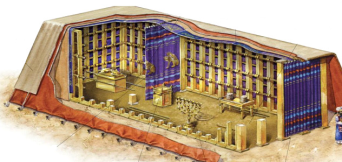 Moses was invited by God to ascend Mount Sinai. Upon reaching its pinnacle, he received the Law of God, and the blueprints for the Tabernacle. The Law was given to reveal the perfection of God, and the sinfulness of men. Had Moses descended the mountain with only the Law, humanity would have been forever condemned. Fortunately, Moses was also given design plans for a large and elaborate tent called the Tabernacle. This tent was designed as the meeting place between God and man. Over and over, we read of it being built “according to the pattern which you were shown in the mountain” Exodus 26:30. This heavenly pattern would serve as a means to reveal God’s plan of salvation. Each and every detail of the Tabernacle, would serve as a picture of the sinfulness of man, the holiness of God, and the way to fellowship with God. Nothing revealed this more than the veil which divided the Tabernacle.
 “If you want something done right, you have to do it yourself.” I am quite certain most of us have heard this little slogan. The lesson in it is, there is no way to get a job done properly, unless you alone are the one to do it. I would guess each of us could supply loads of empirical data that would support such a statement. We have all given a task to another, only to find they proved less than qualified to accomplish it.
 The Law of God was given as a standard to show the people their need for a Savior, and as a pattern to ensure that the people lived righteous lives. Here we find a principle that would protect Israel from becoming like the surrounding pagan nations. God is declaring that popular opinion is not what determines right from wrong. Almost every child has heard his parents say, “Would you jump off a cliff if your friends were doing it?” We attempt to instill within our children the principle that just because the crowd is behaving a certain way, it does not make it right. Sociologist refer to “mob mentality.” They say it is possible for individuals to lose the ability to think for themselves, and begin to follow whatever the crowd is doing. Living in a democratic state can make this even more complicated. God declares to Israel that popular vote is not the standard of righteousness. If all the people vote to erect a golden calf to represent God, that does not make God a gold cow. His righteous standard will never be changed simply by getting a crowd to reject it.
 The purpose of Israel’s time at Mount Sinai was to develop as a nation upon the foundation stone of the Word of God. Moses went up the mountain alone, and came down the mountain with clear and detailed instructions from heaven regarding how the people should live. These instructions are referred to simply as “The Law” and can be divided into three groups. The Moral Law is a list of unchanging standards God set upon mankind. The Religious Law was designed to instruct the people regarding relationship with God, and the Civil Law was created to keep order. Since God was forming this traveling band into a nation, it would be necessary to also establish leadership, and because of the nature of men, it would not be long before the people would begin to complain about those who are in charge. Knowing this was coming, God declares,
 Paul often referred himself as a servant, or a slave. The word he used was “dulous”, which means bond-slave, or a person who was bound to another. It is not difficult to find examples in history of people who have been enslaved. Some are slaves because they were conquered in battle, others for religious or ethnic persecution, and still others because of debt or a criminal offense. It is quite difficult, however, to find examples of people who chose slavery as a way of life. I suppose no ambitious students ever pursued slavery as a career path, seeking a university that offers a good slave training program. Yet Paul refers to himself as a bond slave of Christ. Exodus 21 gives a vivid picture of why Paul would choose to be a slave.
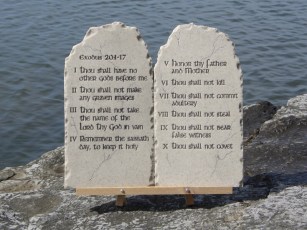 On the top of a mountain covered in smoke, Moses met with God, and heard the standard upon which relationship with God would be established. The Lord gives a list of ten commands that reveal His holiness, and our need for sacrifice. The first four commands reveal things about the nature of God. We learn, along with being jealous, just, merciful, faithful and holy, He is also the only true God and must not be reduced to an image or an idol.
 I imagine if any of the people in this massive caravan were asked where they were headed, they all would have given the same answer, “We are going to the Promised Land.” They had grown up with stories of a land flowing with milk and honey; had been dreaming of this day for generations. Their goal was to reach a land where they were free from the tyranny of Egypt. At the same time, if we were able to look up and ask the Lord where this multitude of people was headed, His answer would not be the same. To Him the destination was somewhere entirely different. God said “I am bringing them to myself.”
 Jim Gallagher