Deuteronomy 17:18-19
“Also it shall be, when he sits on the throne of his kingdom, that he shall write for himself a copy of this law in a book, from the one before the priests, the Levites. And it shall be with him, and he shall read it all the days of his life, that he may learn to fear the Lord his God and be careful to observe all the words of this law and these statutes, . . .”
 Looking centuries ahead into Israel’s future, God speaks of the principles that should govern the life of the king. Four important principles are established which every leader would do well to observe.
First, the king was not to multiply horses for himself. Horses were used in warfare and gave an army a distinct advantage over those who did not have a cavalry. While it is true God wanted the king to trust Him for the protection of the nation, the real reason for not multiplying horses was, the people were not to return to Egypt. Egypt was always a picture of the past life, the life of bondage, the life before being delivered by the blood of the Lamb. If we are going to succeed in following Christ, and leading others, we have to leave the old life behind, and never resurrect the things that were laid down at the cross.
Second, the king was not to multiply wives to himself. It was a common practice among ancient Oriental kings, to have many wives. Their harem was a sign of their position. I think one of the principles behind this, Israel was not to establish their sexual morals based upon the standards of the world around them. Today, it is not common for men to have multiple wives (at least not at the same time.) However, it is common for people to have sexual relations before marriage, outside of marriage, and to treat marriage as a disposable contract that can be erased because we are no longer happy with our spouse. If we are going to successfully follow Christ, we can not let the world determine the way that we are to live.
Third, the king was not to greatly multiply silver and gold for himself. It was not wrong for the nation to have an army or for the king to have a wife. Nor is it wrong to succeed financially, and even acquire great wealth. Often the Bible is misrepresented when we declare “money is the root of all evil.” The Bible actually declares, “the LOVE of money is the root of all kinds of evil.” (1 Timothy 6:10) The principle: the king was not to have a divided heart, loving mammon and the Lord. Nor was the king to put his trust in the bank account of the nation, but in the provision of the Lord. If we are going to succeed in following Christ, we cannot have a divided heart.
Finally, and perhaps most importantly, the king was to transcribe his own copy of the Bible, and read it every day. This would ensure that he did not exalt himself above the people, or wander from the ways of God. The most important principle in leadership, is to be a good follower. If we want to lead others to Christ, we must follow Him ourselves. The more we get to know the Word of God, the easier it is to follow him.
What transformation would our nation experience if our leaders put these principles into practice in their lives, and leadership?
What transformation would your life, family, and community experience, if you put these principles into practice in your life and leadership?
Pastor Jim
 God established three retreats in the calendar year for His people. Three times a year they would gather together to celebrate the Lord, and what He had done for them. At the Feast of Unleavened Bread, they were to remember the way they were supernaturally delivered from Egypt. At the Feast of Weeks, they were to remember they were once slaves in Egypt. And at the Feast of Tabernacle, they were to rejoice over the new life they had in the land.
 Even in ancient times, life was often difficult. Conditions, beyond the control of an individual, would leave him in a place where he could not pay his debts. To address this issue, God set up a system in Israel where a person could become an indentured servant for a period of seven years. During this time the work done by the individual was treated as payment for the debt owed. At the end of seven years his debt was considered as paid-in- full and he was set free. This was called the year of release, and when it arrived the servant was set free and loaded up with provisions to begin a new lease on life.
 Among many of the pagan cultures, it was a common practice to cut yourself as a sign of mourning for the loss of a loved one. This practice served to show others the deep sorrow you were experiencing, as a result of your loss. Moses makes it clear, the children of God are NOT to follow this custom. The reason behind this command was that the child of God is not to mourn like the heathen mourn. Years later, Paul wrote to a group of Christians in Greece, who were dealing with the difficulty of death. He said,
 John 3:16 is the most famous verse in the Bible because in twenty-five words it captures the entire message of Scripture; there is a loving God who will freely give eternal life to all who believe in His Son Jesus Christ. Deuteronomy 13:4 is similar in that its twenty-eight words capture so much of what it means to walk with with God. Moses gives six steps that will lead to success in following Christ.
 There is no question, the children of Israel made mistakes. Their years in the wilderness were marked by complaining, doubt, fear and outright disobedience. Yet, things could have been worse. They could have remained in Egypt, never experiencing any of the great acts of the Lord. Moses reminds the people of what they saw because they were willing to follow the Lord. He recalls the parting of the Red Sea, their provision in the wilderness, and the judgment of those who rebelled.
 Imagine being on a team that has lost most of its games. Time after time, no matter who your opponent was, you figured out a way to lose. Now, imagine your team is about to face the best team in the league. How confident do you think you would be as the coach begins
  We often feel like the struggles of our flesh are too great to ever overcome. Since we have been fighting the same battles our entire Christian life, it is easy to become discouraged, and even to allow things that should be removed, to remain. Knowing that this would be the case, Moses instructed Israel what to do when they became overwhelmed by the magnitude of the battles they were facing.
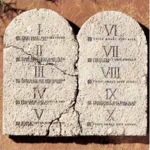 The commandments of God were given to the people of God so they had a standard by which to govern themselves. These laws were given the highest place of honor in the nation. They were placed within the Ark of the Covenant, in the Holiest place within the Tabernacle. Years later, when the Tabernacle was replaced with Solomon’s Temple, the only articles remaining in the Ark were the two stone tablets containing the commands of God. We need to understand, God’s design for His people was that He be at the center of their personal, and their national lives. The center of the nation was the Temple, the center of the Temple was the Ark, and the center of the Ark was the Word. The people of God must always be governed by the Word of God.
 Life is a lot like a journey on a road we have never traveled before. We often face forks in the road without clear signage, and are left to do our best to make a good decision. If there is one thing we need in life, it is wisdom. Webster’s dictionary defines wisdom as “the ability to discern” and “good sense.” We might best understand it as, “knowing what to do.” In life, we often face challenges we do not have answers for, and we need wisdom.
 Jim Gallagher