Psalm 109:2
“My knees are weak through fasting, and my flesh is feeble from lack of fatness.”
 When I read the songs of David, I am fascinated with the level in which He knew the Lord. He expresses praise in a way that reveals the depths in which he understood the majesty of God. He speaks of mercy, grace and loving-kindness, not as one who studied it in a classroom, but as one who experienced it daily. This psalm reveals the level in which David understood the justice of God. If this Psalm seems harsh, it may be partly due to the limited understanding we have of God’s justice. We live in a world that finds it difficult to reconcile love, mercy and justice. We see it as unloving to punish an offender, yet we know it to be unjust to allow them to go free. It is common to project our limited understanding of righteousness on the Lord, only to then accuse Him of wrongdoing when He judges the ungodly. We must never forget, God is a holy and just God. When sin is committed it must be judged, God will bring justice upon those who have rebelled against Him, and mistreated His children. Ultimately, this judgment will be punitive and those who have rejected Christ will be separated from God.
CS Lewis put it like this, “God in the end really gives people what they want, including freedom from Himself. What could be more fair?”
But until then, the judgment of God is meant to draw people to Himself. God does not want the rebellious to continue in their sin, ignorant of how He feels about it. Instead, He desires all men everywhere to be saved.
Before we are too hard on David for the intensity of his prayer regarding the wicked, I think we have to visit where he had been. I am not talking about going through the kind of hardship that make us callous to others, but rather I am referring to the statement David makes in verse 24,
“My knees are weak through fasting, and my flesh is feeble from lack of fatness.”
To be honest, I am humbled by these words. David describes the physical weakness he experienced as a result of the intensity in which he was seeking the Lord. His prayer for the wicked to be judged was not birthed out of their mistreatment of him, but rather out of his time spent seeking the Lord on their behalf. The best thing for those who are living in rebellion against God is to taste a little of His severity, if it will bring them to a place of repentance that they might avoid eternal judgment.
As you seek to understand this Psalm, take a few moments to pray for your loved ones who are still living apart from Christ. Pray that they would surrender all without having to go through any more of the severity of God.
Pastor Jim
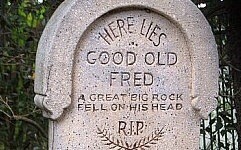 I can remember as a child, standing in line to enter Disney’s Haunted Mansion. While I have forgotten most of the details about this particular attraction, the epitaphs on the gravestones left an indelible mark on my memory. One read, “Here lies good old Fred, a great big rock fell on his head.” Another read, “Dear departed brother Dave, he chased a bear into a cave.” I wonder what will be said of me when my time reaches it’s end.
 1Chronicles 9 is a record of those who lived and served in the city of Jerusalem. Because the Temple resided in this city, it became the religious capital of the nation, and the place where much of the service of God took place. Here, we read about a vast array of people with diverse gifts and callings coming together to accomplish the work of God. Among those listed are leaders, priests, Levites, gatekeepers and singers. Each person had a different calling which required unique skills and gifts. It was when each one served faithfully within his own calling, that the ministry was accomplished in a way that glorified God.
 As Israel followed God out of Egypt and through the wilderness, they faced many obstacles. Some of the more memorable ones were the Egyptian army, the Red Sea, and the wilderness without food or water. These obstacles became opportunities for them to see God accomplish great things. He parted the Red Sea, exterminated the Egyptian army, provided water from a rock, and sent food from heaven to feed His people. As time went on, the people grew tired of the provision of God, and began to yearn for something else. This passage refers to an event recorded in Numbers 11, where the people complained to Moses about the Manna. In response, the Lord sent an enormous flock of quail. The people went nuts beating the quail out of the sky and devouring the flesh. It seems from the text, they were so out of control in devouring the quail, that they did not cook it properly and became sick from it. The Psalmist writes; “They lusted exceedingly in the wilderness.”
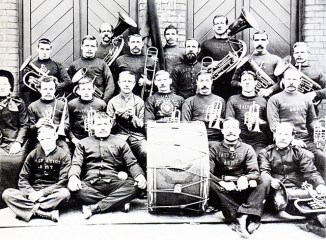 What an interesting phrase, “the service of song.” The word service is a translation of the Hebrew word “Yad”, meaning hand. The idea implies they were putting their hands to the task of serving the Lord with music. When I think of service, I usually think of some sort of labor. Lifting, carrying, working, and sweating are all words that come to mind when I consider service. However, here we are reminded, service can be as simple and as sweet as offering a song.
 This passage reminds us that, in ministry, it is not our natural ability, but the enabling of God that is required for service in the kingdom. In the verses leading up to this, we find the tribes of Reuben, Gad and Mannasseh combined to form an army of nearly forty-five thousand men, but it was not their size that gave them success. These men are described as valiant and capable, but it was not their bravery, ingenuity, creativity or vision that led to their victory. Instead, we find they were victorious because they cried out to God in battle,and they trusted in Him.
 It is a common advertising strategy to attempt to sell an item by comparing it to something else. We might see a car commercial with a cheetah running, to convince us of the speed of the vehicle; or a flowing river, to reveal the thirst quenching power of a soft drink. David is, in a sense, attempting to sell us on the greatness of God. He knows the Lord and wants everyone to taste and see for themselves that the Lord is good. To do this he makes a series of comparisons, to convince us to trust in God.
 Tucked away in a sea of names, we find the brief story of a man named Jabez. From the bits of data recorded about him, we learn he was an honorable man who left a mark upon his world. His name reveals much regarding his upbringing. Jabez meant “to cause pain.” He received that name because of the difficulties surrounding his birth. It seems as though his mother never got over that trauma, because Jabez grew up thinking his life would cause continual pain to others. Instead of growing up in a home where he was nurtured and encouraged to become all God had designed him to be, Jabez grew up being reminded that his life would only cause pain in others.
 As we seek to follow Christ, we often fall along the way. Sometimes, we may only slightly stumble, while at other times, we may take quite a hard fall. It is not uncommon after failing, falling, or having a set back, that we may feel as though we can no longer follow or serve Christ. Without even knowing it, we have turned our relationship with the Lord into something reward based. We think we are blessed when we do what is right, and once we fail, we are no longer worthy of His love, favor or calling. Without a doubt, the low point in David’s life was when he fell into sin with Bathsheba. How remarkable to find that the next king of Israel would be her son, Solomon. The grace of God is an ocean so deep we could never fathom its depth or stop its flow. No matter how far we have fallen, He is able to redeem us completely.
 Since the opening chapters of 1 Chronicles are designed to give us an accurate genealogical account of Israel, very little commentary is given. When that pattern is broken, our attention should be grabbed. In the case of Achar, we find a brief reference to his story alongside his name. Achar, or Achan, lived during the conquest of Canaan. He was among those men who followed Joshua across the Jordan, into the promised land. His situation gave him opportunity to be heroic, until greed got a hold of him.
 Jim Gallagher