Isaiah 48:18-19
“Oh, that you had heeded My commandments!
Then your peace would have been like a river,
And your righteousness like the waves of the sea.
Your descendants also would have been like the sand,
And the offspring of your body like the grains of sand;
His name would not have been cut off
Nor destroyed from before Me.”

The Word of God is given to the child of God as a light to guide us through life’s darkness. Whatever we are facing, we should learn to look to the Bible for guidance. Isaiah details some of the benefits of living life like that.
First, he declares, this will lead to having peace like a river. Rivers have a constant flow that keeps the water fresh. A life lived in accordance with the teaching of Scripture, will be flowing with peace, even in the most difficult times. Jesus spoke of this peace being unlike anything the world could ever provide (John 14:27). In contrast, Isaiah writes,
Isaiah 48:22 “There is no peace,” says the Lord, “for the wicked.”
Second, Isaiah declares, a life lived in accordance with the ways of God will experience righteousness like the waves of the sea. Waves are an interesting phenomenon, they are created by storms; the larger the storm the larger the wave. Waves also develop by traveling over great distances. Strong winds, and lots of time, are what make waves bigger and better. In the same way, God will use the difficulties of life, and the time we spend walking with Him, to produce righteousness in us. This is only true, however, when we use the time to apply the Word of God. I remember hearing, as a kid, “Practice makes perfect.” As time went on, I also learned that practicing something incorrectly only makes it more difficult to re-learn correctly, later. In our trying times, we want to look to the Lord, and do things His way.
Finally, Isaiah speaks of the impact this will have on the next generation. He speaks of our offspring and our descendants being positively impacted by Our right living. I don’t think the impact our lifestyle has on the next generation could ever be overstated. If we want to see our children and grandchildren love, honor, and follow Jesus, we must set the pattern for them.
Remember, no matter what the past looks like, it is not to late for you to commit to Christ and live for His glory.
Pastor Jim
 Sitting in the dust, like wearing sackcloth or throwing dirt in the air was a sign of mourning. It was not uncommon in the ancient world for a person stricken with grief to express it outwardly. Those who lost a loved one, or were burdened by personal sin were easily identifiable to the people around them.
 In Isaiah’s time, it was a common practice, among the people, to fashion gods out of metal, wood, or clay. These little idols formed by their hands, were a reflection, not of the God of Scripture, but rather of the imaginations of men. Their idols were designed to bring them comfort in times of trouble. When things became difficult, they might hold their idol close like a small child with a stuffed doll. The problem, of course, was the comfort these idols brought was merely psychological. These graven images could not heal a sickness, provide during times of need, deliver from oppression, or give eternal life.
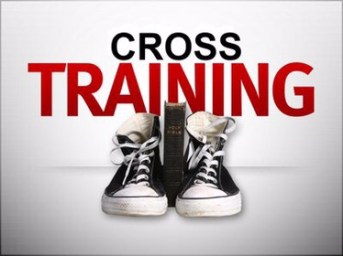 If you are like me, you have probably seen a great number of motivational quotes posted on your Facebook wall. Things like “Pain is only weakness leaving the body” – “The secret of getting ahead is getting started.” – “It’s never too late to become what you might have been” – or “just do it”. While many of us might benefit from a little more exercise, ALL of us will benefit from a little more godliness. Paul is not suggesting that getting in better physical shape is a bad thing, but is contrasting it with the benefits of being in better spiritual shape. He speaks of the profitability of godliness.
 The Bible often uses figurative language to enhance our understanding of spiritual things. Jesus is referred to as a Lion so we would reflect upon His power and a Lamb so we would understand His humility and willingness to be sacrificed for our sin. The devil is also represented with figurative language. He is referred to as an angel of light who goes about to deceive and a roaring lion who seeks to devour his prey. Here in this text it seems likely that Isaiah is referring to Satan as a twisted serpent who will ultimately be destroyed by the sword of the Lord. Satan is referred to as a serpent in other texts. In fact the first mention of him is in the garden where he appears as a serpent to deceive Eve and lead her into rebellion against God. Later, the book of Revelation takes us into the future where we see the dragon defeated, chained and cast into the bottomless pit.
 One of the great quandaries we face in life is how to reconcile the problem of evil with what we understand about the nature of God. The Bible teaches us the God is love and that He cares about each of His children and desires what is best for us. At the same time life seems to teach that evil runs rampant and bad things happen to good people. When we see an evil person suffer we might be able to chalk it up to justice but when we see those we perceive to be innocent impacted by great difficulty we often scratch our heads in bewilderment, struggling to understand how a loving God could allow such things to happen. No doubt the experiences of Job fit into this category. If we are going to understand the problem of evil there are a few things we need to keep in mind.
 Even a casual reading of the book of Job will reveal that this man is enduring intense suffering. His pain is both physical and emotional and has been intensified by he accusations and attacks he received from those he presumed to be his friends. It seems like Job has reached the boiling point and cannot endure it any longer. Under the pressure of his circumstances he determines to “Give free course to his compliant.” In other words, the guardrails are being removed and Job is giving himself license to freely complain about his circumstances.
 Not everything Bibdad the Shuhite had to say is worth listening to, but he has unlocked a very valuable treasure with this statement. He encourages Job to look back upon the lessons the generations before us have learned as we seek to chart out our course forward. There are others who have said the same thing in a different way.
 Life is filled with opportunities to minister to hurting people. Sometimes these hurts are caused by the unfortunate and unavoidable circumstances, other times they are self inflicted. Regardless of the cause we are all surrounded with opportunities to “strengthen the hands that hang down and the feeble knees.”
 Jim Gallagher