1 Chronicles 12:15
“These are the ones who crossed the Jordan in the first month, when it had overflowed all its banks; and they put to flight all those in the valleys, to the east and to the west.”
 As I read through 1Chronicles, I am struck by the heroic actions of those who served alongside king David. His reign led Israel to the height of their success as a nation, and resulted in establishing peace with the surrounding nations. This success was not accomplished alone, but was a result of heroic men who stood tall in the midst of great difficulty and opposition. This seems to always be the case. One person put it this way, “Heroes are not born they are made”, and it is clear it is the circumstances they faced that made their actions heroic. In other words, Heroes are made when men and women stand up against insurmountable odds and risk their own lives for the sake of others.
Those who have studied heroism, have found that the people who are most likely to take heroic steps are those who have been trained in helping others. For example, a person trained in CPR is more likely to step in and help a person who’s not breathing, than someone without any training. Our training in helping others will often spur us to act, rather than run or freeze in a crisis, even if we have never faced that particular problem before. Simply put, we can train to become a hero. As I look at this text, I am particularly encouraged by the training of David’s mighty men. Since their heroic act was crossing the swelling waters of the Jordan River, we can be certain they trained by carefully studying the pages of God’s word. It was in the quiet moments alone with God, and while sitting with others, being reminded of God’s victories in the past, that stirred faith in these men to tackle the obstacles in front of them.
In many ways, the future is uncertain; we are never sure what difficulties we may have to endure, but we can prepare for them daily, by spending time in the Scriptures. Paul reminds us that faith comes by hearing the Word of God (Romans 10:17). The more we familiarize ourselves with our Bible, the more likely we are to become a person who will act in heroic selflessness when difficulties arise in our own lives, or in the lives of others.
Pastor Jim

 My father-in-law uses the phrase,“So soon,” to chide anyone who is late. I personally have heard the term more times than I care to admit. The basic idea behind it is “I am glad you are finally ready, but what took you so long.” I cannot help but think of that phrase as I read of David finally sitting upon the throne as king of all Israel.
 When I read the songs of David, I am fascinated with the level in which He knew the Lord. He expresses praise in a way that reveals the depths in which he understood the majesty of God. He speaks of mercy, grace and loving-kindness, not as one who studied it in a classroom, but as one who experienced it daily. This psalm reveals the level in which David understood the justice of God. If this Psalm seems harsh, it may be partly due to the limited understanding we have of God’s justice. We live in a world that finds it difficult to reconcile love, mercy and justice. We see it as unloving to punish an offender, yet we know it to be unjust to allow them to go free. It is common to project our limited understanding of righteousness on the Lord, only to then accuse Him of wrongdoing when He judges the ungodly. We must never forget, God is a holy and just God. When sin is committed it must be judged, God will bring justice upon those who have rebelled against Him, and mistreated His children. Ultimately, this judgment will be punitive and those who have rejected Christ will be separated from God.
 I can remember as a child, standing in line to enter Disney’s Haunted Mansion. While I have forgotten most of the details about this particular attraction, the epitaphs on the gravestones left an indelible mark on my memory. One read, “Here lies good old Fred, a great big rock fell on his head.” Another read, “Dear departed brother Dave, he chased a bear into a cave.” I wonder what will be said of me when my time reaches it’s end.
 1Chronicles 9 is a record of those who lived and served in the city of Jerusalem. Because the Temple resided in this city, it became the religious capital of the nation, and the place where much of the service of God took place. Here, we read about a vast array of people with diverse gifts and callings coming together to accomplish the work of God. Among those listed are leaders, priests, Levites, gatekeepers and singers. Each person had a different calling which required unique skills and gifts. It was when each one served faithfully within his own calling, that the ministry was accomplished in a way that glorified God.
 As Israel followed God out of Egypt and through the wilderness, they faced many obstacles. Some of the more memorable ones were the Egyptian army, the Red Sea, and the wilderness without food or water. These obstacles became opportunities for them to see God accomplish great things. He parted the Red Sea, exterminated the Egyptian army, provided water from a rock, and sent food from heaven to feed His people. As time went on, the people grew tired of the provision of God, and began to yearn for something else. This passage refers to an event recorded in Numbers 11, where the people complained to Moses about the Manna. In response, the Lord sent an enormous flock of quail. The people went nuts beating the quail out of the sky and devouring the flesh. It seems from the text, they were so out of control in devouring the quail, that they did not cook it properly and became sick from it. The Psalmist writes; “They lusted exceedingly in the wilderness.”
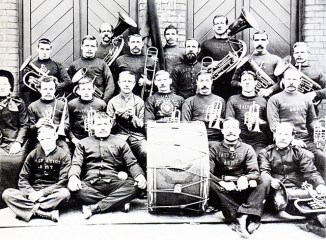 What an interesting phrase, “the service of song.” The word service is a translation of the Hebrew word “Yad”, meaning hand. The idea implies they were putting their hands to the task of serving the Lord with music. When I think of service, I usually think of some sort of labor. Lifting, carrying, working, and sweating are all words that come to mind when I consider service. However, here we are reminded, service can be as simple and as sweet as offering a song.
 This passage reminds us that, in ministry, it is not our natural ability, but the enabling of God that is required for service in the kingdom. In the verses leading up to this, we find the tribes of Reuben, Gad and Mannasseh combined to form an army of nearly forty-five thousand men, but it was not their size that gave them success. These men are described as valiant and capable, but it was not their bravery, ingenuity, creativity or vision that led to their victory. Instead, we find they were victorious because they cried out to God in battle,and they trusted in Him.
 It is a common advertising strategy to attempt to sell an item by comparing it to something else. We might see a car commercial with a cheetah running, to convince us of the speed of the vehicle; or a flowing river, to reveal the thirst quenching power of a soft drink. David is, in a sense, attempting to sell us on the greatness of God. He knows the Lord and wants everyone to taste and see for themselves that the Lord is good. To do this he makes a series of comparisons, to convince us to trust in God.
 Tucked away in a sea of names, we find the brief story of a man named Jabez. From the bits of data recorded about him, we learn he was an honorable man who left a mark upon his world. His name reveals much regarding his upbringing. Jabez meant “to cause pain.” He received that name because of the difficulties surrounding his birth. It seems as though his mother never got over that trauma, because Jabez grew up thinking his life would cause continual pain to others. Instead of growing up in a home where he was nurtured and encouraged to become all God had designed him to be, Jabez grew up being reminded that his life would only cause pain in others.
