Isaiah 52:7
How beautiful upon the mountains are the feet of him who brings good news, Who proclaims peace, Who brings glad tidings of good things, Who proclaims salvation, Who says to Zion, “Your God reigns!”
 It seems as though people have always had “bucket lists.” In ancient times a man put together a list of the seven wonders of the ancient world. It was like a travel guide for the wealthy, of things needed to be seen before they died. Things have not changed much. People still have their wish lists of the sites they hope to see before they are too old to enjoy them. Of all the beautiful things we could see I don’t imagine anything more amazing than seeing a person who has come to our rescue. Imagine being abandoned on a remote island and seeing a Helicopter, or being held captive by an assailant and seeing the prison doors burst open and police have come or being under siege by an enemy and the cavalry has appeared. Of all the beautiful sites their are to see none can compare to seeing the one who has come to set us free.
Isaiah speaks of the beauty of one who will go forth with the message of hope for a lost world. The person who will risk their own comfort in order to bring the message of salvation to others. Think back to the one who shared Christ with you. How thankful are you that they were willing to risk relationship to bring you the message of Christ. Paul spoke of being in debt to the whole world because of what Christ had done for him. He felt the only way to pay the debt was to tell everyone he could about the salvation that was found in Jesus.
I think it is time we saw ourselves as those who have been given the key to rescue men and women from captivity. We need to be willing to take risks and bring the message of Christ to others. Once a person receives Christ they will see the beauty in the message we declare.
Jim
 We use filters every day to keep things pure. A coffee filter keeps the grinds out of the cup, an air filter helps to eliminate dirt and pollens from the air and a water filter keeps harmful impurities out of our drinking water. Isaiah suggests that it is a good idea for us to have a filter for our eyes. He declares that we should look up at the heavens and down upon the earth. The purpose of his “eye filter” is to help us see the difference between the temporal and the eternal. Too often we get fixated upon things that will not last while ignoring the eternal. Jesus echoed the words of Isaiah when He said; “Heaven and earth will pass away but my words will by no means pass away.” Peter wrote that the heavens will melt with a fervent heat and John spoke of a new heaven and earth replacing the one we live in.

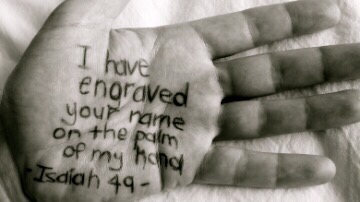 Back in the stone ages, when I was in middle school, it was common for the guys who “liked” a girl to write her name on their notebook or on the side of their shoe. I remember liking a girl named Carol, but being afraid to really admit it, so I wrote her name on the soul of my shoe. It didn’t take long before her name wore off (and the relationship didn’t last much longer than that). I am so glad when I read that God has inscribed our names upon the palm of His hand. What a beautiful description this is of the love He has for us. The word “inscribed” in its noun form means lawgiver. It speaks of the one who inscribed His word on tablets of stone. His love for us is as unchanging as His word.
 Back in the mid 1970′s, disaster movies were the big craze. Towering Inferno, Earthquake, The Poseidon Adventure, and Tidal Wave, were just a few of the titles that topped the charts. Nowadays, it seems people are fascinated with the concept of the undead. Not only have multiple movies and TV shows been released on the subject, but books, magazines and websites, are devoted to zombies and other undead creatures. There is even a popular TV show called “The Walking Dead.” While these all show mindless creatures, who cannot be killed by normal means, walking about with an insatiable appetite for blood, the Bible paints a different picture of the walking dead. Paul speaks of those who have not surrendered to Christ, as being dead while they live.
 Sitting in the dust, like wearing sackcloth or throwing dirt in the air was a sign of mourning. It was not uncommon in the ancient world for a person stricken with grief to express it outwardly. Those who lost a loved one, or were burdened by personal sin were easily identifiable to the people around them.
 In Isaiah’s time, it was a common practice, among the people, to fashion gods out of metal, wood, or clay. These little idols formed by their hands, were a reflection, not of the God of Scripture, but rather of the imaginations of men. Their idols were designed to bring them comfort in times of trouble. When things became difficult, they might hold their idol close like a small child with a stuffed doll. The problem, of course, was the comfort these idols brought was merely psychological. These graven images could not heal a sickness, provide during times of need, deliver from oppression, or give eternal life.
