Psalm 81:4
“For this is a statute for Israel, a law of the God of Jacob.”
 After choosing His people, God established laws to govern their behavior. There were moral laws and social laws, as well as ceremonial laws. All of which, when followed, would serve to benefit the individual, as well as the nation.
The Psalmist draws our attention to a particular set of laws that had to do with worship. “Sing aloud to God our strength; make a joyful shout to the God of Jacob. Raise a song and strike the timbrel, the pleasant harp with the lute. Blow the trumpet at the time of the New Moon, at the full moon, on our solemn feast day.” Psalm 81:1-3
Instead of laws that forbid religious assembly in public places, their laws required it. They were commanded to worship, and to worship loudly. Why? Why does God require His people to worship? We know it has something to do with God. He is, after all, worthy of praise. Just being God, and being exalted above the heavens, demands our highest praise. But I believe, it has at least as much to do with us. There are great benefits derived from taking time for private and corporate worship. Perhaps the greatest benefit is what it does to our perspective.
Too often, we see God in light of our problems. When we come face to face with a trial, perhaps an illness or a financial burden, we often become overwhelmed by the sheer fact that it is bigger than we can handle. We focus our attention on the problem, and it seems to grow larger and larger. Before we know it, we are consumed with worry, doubt, and anxiety. We can’t sleep, become irritable, and lose our appetite. It is even possible to begin to pray about the problem, only to find that after praying, we are more anxious than when we began. The solution is worship. When we take our eyes off of the problem and place them fully upon the Lord, our perspective changes. We no longer see our trials as something so much bigger than ourselves, but we see God as so much bigger than our trials. A healthy dose of the power, majesty, love, mercy, and provision of God, is the antidote to worry.
In Acts 4, the Church was threatened. If they continued to speak publicly about Christ, they would be beaten, imprisoned or killed. These were not idle threats. They had seen the rage of the religious leaders meted out on Christ only months before. Instead of allowing this trial to sink their faith, they turned their eyes upward and prayed, “Lord, You are God, who made heaven and earth and the sea, and all that is in them, . . ” Acts 4:24
Having been reminded of the power of God that casts a shadow over the weakness of human powers, they were able to rise from prayer with a new-found confidence. We read, “. . .they spoke the word of God with boldness.” Acts 4:31
No matter what you are facing, God commands you to worship. As you take your eyes off of your weakness, and the problem you are facing, and place them upon the God of Glory, your perspective will change. Faith will grow and His peace will flood your heart and mind. Let’s be faithful today to raise our voices in praise.
Pastor Jim
Questions for Psalm 81
- This is a call to worship. Look at verses 6-7, why were they to worship God?
- What promise are we given in verse 10?
- According to the Psalmist, how did Israel respond to this promise?
- In verse 13 the heart of God is exposed. He wants so badly for the people to listen to and follow after His Word that He may bless them. How will you respond to His Word today?
Old Testament:
2 Kings 5- Church Life
 Law and Order was one of the longest running television series of all time airing for 20 years. Every episode began with the words; “In the criminal justice system, the people are represented by two separate yet equally important groups: the police, who investigate crime; and the district attorneys, who prosecute the offenders. These are their stories.” And every episode began the same way; a victim was discovered and their case investigated and the suspects brought to trial. I can recall one episode where the judge was corrupt and stood in the way of the man receiving a fair trial. There is something within us where we expect those who judge to behave fairly.
 Memory is a funny thing. There are certain things that no matter how hard I try, I cannot seem to remember, and other things I can never forget. Names are particularly hard for me. It is not that I don’t care, or don’t want to remember; I just have a mental block. I have tried all the tricks: concentrating when the person introduces themselves, repeating the name back to them, using it in the conversation, and even relating their name to something else. Still, if some time has passed, and I encounter them again, the file that holds their name has been corrupted, and my memory refuses to access it.
 If these questions were posed to us on a theology test, we would all answer “No, no, six times no.” We know that He promises:
 Things in the kingdom of God run very differently than they do in the kingdoms of men. This is particularly true of exaltation. The word exalted means “to raise in rank or power, to be elevated or lifted above.” What exaltation is, and how to achieve it, are different in God’s Kingdom.
 It is funny the things I remember from my youth or childhood. Some events seem as clear to me today as the day they first happened. Other events I have no recollection of whatsoever. I can remember one Saturday morning when I was 13. Myself and a group of the neighborhood boys were at our local beach and the waves were unusually large. We made our way past the breaking waves and into the lineup. Not long afterwards the horizon began to fill with the largest waves my young eyes had ever seen. We paddled as fast as we could in hopes of getting past them, but for myself and a few others, our efforts were in vain. Wave after wave came crashing upon my head until I began to despair of life. Just then I began to pray. Keep in mind I was not a believer, I had never been to church, read a bible or even really considered the idea of eternal matters. Nonetheless, in that moment I began to pray and to pray hard. I can still hear the words of that prayer echoing in my memory, I prayed “God if you hep me I will never cuss again.” Soon enough the waves subsided, I made my way back out and immediately forgot the promises I had just made to a God I did not give a second thought toward.
 This psalm is the personal testimony of a man who almost fell away from the Lord. When he speaks of slipping, he is not talking about a little slip, but rather about throwing in the towel, and giving up on following the Lord.
 We have four boys who are separated by only five years. When they were little, we, like so many others families, spent a lot of our time visiting amusement parks. As the older ones grew, they were attracted to the bigger rides, and their younger brother wanted to do whatever they did. The problem was, many of the rides had a standard. If you were not a certain height, you could not ride. At times, this created quite a controversy. We tried everything to make him just a little taller, we spiked his hair, we bought shoes called “Heelies”, that had a wheel in the back, and provided a couple extra inches to his height. However, time and time again, when we reached the entrance, he was excluded. He simply did not measure up.
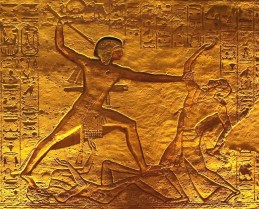 This Psalm is fulfilled in at least three ways. First, it expresses an actual time in the life of David. His enemies have mounted up against him with such great force that he feels like one who is drowning in a mighty flood. The enemies he faces are those who have sided with Saul, to seek his life; those who were against him because he had chosen to follow God, and finally, and perhaps his greatest enemy, is his own sin. In the midst of the battle for his own life, sin had mounted up like an army, seeking to destroy him. David’s victory over these enemies is found as He seeks the mercy of God. He writes, “Hear me, O Lord, for Your lovingkindness is good; turn to me according to the multitude of Your tender mercies.” Psalm 69:16
 Psalm 67 was written by an unknown author. We cannot know for sure who wrote it or what circumstances influenced its content. The one thing we know for sure is that it was penned by a person with a desire for others to come to the Lord. He pleads with God for mercy in his own life, in order that the world around him may come to a saving knowledge of God. The Psalmist is not alone in this. Paul declared

