Psalm 69:1-2
“Save me, O God! For the waters have come up to my neck. I sink in deep mire, where there is no standing; I have come into deep waters, where the floods overflow me.”
 This Psalm is fulfilled in at least three ways. First, it expresses an actual time in the life of David. His enemies have mounted up against him with such great force that he feels like one who is drowning in a mighty flood. The enemies he faces are those who have sided with Saul, to seek his life; those who were against him because he had chosen to follow God, and finally, and perhaps his greatest enemy, is his own sin. In the midst of the battle for his own life, sin had mounted up like an army, seeking to destroy him. David’s victory over these enemies is found as He seeks the mercy of God. He writes, “Hear me, O Lord, for Your lovingkindness is good; turn to me according to the multitude of Your tender mercies.” Psalm 69:16
Second, this Psalm has fulfillment in the daily life of the child of God. At times, we find ourselves facing enemies far greater than ourselves. Trials can be like a mighty force that we cannot overcome; there are even times when people turn against us. Like Job, when we need someone the most, we often feel like we have been deserted. However, the greatest enemy, the one that wages the most intense battle against us, is personal sin. We all know those times when our easily besetting sins seem to mount an offensive so great that we wonder when we will be taken down. It is in those times, we must follow the example of David, and look up to Heaven’s throne of Grace and cry out, “Hear me, O LORD, for Your loving-kindness is good; turn to me according to the multitude of Your tender mercies.”
Finally, this is another of the Messianic Psalms. It has it’s fulfillment at the Cross of Christ. Verse twenty-one draws our attention to the crucifixion; “They also gave me gall for my food, and for my thirst they gave me vinegar to drink” (Psalm 69:21). Jesus was also surrounded by enemies. The enemies He faced were the religious leaders, Roman soldiers, a multitude of onlookers, and even some who had once followed Him. They were all now crying out for His execution. When Peter explained the events of the crucifixion in Acts 2, he made it clear that it was not the Romans, or even the Jewish leaders, who were responsible for the execution of Christ. He said to a group of people, many who had traveled from a distant land, and were not present at the death of Christ, “ . . .you have taken (Him) by lawless hands, have crucified, and put to death” (Acts 2:23). Jesus went to the cross to satisfy the wrath of God. His death provided a way for the insurmountable forces of sin to be conquered, and eternal life to be provided. Our cry for mercy can be answered because of the atoning death of Christ. Even when our sins wage war against us, and it seems like a force too great to withstand, we can cry out to heaven for mercy, forgiveness and victory.
Take time to look to His mercy today.
Pastor Jim
Old Testament:
Psalm 70- Magnify
1Kings 15- It’s Time
1 Kings 16- Walking Through The Lord
 Psalm 67 was written by an unknown author. We cannot know for sure who wrote it or what circumstances influenced its content. The one thing we know for sure is that it was penned by a person with a desire for others to come to the Lord. He pleads with God for mercy in his own life, in order that the world around him may come to a saving knowledge of God. The Psalmist is not alone in this. Paul declared
 Have you ever noticed, when movie stars are walking the red carpet, for one of their many awards presentations, they are not asked what they are wearing, but who they are wearing? One of the marks of success is getting a particular designer to make you a one-of-a-kind outfit.
 Have you ever had one of those times when you are craving something, but you are not sure what it is? When that happens to me I tend to keep trying things, in an attempt to satisfy a craving that I cannot define. What is true with physical hunger, is also true in the spiritual realm. God created us with a need for Him. This need evidences itself with a desire to find meaning in life, answers to what lies beyond this life, and a craving to worship.
 We cannot be certain of the occasion that stirred David to write this psalm. It may have been a time of great difficulty, opposition or trial. He may have been facing severe attacks from Saul, the Philistines or one of the neighboring kingdoms. It is also possible the struggles he faced were not external. It may have been that David was engaged in that great inner struggle between his desire to do what is right in the eyes of God, and his own human weaknesses. Whatever caused the dilemma, he concluded that the only solution was to cry out to the Lord. Crying out to God should include at least three things.
 In the early eighties, a well-known Christian band wrote a song called “God Rules.” In some ways, it became the anthem of many young Christians. I remember having a “God Rules” bumper sticker on my car, and proudly writing it on my school notebook. To me, that phrase was a slang term meaning little more than the fact God was best. I believe the Psalmist is saying much more than that, he is speaking of the sovereignty of God. The word sovereign means ‘to possess supreme power.’ David is declaring that God has supreme power over His people.
 This has to be one of the most striking prayers ever recorded. David is looking at the behavior of those who have cast aside the ways of God and his heart cries out for justice. While it may seem harsh to ask God to break someone’s teeth there is an important principle that is vividly illustrated in David’s song. The principle is that there are certain things that should fill us with rage and produce in us a desire for righteousness.
 David was facing an extremely difficult season in life. The more things began to unfold the more he desired to run away and hide. He writes of his desire to flee to the wilderness far away from the problems and the people that surrounded him. He writes of desiring to have wings that could carry him far from his problems. I don’t think the psalmist is alone in this. I know I have felt this way and have met many believers who long for a way to escape the difficulties of life. I wonder how many of us have wished for our own private get away far from the problems and issues of life? While there is no island or mountain hideaway where we can be saved from the issues of life, there is a place the child of God can run for refuge.
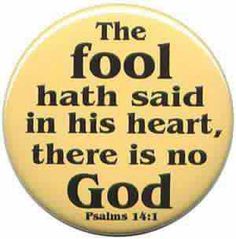 Biblically speaking atheism is considered folly because God has gone to great lengths to reveal himself to mankind. Paul, when writing to the Roman church divided God’s revelation of himself into two categories; he spoke of things being manifested “to us and in us.”
 David makes reference to the fact that he was born into sin. He realizes that his sin is not just a mistake that he made but a consequence of his very nature. The bible teaches that sin was passed down to us from Adam and has affected all of us making all of us sinners. Reforms are good and necessary both individually and nationally but these reforms cannot change our nature. We can become better husbands, fathers, neighbors and citizens but until we are born again we still have a nature that is unredeemed and we will be forbidden access to heaven.
 Jim Gallagher