Numbers 5:14
“If the spirit of jealousy comes upon him and he becomes jealous of his wife, who has defiled herself; or if the spirit of jealousy comes upon him and he becomes jealous of his wife, although she has not defiled herself”
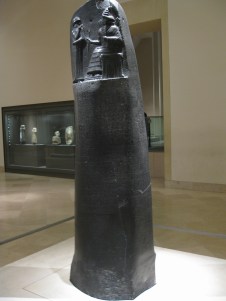 This section addresses the subject of marital problems; specifically that of jealousy. If a husband suspects his wife of cheating on him, but has no evidence, only suspicion; or if she hasn’t cheated, but he becomes jealous of her, this is what they are to do. The man is to bring his wife before the priest, and the priest is to make a concoction for her to drink (holy water, dirt and dried ink). Then, if she cheated on her husband, when she drinks it, her thigh will rot and her belly will swell. What’s this all about?
The Code of Hammurabi law dates back roughly to the time of Abraham. It is believed this code governed the pagan people in the area of Mesopotamia. In this code there is something very similar to what Moses is talking about in these verses. According to Hammurabi, if a woman was suspected of cheating on her husband, she was thrown into the river; if she survived, she was innocent, and if she drowned, she was guilty. Other cultures had similar rites in order to discover the guilt or innocence of a person. They might throw them in a pit of poisonous snakes or alligators, and if guilty, they would die, but if innocent they would survive. Remember when Paul was bitten by the poisonous snake, the pagans believed it was because he was guilty of a crime worthy of death.
At first glance, Numbers 5 sounds similar to those pagan rituals. However, there is a striking difference between what Moses tells the people to do, and what the Code of Hammurabi, and other pagan rituals declare. Here’s the difference. If I filled a glass with water, put in a handful of dirt from the planter, added in a little ink from a pen, stirred it up, then gave it to you to drink, would that cause your stomach to swell and your thigh to rot? It might not taste good, but it’s not going to kill you. There’s nothing deadly about it. It might make you feel sick, but it would not be an effective form of capital punishment. If you have small children, it is a mixture they probably consume on a regular basis. A little dirt, a little ink, unwashed hands and a cheeseburger or handful of grapes. When you see their filthy hands grasping a french fry, you are not concerned their stomach will swell or their thigh will rot. The difference between Numbers 5 and pagan rituals is, in this case, the woman is presumed innocent. She’s not thrown into a pit of poisonous snakes or a raging river, where 99% of the time the person dies. Instead, she’s put into a circumstance where it’s physically impossible for a cup of dirty water to cause your belly to swell and your thigh to rot.
If a woman is out cheating on her husband, there’s something wrong in the home. If the man is so jealous he’s accusing his wife of committing adultery, even when she hasn’t, there’s something wrong in that home. In one case, it’s the sin of the wife, she has committed adultery. In the other case, it’s the sin of the husband, his jealously is unwarranted. In both cases, there are problems going on in the marriage; there are problems going on at home. I think it is important for us to understand that our relationship with the Lord has to be happening in our house. You can be under the banner, in the right camp, marching with the Tabernacle in the center; you can remove the lepers, you can confess the sin, and make the 120% restitution, but if things aren’t right in the home, then the army’s not ready for battle.
What is God’s solution for a marital problem? How were they to go about solving the problem? They were to take their marital problem to the Lord. Notice, it was a problem that only the Lord could decipher. The husband’s saying, “You cheated on me.” And the wife replies, “I didn’t.” And the husband declares, “I know it.” And she’s saying, “Prove it.” And he responds, “I can’t. There’s no evidence, I just know it.” Either he’s wrong or she’s wrong; there seems to be no answer. How are we going to find an answer? God says, “Bring it to Me. Drink some dirty water and I’ll provide the answer.” It’s so ludicrous! Dirty water is not going to make your stomach swell or your thigh rot. Nevertheless, they are putting their marriage into the hands of the Lord. The Lord is going to have to solve this marital conflict.
So often, when things are going wrong in our relationships at home, we want to run to the world for help. But the world‘s answer is, “Get divorced, you were never in love in the first place”, or “Separate for a while, you need some ‘me time’.” And we think that sounds like a good idea. Not recognizing it is as foolish as if we were told, “throw her in a pit with some snakes. If she dies, it was her fault, but if she lives it was your fault.” Christian, the world does not have the answer. We must go to the Lord, and let the Lord be the one to fix the problems. Let the Lord be the One who provides the answers. Then, when she drinks the concoction and she doesn’t gain excessive weight in strange places, and loose it in others, her husband will realize, “I was wrong. Honey, I’m sorry I was so jealous. I’m sorry I brought you through that.” Or if her stomach does swell, and the wife realizes, “I was wrong. Forgive me, I’m sorry.” The Lord has solved the problem, the relationship is restored, and we are able to continue to impact the world for the kingdom of Heaven. Difficulties in marriage are not reasons to give up on marriage, but rather, are opportunities for the husband and wife to seek the Lord together. To see God accomplish the miraculous in their lives. Whatever problems you may be facing, humble yourself, go to your spouse, and begin with your spouse, to seek the Lord to heal and restore.
Pastor Jim
 Lot and his family represent the Christian. Jesus tells us, if we want to save our lives, we must lose them. In other words, life, true life, abundant life, will not be found in holding things back from the Lord, but by giving up all to follow the Lord. Matthew modeled that idea when he left his tax table, Peter and John when they left the fishing business, and you and I when we leave behind our past life, and seek to live for Christ. Unfortunately, even after we determine to follow Christ, we face temptation to return to the things from which we were saved. Satan even has a way of making the sin life which we used to live, look better than it really was. Knowing this, Paul exhorts us,
 Between man and God there is a great gulf of separation. This gap is caused by sin, and makes it impossible for us to have fellowship with God. This is precisely the reason Jesus came. He bled and died on Calvary’s cross to bridge the gap; to make it possible for us to know God now, and spend eternity with Him. This life will come to an end, and when it does, only what we have done with Christ will really matter. In this story, the rich man reveals what happens to those who refuse Christ. Not only do they live separated from God, but they die that way.
 The book of Numbers receives its name from the numbering of the people that occurred in Chapter 1 and again in Chapter 26. In Chapter 1, those who came out of Egypt were numbered. In Chapter 26, 40 years later, at the end of their wilderness journey, they are numbered again. A careful look will reveal, some of the tribes grew, and some of the tribes shrank. I think there is an important application we can glean which pertains to our lives. Just as they were in the wilderness, we often find ourselves in a spiritually dry time. We may even feel like we’re just wandering around aimlessly. I think it is valuable to remember, based upon what we do in the wilderness, we can either come out having shrunk or having grown.I
  Man lives as though God and eternity are a mystery. Even before I became a Christian, I had heard the pseudo–verse, “God works in mysterious ways.” Here, in Luke 15, the mysterious ways of God are revealed. We see clearly how he feels about the lost, as well as what He does about it.
 According to Webster’s dictionary, the word ‘dedicate’ means, “to devote to worship or to set apart for sacred use.” As Leviticus comes to a close, Moses instructs the people to dedicate their homes to the Lord. Since the family is the foundation of society, the key to Israel’s future success was in each and every household dedicated themselves to the Lord.
 Jesus tells a story to reveal His desire for all men everywhere to be saved. The cast includes God, played by the man giving the feast; the Christian, played by the servants sent out to invite people to the feast; and the population of planet earth, played by those who receive the invitation. Notice the excuses given by those who reject the offer. Two of the three who reject the invitation use business as an excuse. Perhaps they were driven by a sense of responsibility. Thinking they did not have time for spiritual things, but must provide for their families. Or perhaps, they were caught up in the desire for more. I believe it was Rockefeller, who, when asked how much money was enough said, “Just a little more than you have.” The third person refused to come, using His family as an excuse. Perhaps he even desired to come, but thought his wife would not be interested. Notice he said, “I have married a wife, and therefore I cannot come.” He may have been thinking, I will eventually come, but now is not a good time for me.
 Moses refers to the Sabbath over twenty times in Leviticus; instructing Israel how to worship the Lord. The Sabbath was a very important facet in the life of the children of Israel. God designated a weekly Sabbath day, then every seven years was a Sabbath year, and every forty-nine years, a special Sabbath year, called the year of Jubilee. One of the Ten Laws written by the finger of God, stated, the Sabbath day was dedicated, above all the others, as a day of rest. The driving force behind this command, was the example God had set in Creation.
 I imagine what the scene must have been like in the Synagogue that day. The crowd had gathered like they did every Sabbath. For some it was no more than a religious duty, for others, it was how they expressed their devotion to God. The scene suddenly shifts from the normal activities of prayer and Bible reading to a woman with a serious medical condition. She had been suffering for eighteen years and nothing could be done for her. Without hesitation Jesus called her to Himself, and when she responded to the call, He healed her. Imagine being there! Imagine the joy that would fill her, perhaps like the lame man in Acts 3, she leaped with joy, celebrating what Jesus had done for her. I would expect to read that the service changed that morning, as the people broke out in unrestrained praise. Sadly however, rather than hearing praise, we hear the sound of objection.
 Jim Gallagher